












- WIADOMOŚCI
New Army Garrison Commander In Poland

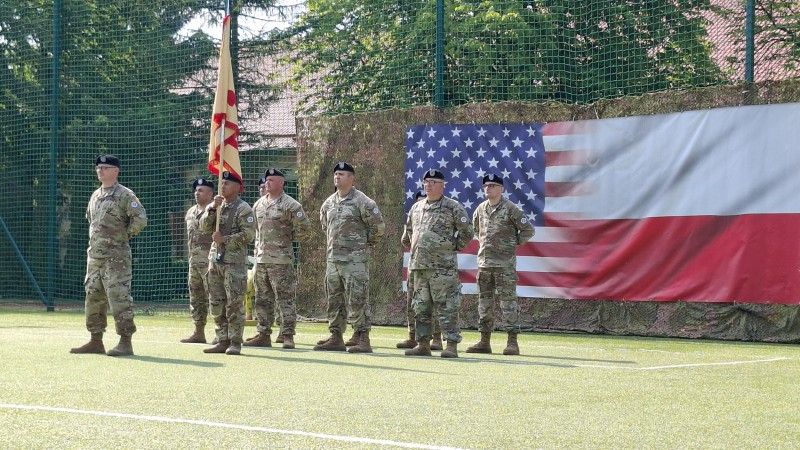
Photo. J. Raubo, Defence24
A new commander has arrived at U.S. Army Garrison Poland in Poznań. Colonel Jeremy A. McHugh now faces significant challenges in continuing to maintain the numerous facilities scattered across Poland, and, above all, in supporting the practical aspects of daily strategic, deepened military cooperation between the United States and Poland amid a highly complex regional situation.
On 15 July 2025 in Poznań, another change-of-command ceremony was held for U.S. Army Garrison Poland (USAG–Poland). Colonel Jeremy A. McHugh assumed duties from the outgoing commander, Colonel Jesse G. Chace. Beyond the formal ceremony itself, the event stood as an important symbol of continuity in the American strategic ally’s approach to operations in Poland, and across NATO’s eastern flank. Both Col. McHugh and his predecessor, Col. Chace, are responsible for the functioning of 12 sites across Poland essential for military activity in the region. These include, foremost, Camp Kościuszko and the nearby base in Powidz, both in Poznań, as well as facilities in Bolesławiec; Drawsko Pomorskie (Combat Training Center – DCTC); Głębokie; Karliki; Lubliniec; Skwierzyna; Świętoszów; Toruń; Trzebień; and Żagań.
Poznań: Epicenter of NATO’s Eastern Flank
Camp Kościuszko is particularly notable, as it hosts the forward headquarters of U.S. Army V Corps. Accordingly, the ceremony was attended by senior V Corps leaders, including Major General Ollie Kingsbury, recent panelist at Defence24 Days 2025, and Colonel Kevin Jackson, V Corps Chief of Staff, whom Defence24 interviewed last year. Formally, USAG-Poland falls under U.S. Army Garrison Black Sea, illustrating the complex command network. Each facility plays a critical role in the overall readiness of U.S. and allied forces to deter and, if necessary, defend.

Photo. J. Raubo, Defence24
What is more, this is a mission inherently and closely tied to daily cooperation with the Polish side, i.e. the host nation. This concerns both maintaining the essential close relations with the Polish Armed Forces, as well as with a variety of other structures and institutions. One can better appreciate this when considering, above all, the complex dimension of modern logistics and civil–military relations. And one must acknowledge the truth of Tommy R. Mize’s words (Director, Installation Management Command–Europe), spoken during the ceremony in Poznań, that the commanders of USAG–Poland operate in a very dynamic and changing environment, which further raises the demands placed upon them. Moreover, Col. Jesse G. Chace emphasized that, in his view, the cooperative actions with the Poles constitute a model example of allied relations. His successor in Poland, Col. Jeremy A. McHugh, noted how much has been accomplished recently regarding USAG-Poland’s activities, praising the work of his predecessor, and recognizing that this will be an even more demanding yet pivotal mission.
Note that the new commander, Col. Jeremy A. McHugh, will oversee approximately 500 soldiers and 150 civilian employees in Poznań alone, and in total this group amounts to about 7,500 military personnel, civilian defense employees, and contractors dispersed across the aforementioned sites throughout Poland. Historically, USAG–Poland is the eighth garrison established in Europe. In Poland’s case, its operations were initiated in early 2023, effectively transforming its predecessor, the Area Support Group, into the current structure. Its establishment, as well as other U.S. deployments—such as the presence of U.S. Army V Corps—stem from the Polish–American agreement deepening the strategic partnership between the two countries, namely the Enhanced Defense Cooperation Agreement of 2020.
Military and Civil-Military Relations
The work of USAG–Poland involves the daily integration of military matters with the aforementioned civil–military issues. Note that as infrastructure develops, the presence of U.S. military personnel in Poland always increases, bringing new requirements for support of soldiers and civilian employees, and in the future, their families as well. There is also room for activities that build cooperation with local Polish communities, primarily in Poznań, but also in Powidz and Bolesławiec. The Americans of USAG–Poland continue, for example, the series of open-to-all events celebrating the national holiday of July 4. As last year, these culminated in concerts and a fireworks display over Lake Powidz. Where, alongside American soldiers, Poles enjoyed themselves late into the evening. It must also be noted that the entire event was very well secured by the Polish Military Police (Żandarmeria Wojskowa), the U.S. Military Police, and Polish law enforcement led by the national Police. And this alone reveals some of the complex intricacies of the daily service of USAG–Poland commanders, who must understand not only defense needs but also be able to integrate seamlessly into the internal security architecture and relations with various authorities, including local ones.
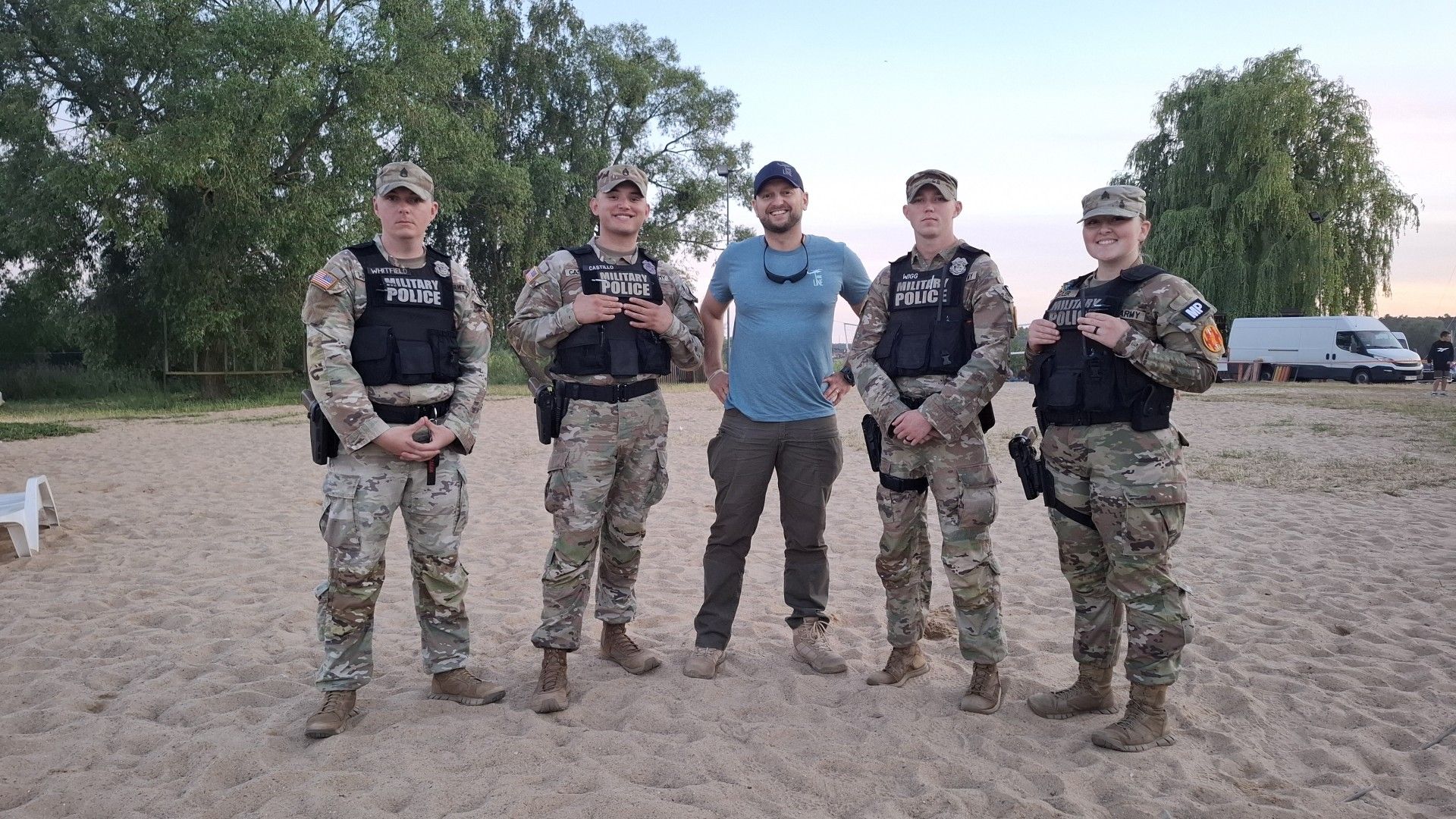
Photo. J. Raubo, Defence24
Importantly, when speaking with the American soldiers, there is always a certain surprise at how warmly they have been welcomed across Poland. But as we pointed out on Defence24 last year, at a macro level this is a continuous effort that must be carried out by both allies in the civil–military relations space and within the information domain. All this to deny any space for disinformation and divisive activities by, for example, the Russians or Belarusians. It is certain that the U.S. presence in Poland poses a challenge to the aforementioned countries, and also with regard to Chinese actions in Europe. Thus, every successive commander of USAG–Poland takes into account the necessity of investments in information security, strategic communication, and possessing resources for crisis response in the information domain as well.
Experienced Officer at the Helm of USAG–Poland
Let us briefly return to the new commander of USAG–Poland, Col. Jeremy A. McHugh. His official biography states that he hails from Petersham, Massachusetts, and has served since 1988. Throughout his career, he has held various command levels and has combat experience from Operation Iraqi Freedom, as well as having provided intelligence support to allied forces in Afghanistan under the Combined Joint Operational Command–East. Interestingly, he has experience in armored units, commanded a mortar platoon, and also served in military intelligence. He was assigned, among others, to the 743d Military Intelligence Battalion at Buckley Space Force Base in Colorado. During that assignment, he served in various positions in the National Security Agency’s Office of Weapons and Space, as well as in the National Geospatial-Intelligence Agency (NGA). It is noteworthy that in 2020 Col. McHugh assumed command of Army Support Activity–Black Sea (ASA‑BS), overseeing IMCOM activities at Mihail Kogălniceanu Airbase (the so‑called Romanian Ramstein) in Romania and at Novo Selo Training Area in Bulgaria. Thus, this is an experienced officer who also brings reconnaissance knowledge regarding the situation on NATO’s eastern flank.
USAG–Poland is growing in strength, as evidenced by the recent article by Chris Gardner of the U.S. Army Corps of Engineers (Europe District) titled Construction partnership in Poland enhances readiness, interoperability and deterrence in Eastern Europe. In it, he noted that, quote, „in Poznań, U.S. Army Garrison Poland and V Corps Headquarters Forward occupy the relatively small footprint of Camp Kościuszko. Most of the upcoming work in Poznań is focused on renovating and improving existing buildings with plans in the works for significant interior renovations that will significantly increase administrative space for personnel”. And indeed, even during the change‑of‑command ceremony one could see how much construction activity is underway at the Camp Kościuszko facilities.

Photo. J.Raubo, Defence24
Key Investments
The same author, Chris Gardner, also noted that „Powidz has seen a great deal of new construction in recent years, with even more projects on the horizon. Through PPI, a new Deployable Air Base System support and storage facilities project is nearly complete that will further enable readiness for the U.S. Air Force. Additionally, a new Bulk Fuel Storage project and associated site improvements as well as key communication infrastructure will also increase Powidz’s operational capacity”. Let us recall that it is in Powidz that the APS‑2 facilities are located, which we have written about in detail many times on Defence24. Importantly, in Powidz, as he stated, in terms of quality of life, construction recently began on new barracks and a dining facility for the soldiers stationed there as part of subsequent rotations. The aforementioned Freedom Fest in Powidz, especially after the event’s conclusion, most clearly demonstrates the scale of necessary actions for the American soldiers stationed there. Simply put, this involves a large group of service members who require not only operational infrastructure but also comfortable living conditions.
Chris Gardner also noted that ” Świętoszów includes the Żagań Training Complex and other military sites in southwestern Poland. Right now, crews are working to increase fueling and rail infrastructure. Designs are in the works for a wide range of additional military infrastructure including an entire new brigade operations facility. This effort will involve design and construction of multiple facilities to accommodate an enduring presence of approximately 4,800 troops”. Thus, we see two key challenges: the necessity of synergy between investments in purely military infrastructure and the systems that support it (e.g., logistics and rail facilities), and the clear signal from our strategic ally regarding a presence on NATO’s eastern flank—the U.S. continues to reinforce the space for a long‑term presence in Poland. Moreover, each such investment and project, such as infrastructure improvements, strengthens not only Poland but also our European allies.
An essential element of this comprehensive allied cooperation process is each successive commander of USAG–Poland. Although it must be acknowledged that their role is not always sufficiently recognized—given the more „combat‑oriented” aspect of military cooperation between Poland and the U.S.—it is therefore fitting to thank Col. Jesse G. Chace for his contribution to the Polish‑American partnership and to look forward to the equally fruitful service of his successor, Col. Jeremy A. McHugh.


