












- WYWIADY
- WIADOMOŚCI
Deputy Minister of DAPA on Polish-Korean cooperation

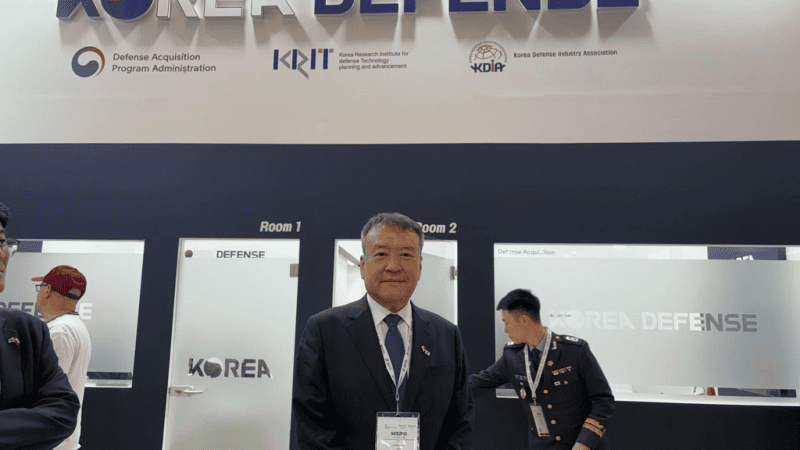
Photo. Defence24.pl
South Korea and Poland are cooperating on multiple fronts, from localization to joint development and exports to third countries, emphasized Bang Guck-cheol, Vice Minister of the Defense Acquisition Program Administration (DAPA) of the Republic of Korea, in an interview with Defence24.pl. He also noted that Seoul attaches great importance to new technologies and is positively considering joining the SAFE initiative.
We are here in Kielce, at the largest defense industry exhibition in this part of Europe, and Poland is a key partner of the Republic of Korea in the defense sector. What do you see as the most important achievements of this cooperation here in Kielce?
Bang Guck-cheol, Vice Minister, Defense Acquisition Program Administration (DAPA): Current defense cooperation between Korea and Poland goes beyond simple trade relations. The export of Korean weapon systems also includes after-sales support, technology transfer, and localization. This means that our cooperation does not end with a one-time transaction but has the potential to develop into a long-term strategic partnership.
Korea shares Poland’s concerns regarding the very serious security situation in Europe. Our bilateral cooperation began in the defense sector but will continue to evolve into a more comprehensive security partnership, encompassing technical cooperation and people-to-people exchanges.
What are the most promising areas of partnership between Poland and Korea—contributing to the security of both countries in the face of emerging threats, the development and modernization of armaments, or perhaps joint exports?
During this year’s MSPO exhibition, a joint venture agreement was signed between Korean and Polish manufacturers regarding the localization of guided missiles for the Chunmoo system (with a range of 80 km). More broadly speaking, industrial cooperation between Korea and Poland will continue to expand. In the near future, Poland will serve as the European hub for the production and maintenance of Korean weapon systems, such as K2 tanks and Chunmoo MLRS rocket systems, through technology transfer, local production, and the establishment of maintenance facilities.
Korea and Poland are cooperating on multiple fronts, from localization to joint development and exports to third countries, and Korea will continue to support cooperation not only between enterprises but also between governments.
Some time ago, Poland also exported loitering munitions and drones to Korea. Do you see opportunities for similar initiatives in the future?
The drone industry is a sector that requires advanced technologies of the Fourth Industrial Revolution (e.g., stealth capabilities, swarming, artificial intelligence, MUM-T, and autonomy) and is a leading industry of the future with the potential to integrate various new technologies. Given the changing combat environment, Korea is also considering the introduction of various drones and other autonomous systems, which means there is potential for greater imports from Poland.
You are responsible for DAPA, one of the world’s key procurement agencies. We are witnessing the rapid evolution of the battlefield and threats—from Russia in Europe, from North Korea and others in Asia. Do you see the need for changes in the procurement system of the Republic of Korea to address new threats such as drones or counter-drone measures?
The widespread use of autonomous systems on modern battlefields is changing the rules of warfare and also poses challenges to conventional weapon systems. The traditional procurement system has been built around large platforms such as tanks, aircraft, and warships, and is not well-suited for the latest technologies such as drones, artificial intelligence, or short life-cycle weapon systems. Therefore, Korea is also working on adopting new procurement strategies, such as fast-track solutions, and streamlining existing procedures to accelerate the introduction of next-generation weapon systems.
Defense markets are evolving. On the one hand, the Republic of Korea is investing in the United States, including in the shipbuilding industry; on the other hand, we have the European Union with initiatives such as SAFE, which support joint procurement but are essentially focused on equipment produced within the EU. Do you see the possibility of a Polish-Korean partnership that could access EU defense funds?
I fully understand the rationale behind the ReArm Europe plan, announced in March 2025, aimed at strengthening Europe’s security capabilities, and I am aware that the SAFE initiative is part of these efforts to support joint procurement among EU member states. Korea is cooperating with European Union partners in the field of security and seeks to work with them not as a vendor, but as a true partner in security and defense. In particular, Poland has strengthened its strategic partnership with Korea based on mutual trust. As Poland considers selling its locally produced weapon systems to third countries in cooperation with Korea in the future, Korea is positively considering joining the SAFE initiative.
Thank you for the interview.


