












- WIADOMOŚCI
Systemic support for veterans. What does it look like in Ukraine? [INTERVIEW]
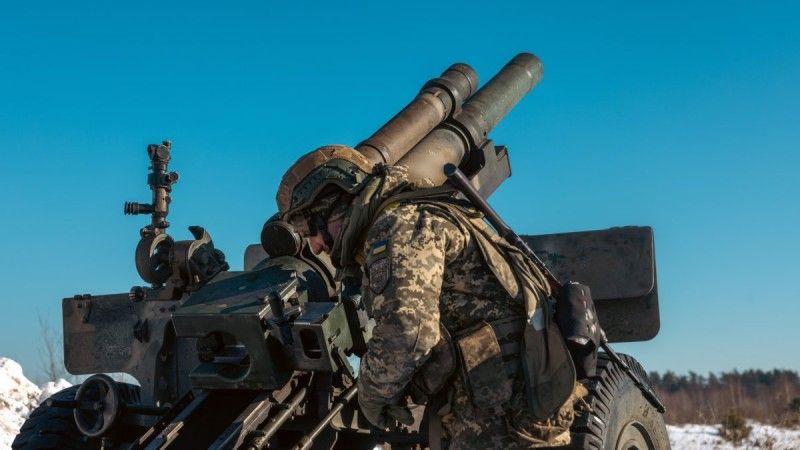
Photo. Державна прикордонна служба України
„In Ukraine, there are between 1.5 and 2 million soldiers alone who have directly fought against the Russians with weapons in hand. (…) This state will be shaped around veterans. Because of the mass scale of the phenomenon, they constitute the social fabric around which the nation’s identity is already being built,” Dr. Piotr Łukasiewicz, Chargé d’Affaires of the Republic of Poland in Ukraine, said in an interview with Defence24.
29th May is marked in Poland as Veterans of Operations Abroad Day. But what is the situation regarding veterans in Ukraine? Does the Ukrainian state have systemic solutions that take this group into account? How can Poland make use of the knowledge and experience of Ukrainian veterans? We invite you to read our interview with Dr. Piotr Łukasiewicz, Chargé d’Affaires of the Republic of Poland in Ukraine.
Michał Górski, Defence24.pl: On 29th May, we mark Veterans of Operations Abroad Day. In Poland, there is talk of a group of around 130,000 people who can be referred to as veterans. Who, in fact, is a veteran? Is the term defined differently in Poland and Ukraine?
Dr. Piotr Łukasiewicz, Chargé d’Affaires of the Republic of Poland in Ukraine: In Poland, the matter is straightforward. A veteran of operations beyond the country’s borders is any soldier or civilian employee who has taken part in foreign operations — that is, people involved in missions in the Balkans, Iraq, Afghanistan, Pakistan, where a military mission also operated in 2005, and Africa.
In our country, this noble title is very often perceived through the lens of whether a given mission participant has been harmed — whether they suffered physical wounds or are struggling with psychological injuries. In the classical understanding, however, a veteran is simply a person who has participated in combat operations. In the Polish case, outside the country’s borders.
In Ukraine, the matter looks entirely different. A veteran is, quite obviously, someone who defended the homeland against Russian aggression from the outbreak of the war in 2014, and later during the full-scale war from 2022 onward.
Interestingly, I recently received an invitation from Ukrainian veterans of the war in Afghanistan in the 1980s. These are older people who participated in the Soviet occupation of Afghanistan, but they made a special mark in Ukraine’s history. In 2013–2014, Afghan war veterans were one of the forces co-organizing resistance during the Revolution of Dignity on the Maidan. They created the Maidan’s security structure, and it was they who laid the foundations for the defense of the young Ukrainians protesting at that time, who were fighting for a democratic and European turn for their country.
That is a certain historical nuance. Contemporary Ukraine, however, defines a veteran as a participant in the anti-terrorist operation in Donbas, as well as anyone who has undertaken the defensive effort and is protecting the country against the current aggression.
Thank you for this introduction. I would now like to ask about the general assessment of the situation of veterans in Ukraine. How does the Ukrainian state view these people?
Ukraine’s defensive struggle has a very distinctive feature: for Ukrainians, the principal criterion of victory over Russia is the human being. Research shows that although victory means for them the recovery of temporarily occupied territories and the preservation of a democratic government in Kyiv — which disrupts Russia’s strategic plans — they always place the individual first.
This internalized strategy defines victory as the return of soldiers from captivity and the return of children abducted by the Russians and subjected to cruel practices aimed at erasing Ukrainian identity. The collective imagination of Ukrainians is profoundly affected by the horrific stories of torture and filtration camps, which are not prisoner-of-war camps, but centers of psychological and physical torment. I regularly meet people who have gone through this. Their accounts inspire horror and anger, but they also fuel the will to resist and the determination to liberate not so much territories as the people living there. Placing the human being first commands my immense respect.
The concept of the veteran is situated within this philosophy. We must realize the scale, which is incomparable with any other country in the world, including American or British examples. In Poland, we speak of slightly over 100,000 veterans over a period of 30 years. In Ukraine, there are between 1.5 and 2 million soldiers alone who have directly fought against the Russians with weapons in hand. In addition, entire families of Ukraine’s defenders naturally fall within the orbit of these communities.
This state, which will certainly endure after victory, will be shaped around veterans. Because of the mass scale of the phenomenon, they constitute the social fabric around which the nation’s identity is already being built.
Exactly. Is Ukraine not waiting until the conflict ends before creating systemic solutions for veterans« affairs?
The most interesting, indeed almost innovative, phenomenon is that Ukrainians are not waiting for the end of the war to solve the „veterans« problem” — they are addressing it now. The best example is the establishment of the Ministry for Veterans Affairs and the organization of a network of centers providing medical, physical, and psychological assistance.
In smaller towns, and even in villages, these veterans« hubs are becoming centers of social life. Because soldiers are at the front, these places serve their families, including highly active associations of mothers of soldiers who have fallen, gone missing, or been imprisoned, and who are fighting for their return. With very limited resources, the state is trying to organize this phenomenon, which commands respect and motivates external actors, such as Polish diplomacy, to provide active support. These people are defending their homes, but also Europe’s distinct identity and the security of the whole of Central Europe.
You mentioned that Ukraine is trying to perceive veterans not as a problem, but as an integral part of the state. Could you give specific examples of actions confirming this thesis? How does Ukraine activate these people and include them in state structures in order to use their knowledge and experience, rather than merely „limiting itself” to paying out rehabilitation funds?
The foundation is having a strategy, and the Ukrainian state has very ambitious and extensive plans covering both medical care and professional activation — although we must remember that these are being implemented with extremely limited financial resources under wartime conditions. All levels of government are involved in this effort, from the central authorities to local self-government. Practically every city supports specific units at the front with funds, equipment, and people, while at the same time taking care of those who, for various reasons, have already ended active service.
We are dealing here with growing budgets for veterans« institutions and the creation of well-known hospitals, such as Superhumans-type centers in Lviv or Kyiv, operating exclusively for wounded soldiers. Importantly, the Ukrainian approach differs from our traditional assumptions. Digitalization is an excellent example. Ukrainian society is highly digitalized. In addition to the government application Diia, the equivalent of Poland’s mObywatel, intensive work is underway on a separate electronic system created specifically for veterans and wounded soldiers. Such an application makes it possible to handle formalities without standing in queues: from submitting documents for veteran status to financial matters and the servicing and maintenance of technologically advanced prostheses.
Another innovation, introduced despite the healthcare crisis, is special funds. In this system, the money follows the veteran. A wounded soldier may, on market terms, choose for himself a convenient place for treatment and for servicing complex orthopedic equipment. The system is being built with the intention of operating as efficiently as possible once even greater financial resources become available.
The role of the aforementioned veterans« hubs is also extremely interesting. Beyond psychological or prosthetic support, they are becoming places where newly mobilized recruits heading to the front can meet their predecessors. It is there that new soldiers obtain invaluable practical information about the realities of combat. These centers function as practical training hubs for future frontline personnel.
As for the labor market, Ukraine still faces the challenge of fully using the potential of veterans. One or two years ago, it was said that they would become a new, powerful economic force in business thanks to their unique technological skills. This has not yet fully happened because resources are lacking, but preparations are underway to support their business activities systemically.
The Ukrainian authorities are also taking active measures to attract veterans into work in state institutions. Veterans have, among other things, priority in recruitment for state positions, and quotas have been introduced for persons with disabilities resulting from participation in armed operations.
How can the Polish state become involved in similar processes?
When I speak with Polish veterans, I remember that in 2004–2005 our system was somewhat late in addressing this challenge, when the first wounded soldiers began returning to the country from Iraq and Afghanistan. The beginnings were difficult; the military system did not quite know what to do. In Ukraine, these solutions are being created dynamically during the war, and Kyiv is very willing and active in drawing on the many years of experience of the Anglo-Saxon countries — Great Britain and the United States — which have a deeply rooted culture of caring for veterans.
Moving on to the question of the Polish effort — for me, this is a priority. When I took up my post a little under two years ago, I agreed with Minister Sikorski and decision-makers in Warsaw that veterans in Ukraine are not solely a humanitarian challenge. This is a social, economic, and political phenomenon in which Poland must participate. We will have as a neighbor a state in which these people will form elites at both the local and central levels. We must understand this phenomenon and participate in it, rather than frighten ourselves with it.
The worst thing we could do — and unfortunately such voices do appear in Poland and in other countries bordering Ukraine — would be to succumb to harmful clichés. One sometimes hears slogans such as: „the veterans will come and set up mafias,” „they will become a criminal problem,” or „they will become a social problem because they will fall into drug addiction.” The basis of every such cliché is ignorance and avoidance of the subject, rather than active engagement with the phenomenon. Diplomacy means being part of this process now, not imagining dark scenarios in which, after the war, Ukrainians become a problem for us. I am far from such thinking.
How can we translate this reality into good-neighborly relations in order to defuse these negative narratives and prove that veterans need not be a threat, but can be an opportunity both for Ukraine and for Poland?
Fear stems solely from a lack of knowledge and interest. We often repeat that we should draw on Ukrainian wartime experience, because we live in the dangerous neighborhood of a brutal Russia and these realities may one day become ours. Veterans from Ukraine are not only wounded people — they are experts with enormous technological and military knowledge. When I meet an engineer developing modern drone systems, I am usually speaking with a veteran who fought close to the enemy and acts on the basis of first-hand knowledge.
Our benefits will be proportional to how much we do for them now, how strongly we support them, and how much we treat them as partners. Then we will gain unique knowledge about how to build a modern model of the state and armed forces under the conditions of contemporary conflict. Dialogue with veterans« communities is not only a discussion about the quality of prostheses — although Polish companies produce excellent orthopedic equipment. It is a debate about the nature of contemporary war and about drawing conclusions in order to adapt our own defense models, rather than blindly copying them.
If we show gratitude to Ukrainian soldiers through interest as well as financial and medical support, this will translate into our military relations, which are already highly allied and friendly. In this way, we build human capital and contacts with Ukraine’s future elites, who will remember this brotherhood and alliance. Direct contact is the foundation of the future coexistence of our states. Our Solidarity Fund, thanks to excellent cooperation with diplomacy and the acquisition of Polish and EU funds, has already opened 16 veterans« centers in Ukraine and is planning more. This is how effective diplomacy is built. This is not non-repayable humanitarian aid. With a state fighting a war, we must build relations based on an analysis of the consequences of that conflict for the future of both nations.


