












- WIADOMOŚCI
- ANALIZA
A dream for Berlusconi and a challenge for Meloni: building a bridge to Sicily

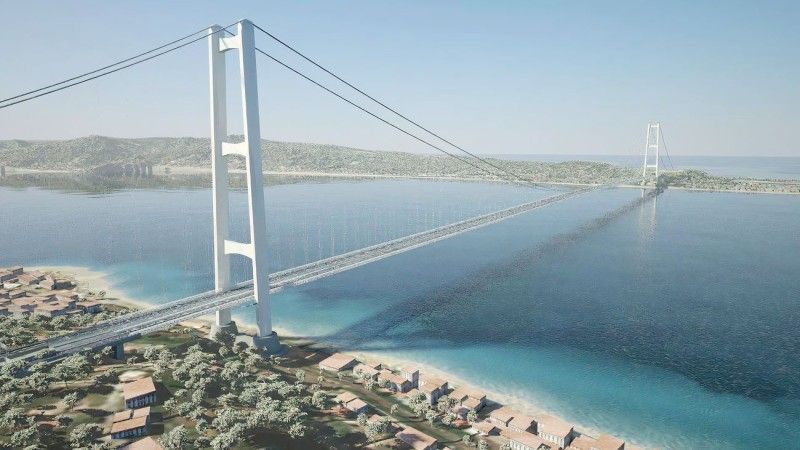
A fantasy of Mussolini, a dream of Berlusconi and a challenge for Meloni – the longest in the world suspension bridge in the Strait of Messina connecting the Italian mainland with Sicily. It has not been built yet but the contemporary history of this idea serves as a litmus test for what is possible to be counted as NATO spending.
The Italian government planned to classify its €13.5bn Sicily bridge as a military asset, but it has abandoned this idea after the US ambasador to NATO decried it as Rome’s „crative accounting” to meet the spending targets. And Italy is in quite a tight spot trying to address the challenge of 5% military spending by 2035. Meanwhile, in 2024 Italy targeted 1.49 percent of its gross domestic product for its military. The country is one of the lowest military spenders of the Alliance. So what’s all the fuss around the bridge about?
Artillery and tanks, not bridges
Of the 5% of GDP NATO target, only 3.5% needs to be core defense spending. The remaining 1.5% can be allocated to broader strategic resilience, such as infrastructure. The Italian government declared the bridge a necessity in April, stating that its construction was in the best interests of the public. According to Rome, the bridge has „strategic importance for national and international security, so much so that it will play a key role in defense and security, facilitating the movement of Italian armed forces and NATO allies”.
Italy also requested that the project should be included in the EU’s financing plan. This is for the mobility of military personnel, materiel and assets. Italy said that the project „would fit perfectly into this strategy”. It would provide key infrastructure for the transfer of NATO forces.
But this justification did not meet understanding of the US. Matthew Whitaker, the US ambasador to the NATO, said in the first week of September that The first shot fired in another European war will be a cyber attack” as he urged the investment in „artillery and tanks, not bridges”. $$
Long military history
We must admit that the idea of the bridge on the Strait of Messina has a long military history. It first occurred to a Roman general some twenty centuries ago, during the First Punic War against the Carthaginians. This necessity was dictated by the need to transfer the elephants captured by the Roman legions to Hasdrubal.
The historian Strabo recounts: „The consul Lucius Caecilius Metellus gathered a large number of empty barrels and had them arranged in a line on the waves, tied two by two so that they could not touch or collide with each other… then they fixed wooden railings on the sides so that the elephants would not fall into the sea…”.
The dream lives on, since 250 BC. One of the historical figures who rediscovered it was none other than stargazed at Rome Benito Mussolini. He repeatedly promoted the idea of building a bridge over the Strait to symbolize Italy’s greatness. In fact, plans for this were already in place in 1934. With the end of World War II, the project of Armando Brasini „vanished, along with many other Italian dreams” – as an Italian journalist Mario Alizzi puts it. And still in 1942 Il Duce said: ”It is time to end this story of the island: after the war, I will have the bridge built.”
Another dreamer with big plans for the bridge was the long-term prime minister of Italy Silvio Berlusconi, nearly as controversial historical figure as Mussolini, althoug for entirely different reasons. In 2005 the Italian parliament has been informed about the risk of mafia involvment, specifically Cosa Nostra, in the realization of the bridge. Nevertheless, in December 2009 the plans to construct the Messina bridge have been revived. Citing the lack of funds, Mario Monti, then prime minister of Italy, shut down the project in 2013. Ten years later the Italian Government under Giorgia Meloni decided to reopen the investment and approved a decree to proceed with the construction of the bridge by remodeling the existing project. In August 2025 the government gave final approval and indicated that it would be a „defense-related expense” in order for it to count as a NATO spending target.
Symbol of global significance
Transport minister Matteo Salvini announced that it will be „the biggest infrastructure project in the West” and prime minister Meloni called it „an engineering symbol of global significance.”
„The bridge will be an engineering symbol of global significance, a demonstration of the strength of the will and of the technical competency of Italy which has few parallels in the world. We believe in this infrastructure, as we believe in all the infrastructure this Nation expects for decades and which can construct a backbone for a faster and more modern Nation”, Meloni said.
Not everyone has been that thrilled by the idea, especially not the opposition. Nicola Fratoianni of Sinistra Italiana said that the bridge is a „foolish choice from every point of view: ambiental and economic”.
Furthermore, this summer more than 600 researchers signed a letter opposing the military classification. In order to do so, the project would require additional assessments to see if it could withstand military use – the researchers argued.
Additionally, the area where the bridge over the Strait is to be built is considered to be „highly exposed to seismic risk and possible underwater landslides,” as well as to tsunamis that could be caused by „earthquakes, eruptions, and landslides,” according to the report by the working group on the Strait bridge commissioned by the Draghi government on the subject.
Nevertheless, Italy has not backed down on the project. If the Romans didn’t, how could Giorgia Meloni?


