












- WIADOMOŚCI
BRICS virtual summit and US tariffs pressure

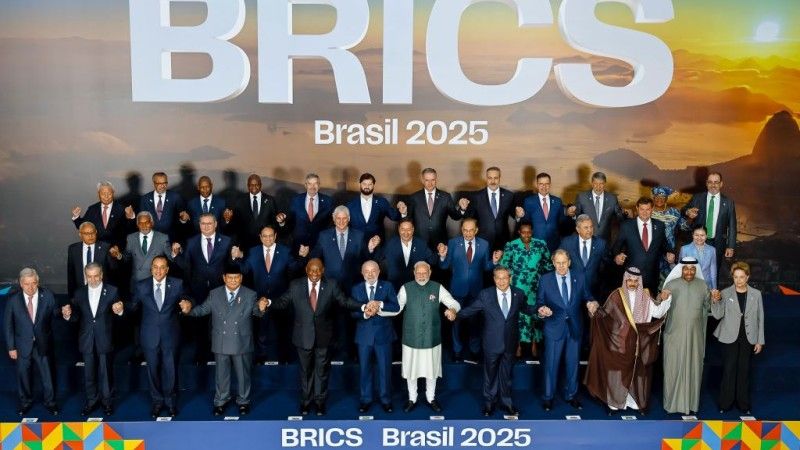
Encouraged by the, at least symbolic, success of the SCO summit in Tianjin and under pressure from the United States, BRICS leaders opted to hold a virtual summit on Monday, September 8. The meeting was hardly a breakthrough, but it did highlight the bloc’s willingness to deepen this form of cooperation. India’s Prime Minister Narendra Modi chose not to attend; instead, in recent days he held talks with Ukrainian President Volodymyr Zelensky and European Commission President Ursula von der Leyen, continuing a policy of „equilibrium”. Modi also spoke positively about India’s ties with the United States.
The annual BRICS summit, held in July 2025 in Rio de Janeiro, was far from a major success, in part because two key leaders were absent. Russia’s Vladimir Putin, facing potential legal complications on Brazilian soil similar to those he sought to avoid during the Johannesburg summit, stayed away and could thus claim a kind of justification. China’s leader, by contrast, offered no such explanation for his absence. Indian Prime Minister Narendra Modi, meanwhile, maintained his strategy of „equilibrium” by offsetting his Brazil trip with a visit to Argentina, a country that had withdrawn from BRICS.
Nevertheless, the group continues to grow and shows no loss of momentum — whether at the working level, which is currently the most important tier for BRICS, or at the highest political level, as new countries join and the waiting list for membership lengthens. Few realize that BRICS working groups hold a few meetings each day, covering a wide range of issues. In January 2025, Indonesia — a pivotal state in Asia — formally joined the organization, while in July Colombia and Uzbekistan entered the New Development Bank, the group’s only joint organization and something of a „gateway” to full BRICS participation. The chairmanship of BRICS rotates annually, and in 2026 the role will pass to India.
U.S. President Donald Trump has long regarded BRICS as a grouping hostile to American interests. He famously dismissed it as a „little group fading out fast” and threatened member states with 100% tariffs if BRICS pursued de-dollarization, as well as an additional 10% simply for being part of the bloc. „There will be no exceptions to this policy!” he insisted. Yet much of this remains rhetoric. The real challenge for many countries, BRICS members and beyond, is the tangible threat posed by potential U.S. tariffs.
This very issue was the focus of the extraordinary, ad hoc virtual BRICS summit held on 8 September. The meeting was chaired by Brazilian President Luiz Inácio Lula da Silva, as Brazil currently holds the group’s rotating presidency. Leaders from China, Russia, South Africa, Egypt, Iran, Indonesia, and the United Arab Emirates participated directly, while India and Ethiopia were represented at the level of foreign ministers. According to Lula, the summit’s primary purpose was to formulate a collective response to President Trump’s so-called „tariff blackmail.”
Meanwhile, the hour-and-a-half-long BRICS meeting primarily served as a platform for each country to present its own agenda. All participants broadly agreed on the need to „promote multilateralism” and to emphasize the interests of the Global South. Lula pressed for stronger financial ties among BRICS member states, while Xi called for reforms of international institutions — raising issues that have been on the bloc’s agenda since its inception. Unilateral imposition of tariffs and trade restrictions was criticized, but in a notably diplomatic manner.
Following the — far more significant — SCO summit in Tianjin, this was another meeting aimed at demonstrating the unity of Global South countries (plus Russia) in the face of Donald Trump’s tariff initiatives. The exercise yielded little beyond a display of willingness and capacity for joint action in rhetorical terms. Nevertheless, it is worth noting that the summit, convened ad hoc and held virtually, did eventually take place.
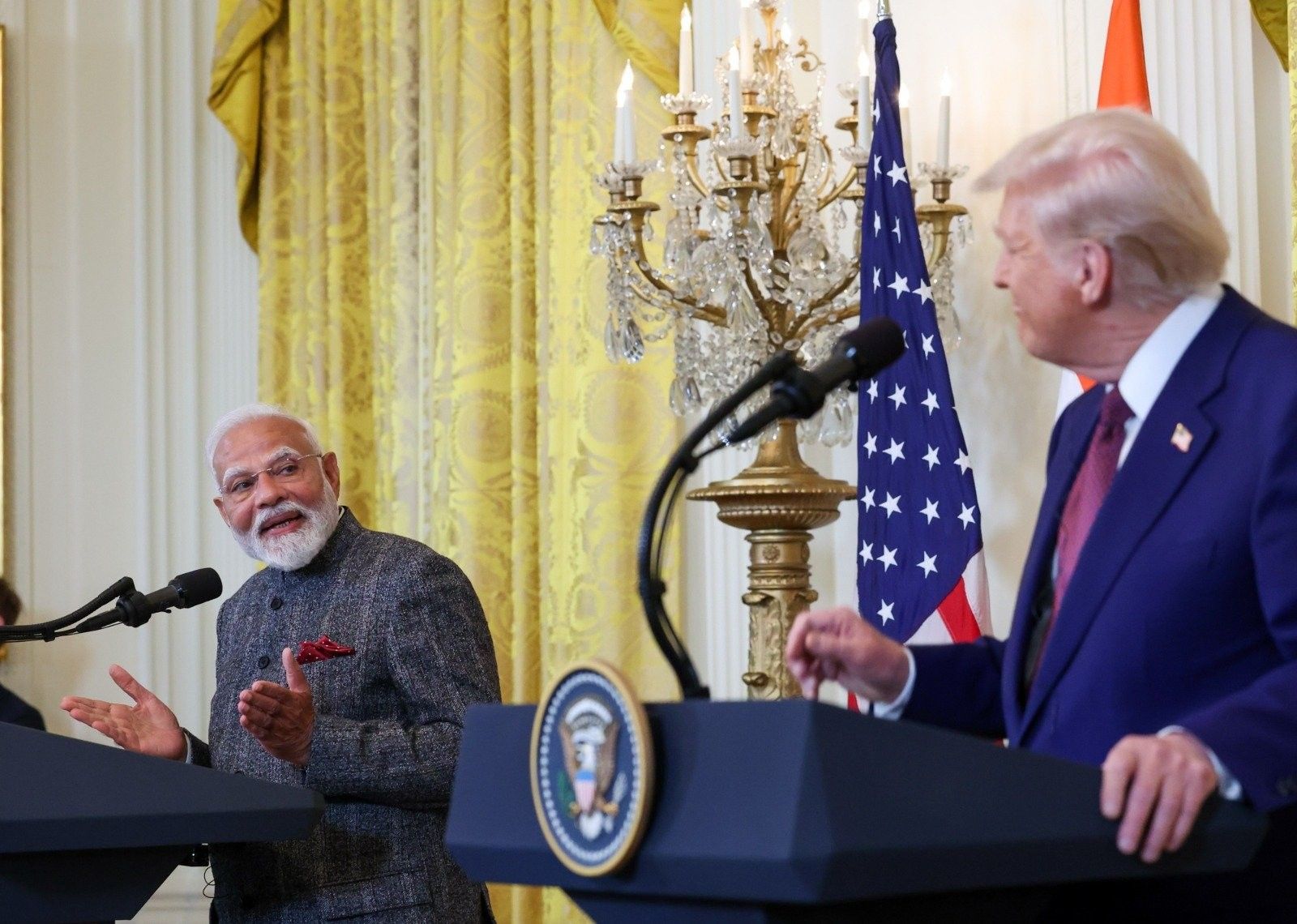
India arguably benefited the most. For decades, it has pursued a policy of „equilibrium,” often counterbalancing one set of meetings with another. Just a week earlier, images from Tianjin circulated worldwide: Modi embracing Putin, riding with him in a car, Modi with Xi Jinping, and even with Lukashenko. The display prompted a dramatic social media post from Trump: „Looks like we’ve lost India and Russia to deepest, darkest, China.”
Consequently, just a few days later, Indian External Minister Jaishankar held discussions with his Ukrainian counterpart, Sybiha, while Prime Minister Modi spoke with European Commission President Ursula von der Leyen. Afterwards Modi spoke with Italian Prime Minister Giorgia Meloni. And afterwards India signed a bilateral investment treaty with Israel. Modi also opted not to participate in the virtual BRICS summit, sending Jaishankar in his place. Speaking on India’s behalf, Jaishankar offered a relatively general statement: „The international trading system is based on the foundational principles of open, fair, transparent, non-discriminatory, inclusive, equitable and a rules-based approach with Special and Differential Treatment for developing countries. India strongly believes that this should be protected and nurtured.”
As a result, India and the United States announced on 9 September that they would resume the talks that had been suspended in August, while Trump and Modi exchanged cordial messages on social media.
Another apparent beneficiary was Lula. The virtual summit allowed him to erase the troubling impression of underpeformance from the Rio meeting. This time both Putin and Xi attended at his invitation.
This episode also illustrates a broader function of the BRICS: serving as a platform for pursuing particular national interests and facilitating ad hoc solutions. Even an absence from a summit might be an useful tool to achieve goals.


