












- KOMENTARZ
- WIADOMOŚCI
- WAŻNE
Germany’s return to security hegemony?

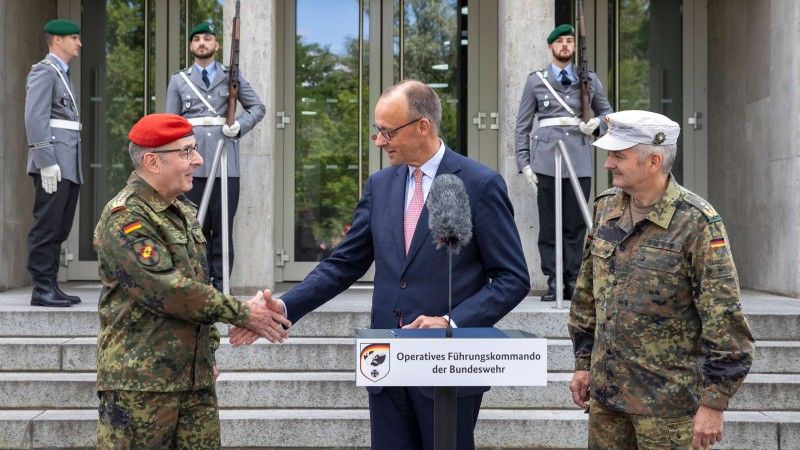
Berlin increasingly signals its ambition to reshape Europe’s security order — strengthening the Bundeswehr, reducing reliance on the US, and leading EU-based defence coalitions. For Central Europe, such plans awaken historical concerns and strategic doubts.
Germany has begun to articulate more openly its ambition to reclaim a leading position in Europe’s security system. Recent publications, including theFinancial Times, point to a strategic turn in Berlin: loosening transatlantic ties, strengthening the Bundeswehr, and taking effective control over European – and even Ukrainian – rearmament. This language of „greater responsibility” may sound noble, but in practice it risks shifting the balance of power in ways that Central European states cannot ignore.
For the nations of our region, this debate is not abstract. The idea ofMitteleuropa once ended in German dominance, border revisions, and ultimately crimes against neighbouring nations. Today, when Chancellor Merz declares on X that the costs of Russian aggression must be raised – a valid point in itself – yet simultaneously advances EU-only defence initiatives as if NATO did not exist, it is worth recalling the very architecture of security that has safeguarded Central Europe since 1991. NATO brought unprecedented peace and prosperity because, as Lord Ismay famously noted, the goal was to keep the Russians out, the Americans in, and the Germans down — under agreed frameworks.
The current debate is clouded by alarmist claims of a U.S. withdrawal from Europe, German eagerness to step in as a replacement, and Russian attempts to destabilise the European order once again. This is a dangerous triangle. Central Europe should be particularly vigilant, knowing Berlin’s mercantile approach to security: once reliant on cheap Russian gas, today increasingly hungry for profits from a resurgent defence industry.
A serious German commitment to security is not inherently negative. The Bundeswehr’s revival could strengthen NATO if pursued transparently and within allied frameworks. Yet if Berlin seeks to create alternative EU mechanisms, where its influence is far greater than in NATO, then Central, Northern, and Southern Europe are entitled to ask: why this path, and what is the long-term direction? Just as eurozone members resist German economic dominance, so too must Europe resist a monopolisation of its security order.
Germany’s awakening to the realities of defence can be a valuable asset — but only if aligned with NATO and the collective interests of the alliance. If Berlin pursues unilateral leadership, Europe risks division and mistrust. For Central Europe, the task is clear: to question, to balance, and to ensure that the continent’s security rests on solidarity, not dominance. Ensuring an equitable security architecture is not merely Poland’s duty, but a responsibility shared by all allied governments if Europe is to remain safe, sovereign, and strategically balanced.


