












- ANALIZA
- WAŻNE
- WIADOMOŚCI
Russian-Serbian ties: secret services, economy and military
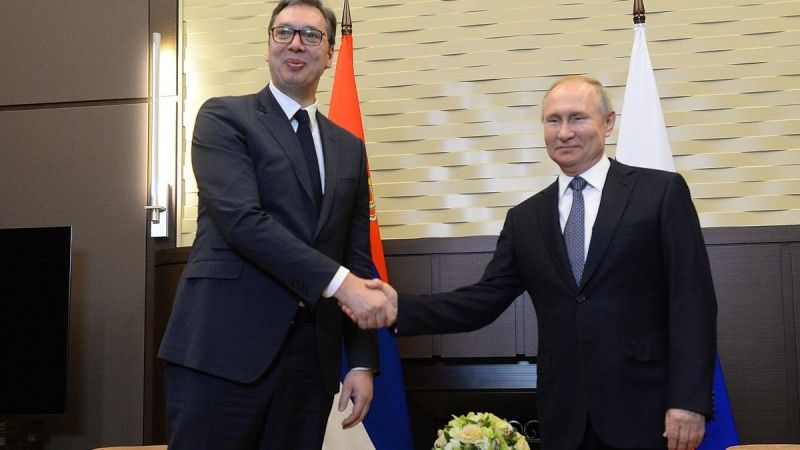
The relationship between Serbia and Russia is deeply rooted in a historical continuity that goes beyond traditional diplomacy. Since the 19th century, Russia has been a central anchor of Serbian foreign policy: first as a protective power during the uprisings against the Ottoman Empire in 1807, later with support in the First World War, and finally through the liberation of Belgrade by the Red Army in 1944 during the Second World War.
Beyond military alliances, Russia became an important ideological and cultural partner, particularly through the Orthodox Church. This historical depth shapes a relationship that is politically, economically and security-relevant.
Economic ties
Serbia has close economic ties with Russia to an extent that is unique in the Western Balkans. Gazprom Neft’s takeover of the Serbian oil company NIS (Naftna Industrija Srbije) in 2008 is considered one of Serbia’s most significant geopolitical decisions in recent decades. Russia thus not only controls a large part of Serbia’s oil and gas value chain, but also has strategic leverage over Belgrade. US sanctions against NIS have been in force since 9 October 2025. Serbia’s energy supply is under increasing pressure, fuel prices are rising, and industrial production, especially in energy-intensive sectors, is at risk. The continued support of payments for NIS by the National Bank of Serbia potentially exposes local banks to secondary US sanctions and jeopardises access to international payment systems and correspondent banks.
Bilateral trade, particularly in energy, chemical products and agricultural goods, remained stable until 2022, reaching nearly US$3 billion by 2021. At the same time, Russian state-owned companies invested in infrastructure, modernising railway lines between Belgrade and Novi Sad and the Vojvodina freight hub, and tying key parts of Serbia’s transport and energy architecture closely to Russian capital.
See also 
Security and military cooperation
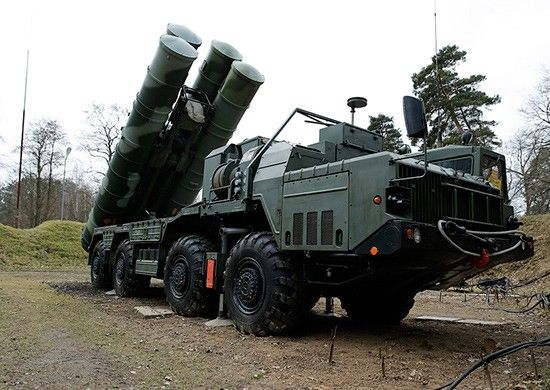
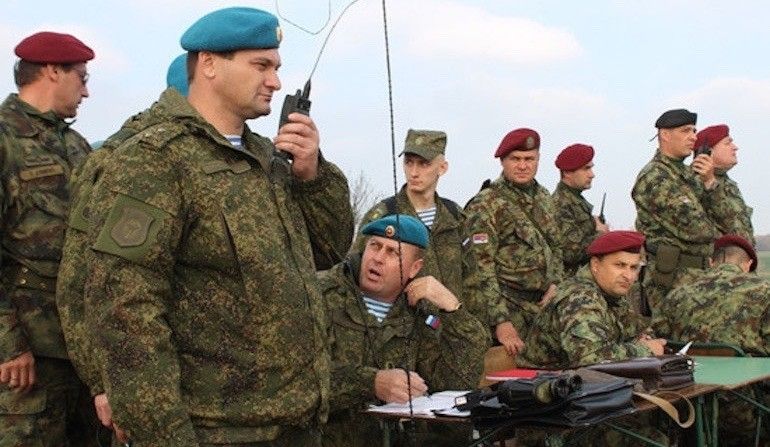
Over the past decade, Serbia has established close military cooperation with Russia. A strategic partnership agreement was formally agreed upon in 2013, followed by a military-technical agreement in 2014. Since then, both countries have regularly conducted joint military exercises, including’Slavic Brotherhood« with a focus on airborne troops, tank and air defence operations.
Serbia has procured various Russian weapon systems, including:
- 14 MiG-29 jets
- Pantsir S1 short-range air defence systems
- T-72 tanks and reconnaissance vehicles such as BRDM-2
- Kh-31 missiles, smuggled in via NATO and EU airspace despite existing sanctions
- Electronic warfare systems such as Krasukha and Repellent
In addition, the Russian Tor M2KM air defence system is expected to be delivered despite the embargo, underscoring Serbia’s strategic dependence and the political controversy surrounding these procurements. At the same time, Belgrade is deliberately pursuing a multi-source strategy to avoid complete dependence on Moscow.
Interestingly, Serbia also participates in NATO structures: since 14 December 2006, Serbia has been an official member of the Partnership for Peace (PfP) initiative and is institutionally integrated into the Euro-Atlantic security network without being a member of NATO.
Military presence and parades, most recently on 20 September 2025, also stabilise Vučić’s domestic policy. The staging of national symbolism and military power is closely linked to the concept ofSrpski svet (’Serbian World«), which is ideologically reminiscent of Russia’sRusskiy Mir and reflects territorial ambitions in the region. During the parade, war flags of the Yugoslav People’s Army were displayed, signalling ideas of a Greater Serbia, inspired by Putin’s assessment of the collapse of the Soviet Union as’the greatest geopolitical catastrophe of the 20th century.«
Intelligence activities and hybrid operations
Intelligence and security cooperation is particularly sensitive. Serbia is the only country in the region with formal cooperation agreements with Russian security structures. Senior Russian intelligence officials regularly visit the country, training programmes are conducted jointly, and the Russian Humanitarian Centre in Niš has long been considered a possible observation or operational base.
In September 2025, pig heads were placed in front of mosques in Paris, apparently to exacerbate social tensions. Shortly afterwards, Bulgarian nationals were arrested on suspicion of collaborating with Russian intelligence services. Serbian involvement was also suspected; further members were arrested in Belgrade. In the same month, five days before the Moldovan parliamentary elections, 74 people were arrested with weapons and cash intended to provoke unrest. Two pro-Russian suspects stated that they and around 200 other people had undergone three days of paramilitary training in Serbia.
Since the start of the war in Ukraine, around 200,000 Russians are said to have moved to Serbia, including suspected intelligence and hybrid operatives who develop political, military and economic strategies.
Geopolitical levers and regional dynamics
Russia directly supports Serbia on the Kosovo issue and blocks international recognition of its independence. Together with the Serbian secret service BIA, Russia is also fuelling secessionism in the Republika Srpska, a constitutional territorial part of Bosnia and Herzegovina, in order to prevent EU accession and subsequent integration into NATO structures.
Pro-Serbian and pro-Russian parties are represented in Montenegro’s parliament, including the New Serb Democracy (NSD/NOVA) and the Democratic People’s Party (DNP). Since Montenegro joined NATO in 2017, there has been a risk that sensitive security information could be passed on via political networks with Serbian-Russian connections. Russian intelligence operations in Montenegro prior to NATO accession brought the country to the brink of civil war; similar activities were observed in 2022.

Political balance and international dependencies
Serbia makes strategic use of these interdependencies: On the one hand, the government presents itself as traditionally pro-Russian, while on the other hand, Belgrade pursues a pragmatic foreign policy in order to strengthen its negotiating position vis-à-vis the EU and the US without officially abandoning European integration. Serbia remains a NATO partner through PfP without imposing sanctions on Russia.
This balance is becoming increasingly difficult: sanctions against NIS and the resulting energy crisis are putting pressure on the country and Vučić’s political system. Serbia is paying a high price for its economic proximity and refusal to impose an embargo on Russia. The US has imposed punitive tariffs of 35%, the highest rate in Europe after Switzerland, affecting around 700 companies.
Today, Serbia stands at a geopolitical crossroads. Russia remains deeply entrenched in energy, infrastructure, security apparatus and military cooperation. Montenegro and other neighbouring countries form potentially influential hubs. At the same time, Serbia’s international scope for action is shrinking due to the geopolitical reality following the war in Ukraine. Although this dependence is translated politically in a flexible manner, structural ties to Russia mean that any reorientation would come at a high economic, security and reputational cost.
Conclusion: historical, economic and geopolitical interdependencies
The Russian-Serbian relationship is a complex web of historical loyalty, energy dependence, military cooperation, intelligence relations, institutional proximity to NATO structures on the one hand, and pro-Russian networks in Bosnia-Herzegovina and Montenegro on the other. The crucial question remains what will follow the heavily burdened Vučić system.
Since November last year, the Vučić regime has also been under strong domestic political pressure, triggered by the collapse of a bus station roof in Novi Sad on 1 November 2024, in which 16 people died. This led to nationwide protests against corruption and nepotism, which lasted a year and did not end despite official denials.
Serbia’s future geopolitical orientation will depend crucially on whether the country seeks to re-establish close ties with Russia or takes into account the growing pressure from Western Europe and the EU. Its geographical location, surrounded by NATO and EU countries with no direct access to Russia, as well as economic realities, make Europe the most likely strategic destination.
The European Union remains Serbia’s most important economic anchor, mainly through subsidies, as its largest trading partner and as the primary source of structural and pre-accession funding. In comparison, Russia’s economic presence in Serbia is relatively small.
After an unusually long silence, Brussels is becoming increasingly alarmed, even though the protests have been going on for almost a year and the regime continues to crack down brutally on demonstrators. Vučić benefits from Serbia’s permanent candidate status, which allows him to cultivate relations with authoritarian, non-EU powers such as Russia and China. The EU must now prove that it stands for the values it propagates and does not tolerate actions that openly undermine them. Belgrade’s declared neutrality serves only to protect Vučić’s personal power.
Serbia’s economy and institutions are too fragile to maintain ambivalent positions in the long term. Sooner or later, the country will have to choose a strategic direction, and this will inevitably be Europe, as geography, trade and capital flows do not allow for any other sustainable path. Those who followed Vučić will do everything they can to distance themselves from the system that kept him in power, and the new government is likely to be pro-European.
On 22 October 2025, the European Parliament sent a strong signal against Vučić’s government. In direct language, the government was accused of brutally suppressing protests, intimidating the media and undermining democratic institutions. On 11 December, Ursula von der Leyen and European Council President António Costa declared on X that the EU expects a democratic Serbia in the future.
Whether Vučić will remain part of this future is uncertain; the decisive factor will be whether the population continues its resistance or whether the regime survives internal and external pressure.
About the author
Eduard Vasilj holds degrees in political science and international law from Goethe University Frankfurt am Main, Germany, and in political science and organisation from the University of Zagreb, Croatia. He began his career advising governments and governmental organisations and has nearly two decades of experience at the executive board level in multinational corporations in the German-speaking region as well as in Eastern and South-Eastern Europe. As a strategic advisor at the board level and chairman of supervisory boards, he advises governments, state organisations, state investors and companies on geoeconomic and geopolitical risks, investment security, governance and strategic decision-making. As an internationally recognised author and expert on geoeconomics and geopolitics, he provides practical recommendations for decisions at the interface of strategy, security and economic policy.


