












- ANALIZA
- WIADOMOŚCI
Western peace mission in Ukraine: Scale and limits

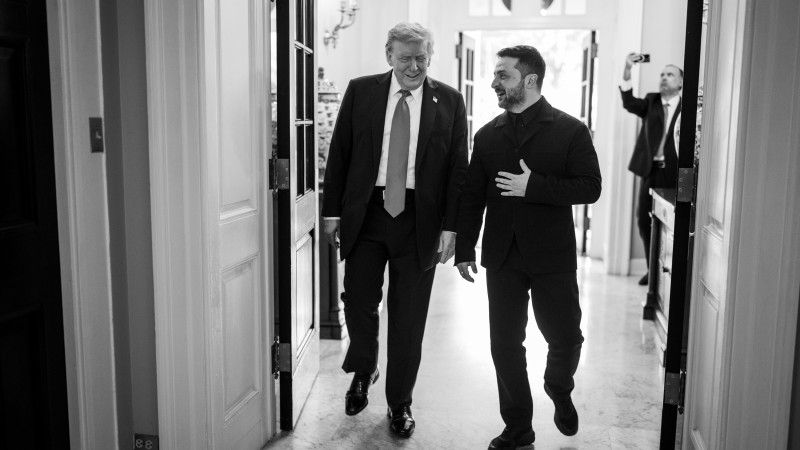
Photo. The White House, X Official Account
Suppose indeed a coalition of the willing is willing to give Ukraine security guarantees and, above all, field a stabilization/peace mission in the period after the fighting stops. In that case, they will face one of the most significant political-military challenges since the end of the Cold War, and perhaps even after 1945.
There is growing talk of the possibility of sending Western troops, including ground units, to Ukraine to conduct a stabilization/peace mission along the line of demarcation with Russia. The leaders of the action are supposed to be Great Britain or France in this regard. Everything, of course, depends on reaching a „peace agreement” between Ukraine and Russia, which Donald Trump has been pushing for since the beginning of his term. But looking at the details of the possible Western mission, about which we know less than more, there are numerous political-military doubts. First, it is still challenging to know how many countries will ultimately agree to send troops to Ukraine even in the post-war period. If there is great optimism about those mentioned above, the British and French, however, going further, real doubts arise. First, one should consider the Germans or Italians, whose leaders, after all, participated in the White House peace talks. And yet, it is challenging to assume today that the authorities in Berlin and Rome are very eager to set aside ground contingents to send to Ukraine, especially as they continue to face problems in simultaneously participating in NATO missions on the eastern flank.
Loud is the issue of German promises vis-à-vis increasing the manpower of its forces stationed in Lithuania. And for the Italians, in fairness, the eastern flank is not a priority. Moreover, for the countries most involved in the defense of NATO’s eastern flank, led by Poland, Romania, the Baltic states, and the Nordic countries, there will be social and military dilemmas. In the latter case, we are primarily talking about the need to balance our own defense capabilities and the possible deployment of adequate forces to the Ukrainian mission. Figuratively speaking, even if the guns on the frontline in Ukraine fall silent to some extent, Russian guns and tanks will not disappear from the Königsberg Region, the land border with Finland or Belarus. At this point, it should also be added that many of the European countries are, after all, still involved not only in NATO activities, but also send their troops on missions under the auspices of the UN (e.g., Lebanon), and conduct numerous training missions outside Europe in support of their policies in various regions.
All of this brings us back to the question of the scale of the mission in Ukraine and its real capacity to carry out its duties. It has been suggested (including in an article by Lara Seligman, Michael R. Gordon, Max Colchester, US Is Prepared to Use Air Power to Support Planned European Force in Ukraine, The Wall Street Journal) that a contingent of up to 30,000 troops is being discussed. And we already must add that, after all, the mere sending of 30,000 soldiers should be expanded by at least another 30,000, which will constitute the necessary rotation and will prepare for departure. In total, we can talk about more than 60 thousand committed soldiers, so to speak, plucked from national and NATO duties, serving in brutal post-war realities and preparing for them. Each international contingent must get together, obtain the necessary certifications, and receive training on the specifics of the area of responsibility. And, everyone in Europe realizes that such a mission can last not a few months, but literally years. Especially in Europe, we have the experience of military contingents in a much less complicated international situation (sic!) in the Balkan region (Bosnia and Herzegovina, Kosovo, etc.). Thus, one cannot escape the conclusion that this will be one of the potentially most challenging tasks for the European pillar of NATO, or rather, a coalition of the willing, being more precise.
Moreover, the difficulty level is raised because the US under Donald Trump will not be willing to dislocate its ground contingent to Ukraine. Thus, the famous „boots on the ground” from the most capable and combat-experienced military force in NATO will be missing. At this point, this does not mean that the Americans will not want to participate in operations in other domains, including air operations. And also that the Americans will fully separate themselves from logistical issues for a potential mission in Ukraine. However, let’s return to the specifics of post-war operations, because further dilemmas arise here.
First of all, the sent soldiers from selected European countries will find themselves in a highly complicated situation on the ground. It is because they will appear in an area where conventional troops, intelligence services, and Russia’s paramilitary structures are operating. It is essential because we will not be discussing gaining an automatic advantage over potential parties to the conflict, allowing them to enforce compliance. It will differentiate the situation found in Ukraine from that in the Balkans. It will be closer to the situation in Lebanon, where both sides, i.e., Israel and Hezbollah, strongly disregarded UNIFIL forces.
The current Russian propaganda narrative, implanting in the heads of its soldiers that they are not fighting Ukraine, but rather the so-called „collective West,” will also become a problem, especially on the tactical level. And suddenly, the West mentioned above appears at Russia’s borders, materializing the propaganda records as they were. So one has to reckon with real threats to the lives and health of soldiers, which the Russian authorities may inspire, but equally result from arbitrariness at the tactical level. These will naturally be threats related to IEDs, mines, but also mortar fire, snipers, and new ones associated with the impact of unmanned systems (not only classic UAS, but also FPVs and potentially UGVs). It implies questions about formatting the necessary RoE (Rules of Engagement) and obtaining the required political assurances to protect soldiers. Regarding the equipment and hardware used, this will be the first mission to require a strong C-UAS component in its entirety and EW. As is known from the current experience on NATO’s eastern flank, the Russians will most likely try to contest the presence of Western soldiers in the cyber, info, and electromagnetic domains.
Mission commanders must contend with a threat to the entire C5 (command, control, communication, computers, cyber) complex on a scale unknown from the Balkans or even the Middle East. All these things will translate into mission costs and, above all, the need to buy new solutions so that subsequent rotations will be flexible in their ability to respond to incidents. And that Russia will try to test the Western mission from day one, of that you can be sure, especially if the Russian side will be able to resort to actions below the threshold of war, with a rich share of sabotage and diversionary activity camouflaged by arbitrary soldiers or the actions of paramilitary and militia formations. Moreover, a massive intelligence crackdown on the Western contingent, which will thus have to have a powerful counterintelligence cover, seems inevitable. So you can always see further financial, organizational, equipment, and quantitative challenges. And not even mentioned yet is logistics, which will also require a significant outlay of forces and resources, seeing the specifics of Ukraine’s vast territory and the distances over which it will have to operate (probably seeing as the core of the logistics bases in Poland, as a NATO country with host nation capabilities).

Finally, the question may arise as to what area will have to be covered by the peacekeeping force - whether only the active part of the front before the end of hostilities, or other inflamed border regions with Russia and Belarus. With such a vastness of the borders and the length of the front, all the more so, 30,000 troops becomes a relatively modest force, knowing that not all of them will be operating, for example, in patrol and observation missions. Then, there is the issue of the Black Sea as a body of water, which should also be considered when conducting security operations (countermine missions, patrol activities). In the case of the maritime domain, it even seems necessary to involve Turkey in such activities, but whether the Turkish authorities themselves will willingly take on all such activities remains a question mark.
Activities in the land and, in part, maritime domains are therefore highly problematic when thinking about the possibilities of a coalition of the willing. However, there is a window for military action that is much more comfortable for Western countries. Namely, we’re talking about air operations, ISR missions, and support in terms of IMINT, SIGINT, etc. In part, support of air defense operations by land-based systems can also be added to this. But above all, for today, the most important and fastest would be introducing something like Air Policing Ukraine and Western aircraft into the airspace and large unmanned ISR platforms. Taking advantage of the enormous disparity of potentials in the air domain, and above all, allowing the camouflage of the deficiencies in the land domain. The second element is to increase intelligence cooperation, aiming for a systemic view of it, rather than efforts to support Ukraine merely.
Indeed, qualitative advantages should be exploited to the maximum, guaranteeing clear skies over Ukraine in the post-war period. Noting that Russia has now been conducting a series of drone and missile strikes against various targets in Ukraine for quite some time, but also continues to resort to aviation activities in frontline areas with a special focus on glide bomb means of destruction. In addition to the aforementioned operations in the air domain, it will be crucial to maintain something that no longer attracts such attention today, namely, the extensive training facilities for Ukrainian forces. In the post-war period, Ukraine will need material, equipment, and training support all the more strongly to rebuild its significantly depleted troop resources. Counterintuitively, the training missions are more critical than a land contingent sent to the line of demarcation and constantly facing troop and equipment limitations.
Finally, it is essential to return once again to the question of finances. Ukraine is potentially set to receive a substantial military support package from the countries supporting it, with estimates as high as around $90 billion. On top of that, the cost of the aforementioned mission in Ukraine itself will not be small. And most European countries will have to fork out additional funds in conditions where their defense budgets are already under enormous pressure from meeting NATO criteria, on top of internal economic perturbations. Therefore, counterintuitively, reaching agreements around diplomatic issues may be much simpler and easier than carrying out a multi-year stabilization/peace mission on the border with an aggressive Russia. Everything today will depend on whether European countries aspire to face the biggest political-military challenge of recent years and how these aspirations will be perceived in their countries, especially in gaining support among voters.


