












- WYWIADY
- WIADOMOŚCI
„Germans lied to us”. Italian attorney's story about the Nord Stream case

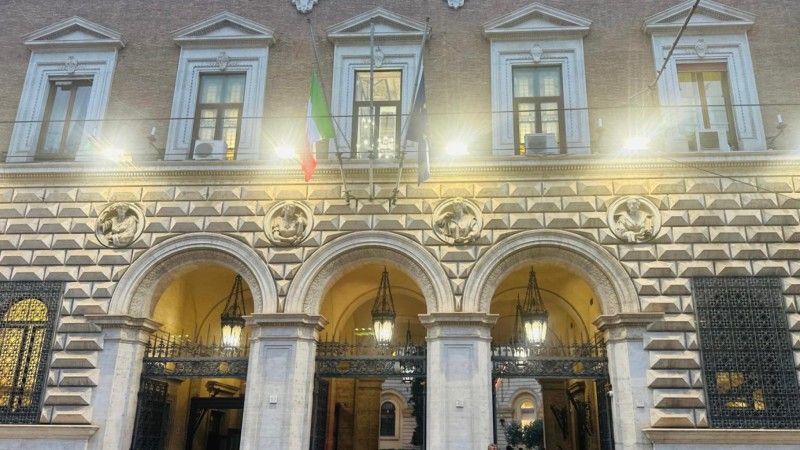
Photo. Dmytro Łubinec/Facebook
The fact that the Germans lied to us may might be a problem, claims Nicola Canestrini, Italian defense attorney for Serhii K., arrested in connection with the sabotage of Nord Stream pipelines. As Canestrini says, the German side provided the Italians with false information regarding the possible fate of Serhii K. in Germany.
„Allow me to say that Germany which is known to be a country held by the rule of law should not play with human rights”, states Canestrini. According to the lawyer, Germany that issued European Arrest Warrant (EAW) does not provide the access to K.’s case file since it is not a national proceeding. The full access, as the German side claims, will be provided when the man will be expelled to Germany. These statements are a display of a „weird logic”, according to Canestrini.
Everyone is entitled to a fair and public hearing
„It’s completely inconsistent with the rule of law and with the European Convention on Human Rights, article six”, Canestrini says. But this is just the beginning of the cooperational problems with Berlin.
According to the article 6 of the European Convention on Human Rights, „In the determination of his civil rights and obligations or of any criminal charge against him, everyone is entitled to a fair and public hearing within a reasonable time by an independent and impartial tribunal established by law”.
We raised some objections about the conditions in detention facilities in Germany. As it seems, there are 13,000 jails and there is the National Institute for the Prevention of Torture which is an official German organization established by the government. In the last year there were some reports claiming that the human dignity was not respected in German jails. We requested information about this and here again, surprisingly, the Germans lied in their answers.
Nicola Canestrini
The German side told Canestrini that the facility where Serhii K. would be locked up in case of extradition did not have any prison conditions problems. „The problem was what we discovered via open sources. The same organization made a report quoting bad conditions at the exactly the same jail where the Germans told us there were no problems”, says the lawyer.
„We think that mutual trust is not something that you can claim without giving it. So the fact that Germans lied to us might be a problem on the Italian side”, Canestrini summed up.
But the main line of the man’s defence – regardless of what Germany might plan for him – is the functional immunity. „A soldier cannot be held liable for something that he or she carried out under orders”, explains the lawyer.
I don’t care about international politics, but what I do care about is that my client needs to have his rights respected. If the Germans say he was part of the command, he obviously did what they say that he did under orders and this should be assessed in the case file. Playing with fundamental rights is always difficult even if somebody says it is done for a for a good cause.
Nicola Canestrini
The long story of functional immunity
In conversation with Defence24.com Canestrini explained that the functional immunity goes back to the year 1835. „There was this US captain who blew up a ship in a Canadian port and the government of the United States of America established 200 years ago that a soldier cannot be held liable for something that he or she did under orders”, Canestrini recalls.
This principle became a part of the international law. Italy itself recognized this principle in the Mario Lozano case – a US soldier who shot by mistake an Italian secret service officer in Baghdad during a rescue operation of an Italian journalist Giuliana Sgrena. In this case Italian Supreme Court in 2008 upheld the functional immunity principle.
You know that during the second world war there were massacres done by the Nazis in central part of Italy. Huge war crimes. The survivors sued Germany for the damages to people and to properties. And in that case as well the international community said no, even in damages claims the functional immunity protects even the state from being liable.
Nicola Canestrini
„What was never considered in case law, was the question if this immunity applies to execution proceedings as well. I think it does but this is an open point”, Canestrini adds.
Inherent right to self-defense
„I frankly don’t care if the president of Ukraine knew or did not know about the operation, of course if the acts allegedly committed by my client are true”, the lawyers says. „Another important thing is that we celebrate the the Ukrainian resistance. Since the day one of the invasion, Europe has consistently stated that Ukraine resists an unlawful invasion. It’s the illegitimate war under the UN charter article 51”, Canestrini adds.
As he explains, the crime that Serhii K. would have committed, if the charges were true, could be seen as a political crime and no extradition could take place, if the nature of the crime is political.
„The Polish court established exactly what we claimed from day one here in Italy. So that there was both a functional immunity and a political crime”, Canestrini says. The Polish court decided to not extradite Volodymyr Zhuravlov, another Ukrainian who might have been included in the Nord Stream sabotage, and was arrested in Poland on the grounds of the German EAW. The case was carefully tracked by the Polish audience and in the end, even Polish politicians claimed that expulsion of Zhuravlov would be a mistake. The Polish court admitted the implementation of functional immunity and Zhuravlov was set free. The fate of Serhii K. in Italy is still unknown. And for Canestrini it’s all about fair trial right, detendion conditions in Germany, political crime exception and functional immunity.
„My question to the court was: what if Polish courts do not limit the rights but expand the rights? Can we really say that this counts nothing? Apparently yes. Italian execution court did not address my question”, the lawyer complaints.
Objective immunity is called this way since it is not subjective. It does not depend on the person but on the actions. Whoever participated in this commando, if the charges are true, is covered by this immunity. So I don’t care if it’s for him or for somebody else, if it’s for the Polish guy, for Mr. Canestrini or for you. Whoever participated is covered unless it’s a war crime.
Nicola Canestrini
As he recals, every international case, „especially if it comes to such a thing like questioning the loyality of Ukraine to Germany, which is an ally in the war against Russia”, has political implications. But at the same time „there seems to be a double standard in upholding international law. So when it comes to Ukraine and Russia, everyone recognizes that the invasion is unlawful and that bombing civilians is a war crime. This standard is not consistent with what we see regarding Gaza and Israel because under international law both are unlawful acts. Both the State of Israel and the Russian Federation invaded or occupy, displace people, shoot and bomb civilians”.
Justice system as a glass house
But there is also another shade that Canestrini considers damaging for the rule of law.
I see that often, especially in high-profile cases, there is always a kind of… There’s an impression that authorities withheld official information because they don’t want the public to be properly informed. That’s exactly what I would like to. We have nothing to hide here. All of this should be discussed in an open court. Sadly, the Bologna court refused it.
Nicola Canestrini
„Especially when it comes to huge cases, one should be very transparent and leave no doubts behind. We live in time in which every important fact leads to suspicions, allegation, conspiracy theories. So I think the right fot the society to be able to react would to make a glass house out of the justice system. I don’t like closed courts. I don’t like secret investigation. I don’t like if the general public is prevented from speaking with a defendant. For example, there were many requests from journalists to interview my client in jail and the Italian judicial authority always denied it claiming that this could harm the investigation”, Canestrini says.
He sees such decisions as a „terrible way to interpret norms”. „Preventing him to speak is a major blowback to fundamental rights. The more the public knows the better it is. Every reader or anyone who listens to an interview could make up his or hers opinion. If we approached it this way, maybe in five years we wouldn’t have conspiracy theories all around”, Canestrini claims.
In his opinion, conspiracy theories, needed for sales or clickbait purposes, „should be completely wiped off in democracy and kept in hold by the rule of law”.
On September 26, 2022, already during the Russia - Ukraine war, three of out of the four Nord Stream 1 and Nord Stream 2 gas pipelines were damaged by explosions that occurred at a depth of 80 to 110 meters. According to the emergency services, explosives planted in the pipelines had caused them to leak. It was a sabotage. The story of the pipelines did not start in 2022 though, but many years ago when Russia and Germany decided to build the infrastructure that would supply the Germans with cheap gas bypassing Poland and the Baltic States. From the very beginning of this yet another show of affection between the two countries, Poland and the Baltics protested against the project and emphasized its safety risks. The real story behind the sabotage is still unknown but the Germans are very eager to capture anyone they think that could be involved in it.


