












- WIADOMOŚCI
Russia-China: A Military Partnership with Limitations

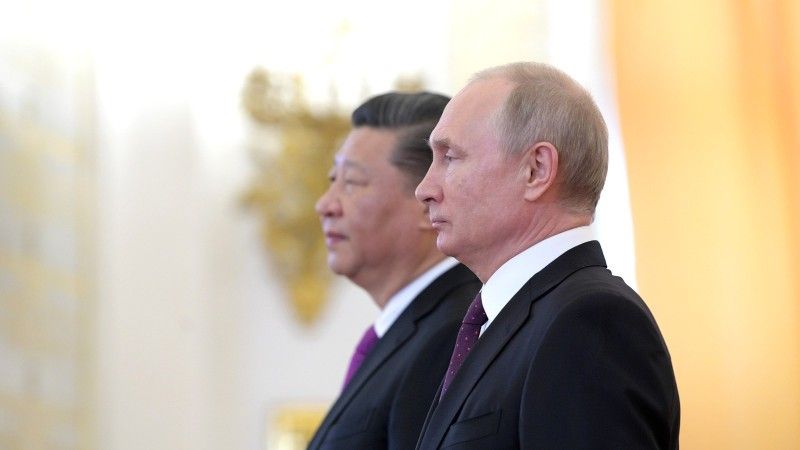
Photo. The Presidential Press and Information Office/Wikimedia Commons/CC4.0
The Russian-Chinese military cooperation—according to a report titled ”Partnership Short of Alliance” published on June 16, 2025, by the Center for European Policy Analysis (CEPA)—has evolved from a purely commercial exchange of post-Soviet weapons to a relationship with deep political and technological ties, though still lacking formal defence guarantees.
The authors emphasize that Western sanctions from 2014 and Russia’s full-scale invasion of Ukraine in 2022 were key catalysts in this transformation. At the same time, they note that Beijing consistently works to preserve its strategic autonomy to avoid secondary economic sanctions.
Referring to data from the Stockholm International Peace Research Institute (SIPRI), CEPA recalls that between 1992 and 2014, Russia supplied China with over 100 Su-27/Su-30 fighter jets, a dozen S-300 batteries, and twelve Kilo-class submarines—helping Beijing modernize its air force and navy while supporting Russia’s defence sector. The acquired know-how was quickly subjected to reverse engineering—examples include the J-11 fighter jet and the HQ-9 air defence system. While this occasionally caused friction between the partners, it did nothalt their cooperation.
Another turning point, as CEPA points out, came in 2015 when Russia agreed to sell China 24 Su-35 jets and S-400 systems, opening the market to next-generation weaponry. However, after annexing Crimea, Russia lost access to Ukrainian engines and Western components and—according to Russian industry sources—began installing Chinese engines in its Buyan-M class corvettes, which proved inferior to the originally planned German equivalents. Simultaneously, between 2016 and 2019, Russia delivered 24 Su-35 jets, eight S-400 batteries, and a batch of upgraded Il-76M aircraft to Beijing. Both capitals also agreed on five-year „roadmaps” governing military contacts—further integration scenarios are detailed in a 2024 RAND report.
Just before the invasion of Ukraine, on February 4, 2022, Xi Jinping and Vladimir Putin announced a „no-limits partnership,” but—according to CEPA—China’s support includes clearly defined safeguards. Asia Financial reports that in 2023, 88–89% of all microchips imported by Russia came from China, sustaining weapons production despite Western embargoes. Meanwhile, the South China Morning Post cites „conclusive evidence” from the EU that armed drones for the Russian military were being manufactured in Xinjiang. Ukrinform highlights that Chinese exports of nitrocellulose—a key component in gunpowder—rose from zero to around 700 tons in 2022 and over 1,300 tons in 2023 during the first two years of the war.
At the same time, mil.in.ua describes the mass use of DesertCross 1000-3 lightweight vehicles (so-called „golf carts”) bought from China for logistics and combat roles, while Army Recognition confirms the delivery of at least one Baoji Tiger armoured vehicle to the „Akhmat” unit. Still, as CEPA notes, China is holding back from supplying tanks, howitzers, or artillery ammunition—concerned about Western retaliation.
According to Reuters, the annual „Joint Sea” exercises and the 2024 „Beibu/Interaction-2024” series in the Sea of Japan have already included artillery and missile drills—presented by Moscow as a signal to the U.S. in the Pacific. The CSIS „Space Threat Assessment 2025” also observes that both countries are testing anti-satellite capabilities and jointly developing advanced electronic warfare. In the covert domain, ERR recalls an incident from October 2023, when the Newnew Polar Bear container ship—Hong Kong-flagged but crewed by Russians—damaged the Balticconnector gas pipeline and two fibre optic cables, with a Finnish investigation linking it to deliberate sabotage.
Despite increasing cooperation, a report from the Council on Foreign Relations stresses that an open alliance with Moscow would jeopardize Beijing’s access to Western technology and financial markets—clashing with Xi Jinping’s „dual circulation” strategy. RAND adds that incompatible command systems and doctrinal differences still prevent the two armies from conducting complex joint combat operations.
Crucial insight into hidden tensions comes from an FSB leak, described by InfoSecurity24. The document, obtained by the Ares Leaks hacking group, labels China a „dangerous adversary”, accuses it of recruiting Russian engineers, analysing NATO weaponry in Ukraine, and pursuing four axes of infiltration: the Ukrainian front, technology theft, Arctic expansion, and preparing territorial claims in the Russian Far East. The report also reveals the existence of a counterintelligence program called „Entente-4” (launched February 20, 2022), and the use of a tool called „Skopishche/Laretz” to filter data from WeChat.
The consequences for the West are twofold. First, as CEPA notes, any synchronization of crises around Ukraine and Taiwan would force NATO and the U.S. to defend two fronts simultaneously with limited resources. Second, the lack of mutual defence guarantees gives the U.S. and EU a kind of „pressure window”: sanctioning Russian entities via export controls on semiconductors, nitrocellulose, drones, or ATVs doesn’t automatically trigger Chinese military aid.
As a result, CEPA concludes that „Russia and China cooperate because they have to, not because they trust each other.” The Kremlin is becoming increasingly dependent on Chinese chips, raw materials, and exports, while Beijing carefully calculates the political cost of its support to avoid outweighing the benefits. This creates a relationship that can be easily expanded or scaled back, but is difficult to turn into a full-fledged alliance—confirmed by both CEPA’s open analyses and the internal concerns revealed in the secret FSB report.
Author: Adam Jawor, InfoSecurity24


