












- WIADOMOŚCI
“President Nawrocki’s message to President Trump: American Forces in Poland are essential to deterring China and Russia”

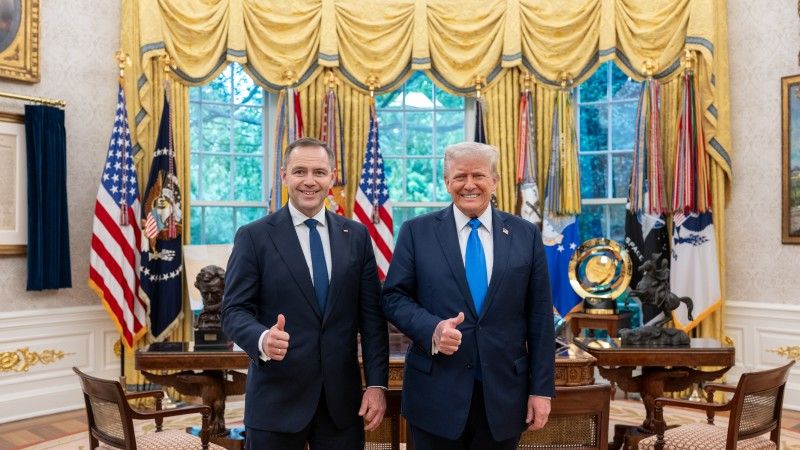
Photo. White House
American Forces in Poland are essential to deterring China and Russia – the title should be the topline message for Poland’s President Karol Nawrocki’s upcoming meeting with U.S. President Donald Trump at the White House, as Colonel Ray Wojcik, U. S. Army (retired) writes for Defence24.com.
In early September, President Karol Nawrocki of Poland will travel to Washington for a crucial meeting with U.S. President Donald Trump. The visit follows Nawrocki’s stunning electoral victory and Trump’s unprecedented decision to send an official delegation to his inauguration. This early White House meeting signals renewed energy in U.S. – Poland relations and comes at a decisive moment: Russia’s war on Ukraine has reached a turning point, and the U.S. is reevaluating its global military posture.
The timing of this meeting could not be more important, as it follows recent dramatic international discussions regarding the resolution of Russia’s brutal War on Ukraine, and the implications for the future of Europe. The meeting also comes while the U.S. is undertaking a „global posture review” of American forces. It’s in this context that Nawrocki can make a compelling case about why American forces stationed in Poland are so vital to not only the security of Poland and Europe, but to the future of the American-led Western Alliance.
Nawrocki should focus on two points with President Trump. First, he should emphasize the threat nexus of China and Russia in both Europe and the Indo-Pacific region. Second, he should underline how Poland’s Army is quickly becoming a smaller twin version of the U.S. Army and what that means for increasing U.S.-Poland defense capabilities and readiness. Ultimately, President Nawrocki must make clear how American forces in Poland are essential to achieving the U.S. President’s imperative of „Peace, Through Strength.”
Nawrocki should shape the conversation ensuring that President Trump understands that this is not a „one way street” concept good only for Poland and Europe. Nor is it a call for a massive American troop presence. Positioning an appropriate combination of American forces in Poland for a specified timeframe – ten years – would greatly enhance Poland’s military capabilities within Europe, and thus, U.S. deterrence globally.
Importantly, while Poland becomes an iron bastion on NATO’s eastern flank, it can simultaneously lead the rest of Europe in the same direction. In this sense, U.S. troops in Poland will help make NATO, an immovable object for Russia.
The deepening China-Russia nexus
Communist China’s ambition to replace the United States as global leader is reinforced by its increasingly close partnership with Russia. China competes economically and militarily around the world with America. Bejing’s goal is to undermine American leadership and influence by stripping away America’s Allies with the ultimate objective of ushering in a China-led world order. China does not want to see Russia lose the war in Ukraine as this weakens China’s position globally, including its ability to forcibly reunify Taiwan with mainland China.
In February 2022, just days before Russia’s full-scale invasion of Ukraine, China declared its „No Limits” partnership with Russia, and President Xi and President Putin reaffirmed this partnership in March 2025. China „fuels” Russia’s war machine by buying massive amounts of Russian energy at a discount from Moscow. China ensures Russia can expand its drone production and provides 80% of the critical electronics used to produce Russian drones. Chinese officers are embedded in Russian command and control headquarters in Ukraine, learning and adopting war lessons. China is producing ammunition for Russia while Chinese companies are present and engaged in Russian occupied Ukraine. In a great irony, China even seeks to join a peacekeeping mission in Ukraine.
China recently conducted its first military exercises with Serbia’s Armed Forces, while Belgrade fields modern Chinese Air defense systems. China is a major supplier of military equipment to Belarus, and its defense relationship with NATO Ally Turkey continues to deepen. China continues exercising and patrolling with the Russian Navy in the Pacific and has even participated in Russian maritime drills in the Baltic Sea region. In late 2024, a Chinese-flagged cargo ship was linked to the severing of two undersea communication cables in the Baltic Sea.
The United States 2025 National Threat Assessment concludes:
”China presents the most comprehensive and robust military threat to U.S. national security,” and „Regardless of how and when the war in Ukraine ends, Russia’s current geopolitical, economic, military, and domestic political trends underscore its resilience and enduring potential threat to U.S. power, presence, and global interests.”
In the Indo-Pacific region, China continues threatening American interests and our allies making illegal territorial claims and conducting aggressive military maneuvers. Most experts assess that it is only a matter of time – likely sooner than later - before China will attack America’s ally Taiwan, to force its reunification. China is intently watching the outcome of Russia’s War on Ukraine. If China sees Russia reaping major advantages from its aggression against Ukraine, while driving a wedge between America and Europe, then China will be emboldened to strike Taiwan, and even other Indo-Pacific Allies.
Around the globe, China is expanding its „Belt and Road Initiative,” to dominate global trade. China is invested in 130+ ports in dozens of countries. Alarm bells are only just starting to sound among allies in Europe, raising concerns about China’s strategic position in Europe. China is a stakeholder in multiple important ports in Europe, many of which are vital delivery points used by U.S. and Allied navies to reinforce Europe in crisis and war.
On the Mediterranean Sea, a strategic region vital to American trade and security, China has majority control of Piraeus, the largest port in NATO Ally Greece. China is heavily present in Europe’s telecommunications networks and has holdings in ports in Germany, France and the Netherlands – key to NATO. China is also investing in German and Dutch rail – important to NATO mobility in crisis and war.
Given the „no limits” partnership of China and Russia, it’s not hard to imagine how China might disrupt a European port, rail system, or other strategic infrastructure, to support Russia’s attack on a NATO Ally. Making this possibility even more clear, NATO’s Supreme Allied Commander, U.S. General Alexus Grynkewich recently stated that the US-led NATO Alliance should prepare for Russia and China to potentially launch wars in Europe and the Pacific simultaneously, as early as 2027.
American forces in Poland
President Nawrocki should convey to President Trump that he is aware and understands the U.S. is undertaking a global posture review of American forces, including U.S. forces stationed in Europe and rotational forces in Poland. The Polish President should provide President Trump details about why the right mix of U.S. forces present in Europe – particularly in Poland - are vital to President Trump’s imperative of Peace Through Strength. He should underline the benefits to America of U.S. troops permanently based in Poland.
It is vital to have U.S. troops working closely with Poland’s Armed Forces. This is the best way to sharpen both Armies for future conflict – anywhere on the globe. Nawrocki should remind President Trump, that every time America calls, that Poland’s Armed Forces - even before joining NATO – are „there for America,” joining multiple combat operations shoulder-to-shoulder with U.S. soldiers. There’s no question, it benefits America when Poland’s Armed Forces can operate and fight at the same level.
President Nawrocki should underline that the threat of a Russian attack on Poland, or on other Allies is increasing. In fact, Russia has frequently violated Poland’s sovereign skies, most recently with a Shahed drone. In this case, Russia’s drone violently exploded, shattering windows of nearby homes. It was a near miss for Polish civilians, a stark reminder of a Russian attack on Ukraine, which caused the deaths of two civilians in eastern Poland, in late 2022.
Throughout its history, Poland makes outsized contributions to defending the West, including fighting for America’s freedom from tyranny. It’s not an easy mission for Poland, which for the last 250 years, is more the captive, than a free state, thanks in no small part to Russia and Soviet-Russia. Poland has learned history’s lessons. For over two decades, Poland has been the „canary in the coal mine” warning the U.S. and NATO about revisionist Russia, and Poland is determined to ensure it remains free, ready to defend itself and NATO despite the outsized financial burden.
Today, Poland dedicates 5 percent of its GDP to defense spending. That’s more than any NATO Ally (including America). For years, even when the idea of raising GDP-defense spending to just 2 percent, is not „fashionable” at NATO, Poland increased to 3 percent, then 3.5 percent, and then more.
Poland strongly urges other Allies to do the same regarding spending. During NATO’s Summit at The Hague this past June, Poland is spared President Trump’s admonishment to raise spending to 5% of GDP. Instead, Poland assisted America in delivering the message to Allies. This is why American leaders, including President Trump refer to Poland, as „the model Ally,” setting the example for what „right looks like” towards achieving Peace-Through-Strength.
Some Allies recognize how much of the Alliance’s burden Poland is carrying. President Nawrocki should thank President Trump, that American troops, tanks and fighter jets are rotationally present in Poland. He can underline, that U.S. Army armored brigade formations began deploying to Poland during Trump’s first term. He should underline how important the integration and cooperative training is with these U.S. armored brigades and Poland’s Armed Forces.
It’s important to convey to President Trump why the U.S. needs troop presence in Poland. Today, American troop numbers are around 9,000 in Poland. These are mostly rotational deployments, with two small headquarters units on permanent assignment orders. President Nawrocki should urge President Trump to change the status of U.S. forces from rotational to permanently assigned units in Poland. He should explain how Poland is preparing to support the long-term basing of U.S. troops, and that Poland bears the brunt of the costs of hosting U.S. soldiers.
President Nawrocki should urge President Trump to permanently assign 15,000 American troops to Poland, and to maintain this, for at least a decade.
The mission for these U.S. troops is not just to help deter Russia, but to ensure Poland’s Armed Forces rapidly reach full capability. That’s impossible to do, without American units permanently assigned to Poland working side by side their Polish Allies. The U.S. must transition from rotational units in Poland to permanently assigned forces. The rotational deployment system is the failed model America utilized for two decades in Iraq and Afghanistan. There is little continuity between shorter term U.S. rotational units and their Allied-partners. President Nawrocki should emphasize, that to spur U.S.-Polish training coherence and interoperability, it is essential for Polish and American Allies to train daily together to America’s standard of „Being Ready to Fight Tonight.”
This is not just a catchy U.S. Army slogan. It’s an ethos the American Army lives by. Poland’s Armed Forces embrace the same ethos (a hard trait to find, even among America’s best Allies). For Poland to achieve this level of readiness, it must speed up its equipping and training. Besides adding so much new American equipment, on Armed Forces Day in mid-August, President Nawrocki stated that Poland is organizing two additional divisions. That’s a total of 6 combat divisions (4 more than the UK). Poland’s President emphasized that Poland, will have the strongest and most ready Army in Europe.
The central question is, how can Poland achieve so much and so quickly with its Army? The answer again, is having dedicated permanently-assigned American forces in Poland, training side by side, incorporating lessons from Russia and Ukraine.
Poland is in the midst of an unprecedented defense modernization massively increasing its force structure and troop numbers, while fielding and integrating ~$60,000,000,000 (and growing) in newly arriving state-of-the-art American equipment. In total numbers, Poland will expend, more than ~$170,000,000,000 in the next ten years on defense modernization. Again, the lion share of this is for new U.S. equipment. American troop presence ensures Poland can field and integrate this new kit, at a rapid pace. American forces in Poland, will be able to conduct large scale land and air combat exercises, with an increasingly near-peer Ally. The U.S. should seize this opportunity, to help such a willing and stalwart Ally „raise its game” to U.S. levels, to defend itself and Europe, which increases U.S. global deterrence.
No other nation is engaged with Poland at this level regarding defense modernization. At Poland’s recent Armed Forces Day an almost 100-page booklet was handed to observers. It includes photos and descriptions of the equipment seen by millions of Poles at the parade, or on television. It’s not surprising that on every second, or third page in this book, that American produced equipment is found. President Nawrocki should hand a copy of this book to President Trump.
President Nawrocki's ten points on the vital role of U.S. Forces in Poland
1. U.S. forces in Poland, help Poland to rapidly become a military powerhouse for America and NATO. This deters Russia, while simultaneously deterring China.
2. In order to rapidly become a military powerhouse for America and NATO, Poland is ready to permanently host the following American units in Poland
a. The entire U.S. V Corps Headquarters (HQ). Currently, only a small „forward portion,” of this important HQ is in Poland. The Vth Corps is the only U.S. Army Corps dedicated to operations in Europe, yet it remains mostly based in America. It should be fully in Europe, at its forward location - Poznan, Poland.
b. A full U.S. Army division headquarters;
c. Two U.S. Army heavy brigades, with tanks. Poland is the U.S. Army’s top tank partner on the globe, already fielding hundreds of state-of-the-art U.S. Abrams tanks (with likely more to come). Experts say, as always »this war is the last tank-war.« This is never the case, and there is no better place for the U.S. Army to train for future armored warfare, than with our Polish Allies.
d. An USAF F35 Fighter Squadron;
e. U.S. Army Apache Attack Helicopter company;
f. U.S. Army Patriot Air and Missile Defense (AMD) Battery;
g. U.S. Army THAAD Long Range AMD Battery;
h. U.S. Army HIMARS, Rocket Artillery Battery;
i. U.S. Army Drone, Counter-drone and Electronic Warfare units;
3. As Poland becomes Europe’s immovable force against Russia, Poland will simultaneously lead the rest of Europe onto the same path.
4. At America’s request, Poland is upgrading its training centers to enhance American joint forces training alongside Polish and other Allies. If asked, Poland is ready to do more. U.S. and Polish forces will train and incorporate lessons from Russia and Ukraine. Poland is already NATO’s hub for Lessons Learned in Ukraine, where U.S. Army doctrine experts often visit. This synergy means America, Poland, Ukraine and other Allies, can develop new doctrine and tactics to prepare for future conflict, including with China. New doctrine and tactics can be tested together on Poland’s expanding training complexes.
5. President Nawrocki should inform President Trump, that Poland is not only making major financial outlays to rapidly modernize defenses. Poland is also spending additional billions of dollars to improve infrastructure on its bases to support American forces. He should remind President Trump, that this is the commitment Poland made to America when President Trump and President Duda signed the U.S.-Poland Enhanced Defense Cooperation Agreement in 2020. Poland keeps its promises and to date, has spent over $3,000,000,000 on base improvements and logistical support for American troops.
6. USA „Global Reach” is maximized, utilizing Poland as a logistics and support hub. The US Air Force (USAF) has decades of experience working out of multiple Polish Airbases which Poland continues to expand and improve, including to support U.S. and Allied aircraft. This includes Rzeszow Airport, where Poland hosts NATO’s vital logistics hub for Ukraine. Additionally, the small USAF Aviation Detachment based in Poland, plays an important role in coordinating USAF - Polish Air Force and Allied air operations.
7. Poland’s infrastructure expansions include construction of a 30-40 million passenger mega-airport connected to high-speed rail across Poland. This is Poland’s „Central Communications Port” (CPK), located outside of Warsaw. This project will massively boost Poland’s economic outlook and increase transportation options for all of Europe. Importantly, for the U.S. and NATO, CPK significantly increases Military Mobility for exercises and during crisis and war. This CPK development means that in the future, there will be a USAF Ramstein-level airbase capability in Poland, available for U.S. global operations.
8. With the majority of Poland’s new state of the art military equipment produced in America, Poland is the perfect European Hub for Maintenance Repair and Overhaul (MRO) of American tanks, helicopters, fighter jets, Air and Missile Defense systems, Rocket Artillery, Anti-Tank systems, and more. While the rest of Europe focuses on its own domestic production, Poland’s industrial base has the flexibility and capacity to be an essential partner in America’s defense-supply chain. This comes when America needs to rapidly expand defense Industrial capacity and needs supply chain partners.
9. Partnering with Poland ensures that America can participate in the EU’s €800 billion „Rearm Europe” project. This can be done in U.S.-Poland Joint Venture arrangements, which then, give America access to compete. This will ensure that Allies can achieve high deterrence and readiness levels and interoperability with America, while keeping American defense industry competitive in Europe.
10. Arming Ukraine similarly to America and Poland, is the best way to ensure that whatever „security guarantees” NATO provides to Ukraine, that these are multiplied by Ukraine’s own powerful defense capabilities and readiness. Europe and America need to continue arming Ukraine now. When the guns go quiet, Poland will be key to assisting the U.S. to equip Ukraine. Poland can continue playing a vital role in support and as a training partner, assisting Ukraine’s acquisition and integration of new American equipment.
Conclusion
Hands down, there is simply no better place for American forces to be stationed, to train for future conflict - and that means a conflict anywhere - than alongside their stalwart Polish Allies, who have stood with America for 250 years. Poland has the political will and is building a smaller twin version of the American Army and Air Force, exactly where America needs such a military powerhouse - right in the „Heart of Europe.”
President Nawrocki must seize this important moment to convey to President Trump what’s at stake in Europe — not only in relation to Russia, but its nexus with China as Bejing’s malign influence expands across the continent. For these reasons, a sustained American military presence remains essential in Europe, and especially in Poland. Ultimately, permanently assigned U.S. forces in Poland represent an America-First and Poland-First strategy. They are essential to advancing President Trump’s mandate of „Peace Through Strength.”
Author: Colonel (retired) Ray Wojcik is a defense expert, at the Kościuszko Chain, Warsaw, and the former Army Attaché, American Embassy, Warsaw. He served more than three decades in the U.S. Army as a Soldier, NCO and Officer, where he worked closely with America’s Allies building transatlantic defense capabilities.


