- ANALIZA
- WIADOMOŚCI
Belarus on permanent alert: What is Minsk really testing?

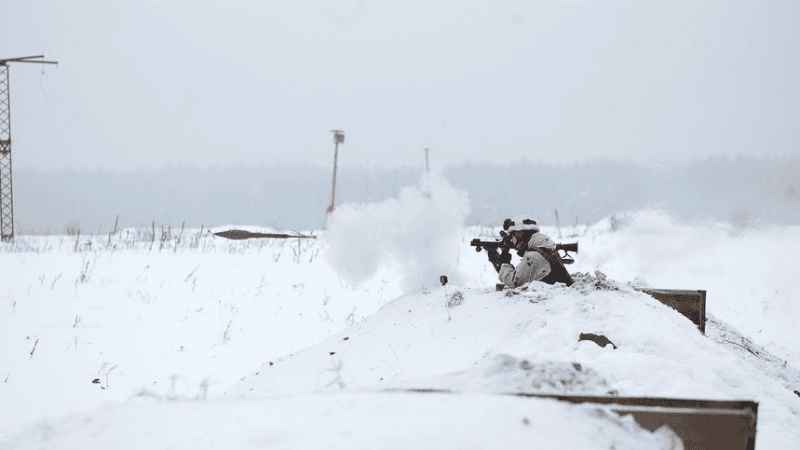
Since mid-January, Belarus has been conducting one of the most extensive and multidimensional readiness assessments in the history of its armed forces.
State authorities in Minsk consistently stress that these are not exercises but a genuine evaluation of the army’s capacity to operate under crisis and wartime conditions. Crucially, the assessment is sudden, rotational, and encompasses both frontline units and logistical support, personnel reserves, and command systems. The operation is conducted under the personal supervision of President Alexander Lukashenko, who deliberately bypasses the traditional decision-making channels of the Ministry of Defence.
Belarusian state media have highlighted the scale of the undertaking from the outset, calling it „the largest readiness test since the founding of the Armed Forces of the Republic of Belarus.” Broadcasts on ONT, CTV, and reports from BELTA regularly show moving military columns, soldiers operating in winter conditions, and intensive live-fire training. Importantly, the assessment is not limited to performative elements; it evaluates real mobilization and combat capabilities, with officials openly stating the aim is to „see the truth, not reports.”
One of the first elements of the evaluation was the immediate mobilization of selected units and reservists. Belarusian media emphasized that calls were issued without prior warning, requiring personnel to report to their units as quickly as possible. The test examined not only discipline and personnel readiness but also the state’s ability to equip reserves with weapons, uniforms, and protective gear. In practice, it was a stress test of the entire mobilization apparatus, whose vulnerabilities were brutally exposed on both sides of the front during the war in Ukraine.
Subsequent phases focused on mechanized and infantry units. The 19th Independent Mechanized Brigade became a key example in media coverage. Soldiers undertook multi-day marches in unfamiliar terrain, under heavy snow, low visibility, and subzero temperatures. Official statements emphasized that these operations were designed to prepare troops for the realities of Belarusian terrain, dominated by forests, marshes, and underdeveloped road infrastructure.
Minsk’s narrative increasingly emphasizes „maneuver warfare” in challenging terrain—a shift from previous years« more conventional, static exercises. The current focus is on rapid redeployment, force dispersion, and operations independent of permanent supply bases. This approach directly reflects lessons from Ukraine, where concentrated troop formations and logistics repeatedly resulted in catastrophic losses.

Live-fire training remains a core element of the assessment. In official statements, Alexander Volfovich, Secretary of the Security Council, repeatedly stresses that „fire determines the outcome of engagements.” Notably, evaluation commissions do not assess only accuracy; handling weapon malfunctions, communication disruptions, and operating under pressure are equally scrutinized.
A growing feature in Belarusian coverage is the focus on soldiers« psychological resilience. State media openly report endurance tests, prolonged operations without rest, and tasks under sleep deprivation. In one report, a brigade commander stated that „a soldier must be ready to fight not when comfortable, but when utterly exhausted.”
Logistics are being tested in parallel. Media coverage highlights stockpiling, movement of field depots, and supply system functionality under winter conditions, with particular attention to fuel and medical support. This reflects hard lessons from Ukraine, where even the best-trained units quickly become ineffective without fuel or medical evacuation, after several hours.
Electronic warfare and protection against unmanned aerial systems are increasingly featured in official statements. While Belarus lacks the extensive drone capabilities of Russia or Ukraine, authorities acknowledge that air threats are now central to modern battlefields. Exercises test camouflage, force dispersion, and responses to enemy reconnaissance.
President Lukashenko has publicly emphasized that Belarus „cannot copy other countries« wars directly,” noting that its geography differs significantly from the steppe or urbanized areas of Ukraine. In his framing, forests and marshes are natural defensive advantages—but only if troops can navigate, fight, and survive in them. This explains the strong emphasis on field training and operations outside established infrastructure.
Readiness assessments also have a clear political dimension. Bypassing the Ministry of Defense and the General Staff signals Lukashenko’s desire for a direct view of operations and full control over the military. In practice, this centralizes command and reduces the autonomy of military elites—a lesson seemingly drawn from Russia’s early command failures in Ukraine, where decision-making chaos proved costly.

Alongside Belarus’s internal readiness tests, Polish authorities have observed a different, less conspicuous—but equally significant—process. Since late January 2026, Polish military and border services have repeatedly recorded night-time incursions into Polish airspace from Belarus. The incidents occur regularly over consecutive nights, indicating they are not accidental and warrant careful analysis.
Initial events were recorded in mid-January over eastern Poland, primarily in Podlasie. The pattern persisted: nocturnal detection, military monitoring, and action by border guards and police. Authorities emphasized that these objects posed no direct threat to civilians or aviation, but the frequency of incidents has attracted growing attention.
Analysis of flight paths and behavior led Polish forces to conclude that the objects are likely unpowered balloons drifting with the wind. Such objects are challenging to identify on radar because they move slowly, change altitude, and emit no signals typical of aircraft. Militarily, this creates difficulties for air defense, forcing constant threat assessment.
These balloons are technologically simple, but their simplicity is paradoxically their main advantage. Made of lightweight materials and filled with helium or hydrogen, they can carry small payloads hundreds of kilometers. Under favorable conditions, they can remain airborne for hours, crossing borders without active control.
From a security perspective, the concern is not merely smuggling or border violation. Mass deployment allows observers to test defensive responses: detection time, monitoring methods, decisions on airspace closure, and inter-agency coordination. Balloons thus serve as a testing tool—cheap, ambiguous, and politically „safe.”
Experience from Ukraine shows that balloons, seemingly archaic and primitive, have returned to modern conflict arsenals as inexpensive, effective, and hard-to-classify tools. Both Russia and Ukraine have employed balloon platforms to complement conventional drones. Their main advantages: simplicity, low signature, and ability to remain airborne for extended periods without propulsion.

Early wartime uses included reconnaissance. Russian forces experimented with camera- and sensor-equipped balloons anchored or drifting at set altitudes, enabling observation without risking costly drones or emitting detectable signals.
Over time, the balloons also began to serve as decoys and false targets. Ukrainian sources repeatedly indicated that the Russian military was deploying objects into the airspace that resembled drones. Their purpose was not to strike but to compel air defense forces to react, activate radars, and expend resources. The balloons proved particularly useful for testing the responses of air defense systems. By moving slowly, changing altitude, and drifting with the wind, they evaded conventional target selection algorithms. For radar operators, they presented a decision-making problem: ignoring the object carried the risk of missing a real threat, while engaging it meant wasting expensive missiles or revealing the position of the batteries.
A key lesson from Ukraine was that balloons forced the integration of different layers of air defense. They were neither a typical target for fighter jets nor a clearly defined task for very short-range systems. They often fell into a „gray area” of operational responsibility, leading to decision-making delays and information chaos. The same problem is now evident in responses to balloon objects over NATO countries.
In later stages of the war, reports also emerged of balloons being used to carry simple radar reflectors or components mimicking drone signatures. Such measures artificially „densified” the air picture, complicating the identification of real threats. From the aggressor’s perspective, this was a low-cost method; from the defender’s perspective, it was extremely expensive to manage.
It is no coincidence that the Polish command began to classify these incidents as hybrid in nature. They do not meet the criteria for conventional aggression, but at the same time, they do not fall under ordinary border crime. Their objective may not be to cause physical damage but to gradually burden the security system, compel reactions, and test procedures under conditions of permanent ambiguity.
The number of such incidents increased noticeably at the beginning of 2026 compared with the same period in the previous year. This could indicate a change in calculations on the Belarusian side, but equally, it may reflect adaptation by criminal groups to increasingly tight ground security. What is crucial is that both scenarios operate within the same strategic environment and intersect with each other.

Photo. Министерство обороны Республики Беларусь / Facebook
Regional context is also significant. Similar incidents have previously been recorded in Lithuania, where they even caused temporary disruptions to aviation infrastructure. It is difficult to ignore the fact that the increase in such events coincided with an intensive combat readiness assessment of the Belarusian Armed Forces. Even if there is no direct evidentiary link between these processes, their parallel occurrence creates a coherent picture of multi-vector activity. On one hand, Minsk is testing its own army and mobilization apparatus; on the other, it is observing neighboring states« reactions to low-intensity pressure.
Looking at Belarus’s readiness assessment and the simultaneous appearance of balloons over neighboring airspace, it is clear that these actions serve two parallel functions. On one hand, they allow Minsk to verify the real readiness of its armed forces: reserve mobilization, logistics, maneuvering capability in difficult terrain, soldiers« psychological resilience, and the effectiveness of command systems. On the other hand, simultaneous monitoring over the borders may serve as an indirect test of neighboring states« responses. Balloons, while not a combat threat themselves, enable testing of air defense procedures, reaction times, and inter-agency coordination.
In this way, the readiness assessment takes on a multi-vector dimension. Minsk is simultaneously strengthening its own forces and preparing for various crisis scenarios, while—in a subtle, cost-effective manner—observing how its environment reacts to low-intensity pressure. It is not necessary to assume that every balloon incident is part of an operational plan; the mere parallelism of these processes allows information to be collected and systems« responses to be tested in a manner that is difficult to interpret unambiguously.