












- WIADOMOŚCI
- KOMENTARZ
Poland’s Eastern Shield needs stronger counter-UAS

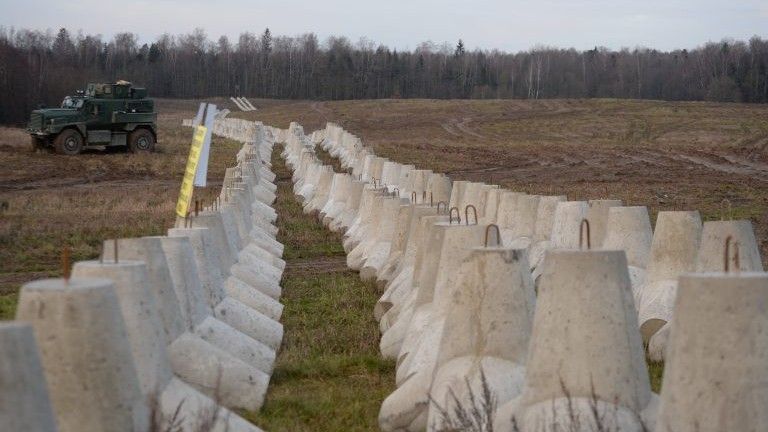
Poland needs to boost C-UAS in the Eastern Shield and beyond. The incident of 20 August 2025, in which an unidentified unmanned aerial vehicle crashed in the Lublin Province, is another signal indicating the need for systemic strengthening of the protection of the entire eastern border of the Republic of Poland as well as the comprehensive Counter-UAS.
Although this incident had limited material consequences, its strategic dimension is significant and should not be ignored in the process of shaping the national system for responding to hybrid threats and new forms of force projection. In particular, reinforcement of the counter-UAS capabilities is needed, including, but not limited to, in the Eastern Shield of Poland project.
New challenges for the Eastern Shield
To date, infrastructure and operational activities under the Eastern Shield programme have focused primarily on the border with Belarus and the Kaliningrad Oblast. Meanwhile, the full-scale conflict in Ukraine, Poland’s direct neighbour and strategic partner, also poses a number of challenges that should be addressed not only in bilateral relations, but also through appropriate technical, operational and legislative measures. Importantly, a similar perspective should also be adopted with regard to the border with Lithuania. Although this is an intra-EU and NATO border, it cannot be excluded from the logic of planning the resilience of the state and the entire Alliance. Only close cooperation with Vilnius will allow for the effective protection of the key section, which is the Suwałki Gap.
Unmanned aerial vehicles as a tool of pressure
The modern battlefield has confirmed that unmanned aerial systems, especially mini and micro ones, are playing an increasingly important role in both reconnaissance and strike operations. At the same time, they are highly accessible, relatively inexpensive and capable of operating near or below classic radar detection thresholds.
From the territory affected by military operations, even if unintentionally, such systems can move towards the territory of the Republic of Poland, posing a threat to the civilian population, critical infrastructure or logistical operations conducted in support of Ukraine. The potential use of the border area for sabotage, response testing or deliberate projection of influence cannot be ruled out either.

New operational requirements
In view of the above, the expansion of the border protection system — both physical and electronic — should also cover the border with Ukraine. These measures do not necessarily imply a change in political relations with Kyiv, but should be part of a realistic approach to national security in a context of high strategic uncertainty.
Key components of this expansion should include UAV detection and classification systems, including low-altitude radars, optoelectronic systems and passive signal sensors; countermeasures (C-UAS) capabilities, including stationary and mobile jamming systems and kinetic and non-kinetic threat neutralisation measures; integration with command and control (C2/ISR) systems, enabling real-time situational assessment and information sharing. Such a system should also be transnational in nature – interoperable with solutions adopted by Lithuania and other Baltic states, so that joint operations can be conducted within the allied system in times of threat.
Currently available technological solutions enable the precise determination of the operational capabilities necessary to build an effective border protection system for Poland. Firstly, early detection of drones and identification of their control signals and video transmissions. Secondly, real-time location of drone operators, enabling the neutralisation of threats at source. Thirdly, the ability to continuously monitor the electromagnetic spectrum over a wide range, at a speed that allows the detection of jamming, spoofing and surveillance attempts. These solutions should be complemented by quantum-resistant encrypted communication tools, infrastructure access control systems and mobile scanners for quick and discreet checks of persons in the border area. The integration of these capabilities into a single coherent ecosystem, both in terms of hardware and organisation, must be a strategic objective at national and allied levels.
Cooperation and local response capabilities
It also seems reasonable to expand the ICT infrastructure and create local response centres in the border area that will be able to cooperate with the Border Guard, the Armed Forces and other state services in the event of an incident. In this context, cooperation with Lithuania could include joint crisis response exercises, data transfer procedures and coordinated plans for the evacuation of civilians from border areas.
Going beyond the border
Of course, Eastern Shield will likely be only the first line of defence against low-flying threats. An expansion of Air Defence and Counter-UAS in Poland is required. To that end, hundreds of various mobile systems based on guns, jamming, and potentially interceptor UAVs and Directed Energy are needed to protect the forces and critical infrastructure. Also, a further enhancement of detection systems is needed, including both dispersed systems and high-end ISR such as aerostats (similar to the Barbara radars currently being procured), AEW&C aircraft, large UAVs with sensors (including millimetre wave radars) and advanced radar systems such as Polish passive SPL (PET/PCL).
Strategic response of the state
In response to the growing challenges in the field of unmanned technologies, Poland must adopt a systemic approach. This means not only investing in equipment and infrastructure, but also preparing personnel, appropriate response procedures and proper mechanisms for information exchange between ministries and institutions. The implementation of training programmes and testing of response scenarios for incidents involving UAVs should become an integral part of defence planning. In this regard, the role of cooperation with Lithuania as a natural ally and partner in the protection of the Suwałki Gap cannot be overestimated.
The importance of international cooperation
International cooperation is equally important. Poland could actively participate in NATO and EU projects on countering drone threats, drawing on the experience of its allies and jointly developing detection and neutralisation technologies. Partnerships with countries such as Lithuania, Romania and Finland, which are also investing in C-UAS systems, could result in a regional early warning and joint response network. In the long term, it is necessary to develop a common security management model for the Lithuanian-Polish border area, covering not only cooperation between services but also the integration of infrastructure and decision-making procedures in the event of a real threat.
Conclusions
Poland needs to increase the counter-UAS capabilities both on the Eastern border (including not only sections bordering Belarus and Russia but also sections bordering Ukraine and Lithuania) and various mobile, strategic and point protection systems, to have a layered and effective defence system. As the UAS threat is expected to grow, the time to act is now.


