












- OPINIA
- WIADOMOŚCI
Change of President in Korea: New Tactics, Old Strategy

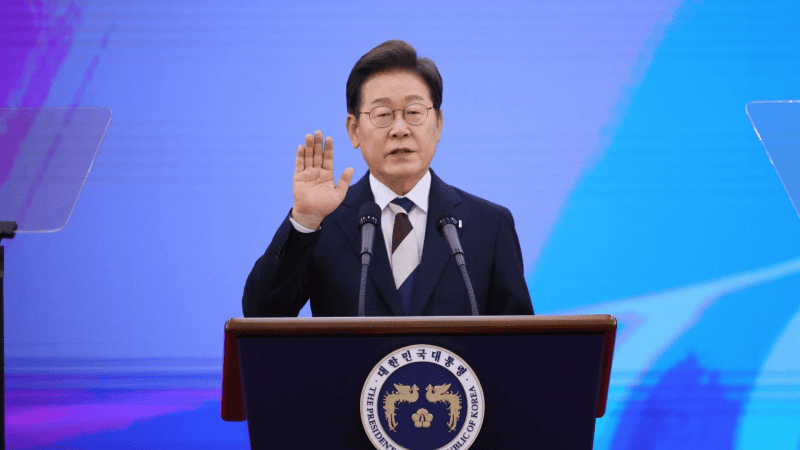
Photo. Wikimedia
On 3 June, South Korea held early presidential elections, which Lee Jae-myung, the liberal candidate from the Democratic Party, won. South Korea is not a country where a shift in political power leads to the dismantling of its predecessor’s projects. What will change, however, is the tactical approach and handling of key issues the new president will face. In a time of political turbulence and the reconfiguration of the global order, uncertainty becomes the norm.
- The change of president does not signify a revolution in the Republic of Korea’s foreign policy;
- Engagement with North Korea remains a constant objective for all political forces, what differs is the method of pursuing it;
- The United States will continue to serve as the cornerstone of stability on the Korean Peninsula.
$$
Korean Democracy
South Korea has come a long way from dictatorship to democracy. Unlike communist regimes in Central Europe, Asian right-wing authoritarian systems were marked by economic priorities. The transitional period in South Korea came under President Roh Tae-woo (1988–1993), who introduced reforms, including direct presidential elections starting in 1987. Since then, South Korea has had a presidential system with a single five-year term. The president holds most executive powers and appoints the prime minister, who handles administrative duties.
Legislative power rests with the 300-member unicameral National Assembly, elected for four years. Two major parties dominate: the Democratic Party (liberals) and the People Power Party (conservatives).
Since 1988, Korea has experienced multiple political crises. The latest was triggered in December 2024, when President Yoon Suk-yeol imposed a six-hour state of emergency, which cost him his office. This crisis tested but ultimately confirmed the strength of Korean democracy, with the public fully aware of its rights and responsive to any overreach. The early elections on 3 June, which brought Lee Jae-myung to power, granted the new president a strong democratic mandate.
From Conservative to Liberal Leadership
Lee Jae-myung, former governor of Gyeonggi Province, narrowly lost the 2022 presidential race to Yoon by just 0.7%. His recent win, with a margin of nearly 12%, reflects the public’s hopes for stability after months of political turbulence and a diminished presidential reputation.
Regardless of who is in power, national development remains a central strategy. Unlike some democracies, South Korea avoids scrapping previous administrations« projects, thanks to a governance model with significant state intervention. The security alliance with the US and cooperation with Japan remain untouchable. However, President Lee has signalled a pragmatic shift in foreign policy, moving away from his predecessor’s”value-based diplomacy” to a more practical approach, as outlined in his 2022 Foreign Affairs article and 2025 campaign.

The North Korea Dilemma
Traditionally, conservatives favour strategic patience, while liberals pursue gradual engagement with Pyongyang. This is not about reunification seen as legally, politically, and economically complex, but rather about reducing tensions and fostering informal ties. Formal diplomatic recognition of North Korea is off the table, as it would require constitutional changes that would effectively recognise a permanent division of the peninsula.
Unlike his predecessor, President Lee proposes a gradual re-engagement aimed at restoring trust. Key steps include forming a joint inter-Korean military commission and reopening communication channels.
However, engaging North Korea is a double-edged sword. Under President Moon Jae-in, a thaw in relations collapsed following the failed Trump-Kim summit in Hanoi in 2019. Kim Jong-un is more interested in direct dialogue with the US, which strengthens his international nuclear legitimacy and domestic authority.
By 2025, Kim will be stronger than ever. In June 2024, he deepened ties with Russia, receiving food aid, military tech, and exporting weapons, even sending troops to Ukraine. This has shifted his priorities away from sanctions relief, which once drove negotiations. Any South Korean aid would likely be rebranded by Pyongyang as a domestic achievement, hiding its origin from the North Korean public.
The thorny issue of complete, verifiable denuclearisation is bound to resurface. Progress in inter-Korean relations will again depend on the United States, especially since previous summits involved Russia, China, and Japan. South Korea’s role could be to support US negotiations, particularly those led by President Donald Trump. Lee’s approach seems reminiscent of 2018–2019, offering political incentives to Pyongyang in exchange for gradual denuclearisation, a stance that now lacks leverage.
The US remains the key actor. On 12 June 2025, White House Press Secretary Karoline Leavitt confirmed openness to dialogue with Kim. Pyongyang’s silence is telling, it reflects a self-assured position. Diplomatically, this may open space for Lee to act as a mediator, but neither the US nor South Korea currently has the tools to compel Pyongyang to negotiate. Kim’s nuclear arsenal is non-negotiable, and even talk of freezing development is likely unverifiable. The primary beneficiary of any summit would again be Kim Jong-un.
Between the US and China
The US security architecture in the Pacific is built on South Korea, Japan, and Taiwan. However, Trump’s new trade policy presents fresh challenges for Seoul. Negotiating favourable terms with the US is now crucial. A strong deal would bolster Lee’s credibility; a weak one could undermine him early in his presidency.
South Korea is also caught in the US-China trade conflict. In 2016, US Pacific Commander Harry Harris said China’s aim was global hegemony. This puts Lee in a tight spot: both powers are South Korea’s key trading partners. At the same time, the US is pushing regional allies to increase defence spending.
Lee must now pragmatically balance ties with both China and the US, maintaining markets without jeopardising his role in US-led security structures in Asia. The Taiwan issue is ever-present. While speculation about a US withdrawal from Taiwan is exaggerated, President Xi’s declaration of reunifying Taiwan by 2049 should not be ignored. Lee’s stance appears to align with „pragmatic non-engagement” maintaining distance and supporting the status quo. A shift could disrupt the entire Asia-Pacific security architecture and force South Korea to re-evaluate its strategic priorities.
The Russian Factor
Lee has stated he will maintain friendly relations with China and Russia, which is in Korea’s interest. Unlike in Europe, Russia’s image in Korea is more ambivalent. South Korea condemned Russia’s invasion of Ukraine in its 2022 Indo-Pacific Strategy, labelling Russia a destabilising actor. Moscow-Pyongyang ties now directly threaten Korean security.
This makes friendly ties with Russia difficult. In 2024, Lee opposed direct arms supplies to Ukraine and rejected sending military observers to monitor North Korean involvement in Ukraine. But since his predecessor’s responses were mainly rhetorical, Lee faces no pressure to shift policy decisively.
Relations with NATO
South Korea’s formal cooperation with NATO began in 2012, but gained momentum in 2022, with Seoul opening a diplomatic mission to the alliance. President Yoon also participated in three NATO summits with the Indo-Pacific Four: New Zealand, Japan, Australia, and South Korea.
In May 2025, Lee expressed doubt about attending the next summit (24–25 June, Netherlands). This wasn’t a refusal, but suggests a more cautious stance, not as a rejection of NATO, but a symbolic gesture to assert South Korea’s independent approach towards North Korea.
Conclusion
Neither presidential or parliamentary elections in South Korea result in radical shifts in foreign or economic policy. The main difference lies in how political camps approach challenges. Facing the implications of US trade policy, President Lee must pragmatically manage the US-China rivalry in a way that benefits Korea. Lee’s position on Russia remains unclear and is linked to North Korea’s behaviour. The previous administration failed to take meaningful action in response to North Korea–Russia military cooperation.
North Korea remains the central issue. Reopening dialogue will largely depend on the United States. Summits are for nuclear powers, and South Korea is not one. Seoul remains under the US extended deterrence umbrella. Dialogue with Pyongyang is necessary but risky. It will depend on President Lee’s diplomatic skill whether South Korea is marginalised or meaningfully included in future Trump-Kim summits. A visible role would be a significant diplomatic success. However, denuclearisation remains a theoretical goal. North Korea’s nuclear arsenal guarantees Kim’s regime’s survival and his international clout.
Wishing President Lee Jae-myung success is warranted, but his fate will also depend on factors beyond his control. With parliamentary backing, he holds strong cards. The real test will come by 2030, and hopefully, he will have a few notable successes to his name.
Author: Prof. Piotr Ostaszewski, SGH Warsaw – former Ambassador of Poland to Korea (2017–2024).


