












- WIADOMOŚCI
- OPINIA
Nuclear lessons from Iran: Strategic implications for North Korea

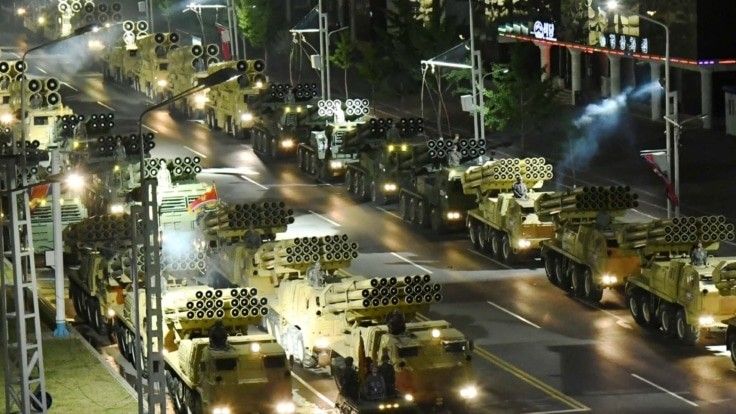
Photo. KCNA
Nuclear weapons are the ultimate guarantor of regime survival in North Korea; therefore, any negotiations on so-called denuclearization should be regarded as entirely unfounded. (…) Iran serves as a powerful example for Pyongyang that its pursued strategy is rational and ensures the regime’s continuity, writes Professor Piotr Ostoja Ostaszewski, Ambassador of the Republic of Poland to the Republic of Korea (2017–2024).
North Korea’s cooperation with Iran dates back to the Iran–Iraq War (1980–1988), during which Pyongyang became one of Tehran’s key suppliers of weapons and ammunition. More significant, however, was their collaboration in acquiring components for nuclear weapons development in the early 2000s. Since 2021, this partnership has accelerated notably in the area of long-range delivery systems.
The U.S.-Israeli bombings in Iran have alarmed Pyongyang, which condemned the strikes as violations of the United Nations Charter. This does not mean, however, that North Korea is destined to share Iran’s fate. Unlike its partner, the DPRK has possessed nuclear weapons since 2005 and continues to develop them, including intercontinental ballistic missiles (ICBMs) capable of reaching U.S. territory.
What implications might the rollback of Iran’s nuclear program have for Pyongyang’s strategic calculus?
Fluctuations in nuclear weapons strategy
Nuclear weapons are the ultimate guarantor of regime survival in North Korea; therefore, any negotiations concerning so-called denuclearization should be regarded as entirely unfounded. Moreover, by possessing weapons of mass destruction of this kind, North Korea ranks among the world’s nuclear powers, an essential factor shaping its international standing.
The DPRK’s strategic arsenal is estimated to contain between 50 and 60 nuclear warheads, although some intelligence reports suggest the number could be as high as 90. Admittedly, this is little in comparison to Russia (approx. 5,900) or the United States (slightly over 5,000).
Nonetheless, their number and range allow North Korea to effectively apply both defensive and offensive strategies, to use them within the framework of deterrence policy, as well as to carry out various provocative actions. This aspect should also be viewed as part of psychological warfare, in which Pyongyang holds the initiative over open societies. Noteworthy is the evolution of North Korea’s strategy regarding the use of nuclear weapons:
- Defense: In 2016, at the 7th Congress of the Workers' Party of Korea (convened after a 36-year pause), Kim Jong-un announced that North Korea's nuclear weapons could only be used by order of the Supreme Commander of the Korean People's Army and solely to repel a potential invasion or hostile nuclear attack, meaning they were treated as a retaliatory measure. This also served as a strong argument during the détente period of 2018–2019 and the negotiations with South Korea, and above all, with the United States. It should not be interpreted as a step toward denuclearization, but rather as a bargaining chip in negotiations, with potential consequences of arsenal reductions not affecting North Korea's strategy or combat capabilities.
- Defense, retaliatory and preemptive strike: At the 8th Congress of the Workers' Party of Korea in January 2021, Kim Jong-un presented a Five-Year National Defense Policy Plan, which, as part of the deterrence policy (primarily against the United States), prioritized acquiring capabilities for both retaliatory and preemptive strikes. Measures to achieve these goals included: increasing the deterrent potential of nuclear weapons, including the development of both strategic and tactical weapons; continued work on technological advancement and miniaturization in this field; acquisition of a hypersonic glide vehicle (HGV); and securing solid fuel for intercontinental missiles launched from submarines and ground-based launchers.
- Expanding preemptive strike initiative: In September 2022, by decision of the Supreme People's Assembly of the DPRK, North Korea was officially proclaimed a nuclear state, declaring the use of nuclear weapons in the event of defending the country, preventing the escalation of war, and countering threats to the existence of the nation and state (read: the regime). As a consequence, a decision was also made to increase the national defense budget, which includes the development and expansion of nuclear weapons production and the options for their use.
Nuclear-cognitive strategy
An attack on Iran’s nuclear weapons production facilities will likely serve as an indication for Pyongyang to fully develop the nuclear-cognitive strategy that began to take shape in 2024. The sine qua non condition for its implementation is, first and foremost, the possession of nuclear weapons along with the capability for their technological advancement and production. The second essential condition is the possession of second-strike forces, capable of responding to a nuclear attack by an adversary. The third is operational capabilities in cyberspace, enabling proper assessment of the adversary’s cognitive abilities, as well as specialized institutions and units responsible for shaping a favorable narrative. Having fulfilled all of these conditions, North Korea is therefore prepared to implement such a strategy.
The two components contained within it—nuclear weapons as a tool of deterrence, but also as a threat of use, and cognitive (or psychological) warfare—are closely interrelated. The first serves as a form of pressure, instilling in the adversary a sense of fear over the potential use of nuclear weapons, or even the mere suggestion of their use.
Cognitive operations belong to the broader realm of psychology and mental influence, aimed at shaping beliefs, perception of reality, and, consequently, specific actions. The objective is to distort the adversary’s assessment, decision-making process, and response strategy. Cognitive warfare is essentially the manipulation of information, control of the narrative, and influence over the opponent’s decisions, with nuclear weapons serving as both a direct target and an instrument of that influence.
The essence of the nuclear-cognitive strategy lies in integrating these two elements, which is considered a form of hybrid warfare.
Kim Jong-un’s latest achievements in the nuclear sphere
To date, North Korea has conducted six nuclear tests (2006–2017). However, according to information published in the Annual Threat Assessment by the group of 18 U.S. government agencies and organizations that make up the United States Intelligence Community, Kim Jong-un has resumed preparations for nuclear testing and intends to conduct another at a time of his choosing.
The expansion of the nuclear arsenal since 2019 includes, among other things: the introduction of long-range intercontinental ballistic missiles such as the Hwasong-15 (range: 13,000 km) and Hwasong-17 (range: 15,000 km); since 2023, the possession of tactical nuclear weapons in the form of Hwasan-31 missiles; since 2024, the possession of solid fuel (which reduces the time from launch order to strike); and in January, a successful test of the medium-range hypersonic missile Hwasong-16B.
Certain issues remain unclear, such as whether the DPRK possesses thermonuclear weapons and whether its nuclear warheads have been miniaturized as data on these matters remains unconfirmed. Additionally, in March 2025, North Korea launched a nuclear-powered submarine capable of deploying nuclear missiles into its naval forces.
Following its 2009 withdrawal from nuclear non-proliferation agreements, North Korea resumed uranium enrichment (at Yongbyon and Kangson) and plutonium extraction (at Pyongsan), as confirmed by International Atomic Energy Agency (IAEA) reports from 2025.
These developments clearly confirm the implementation of strategies outlined in 2021–2022, and there is no indication that this process will be halted or even slowed.
What lessons from the Iranian case?
Iran serves as a clear example for Pyongyang that the strategy it has adopted is rational and guarantees regime survival. From a political standpoint, Kim Jong-un may seek to strengthen the partnership with Russia concluded in June 2024, which also translates into access to Russian nuclear technology.
In relations with South Korea, whose new president, Lee Jae-myung, will likely pursue a policy of easing tensions, Kim Jong-un will be in a position to exert pressure, for example in the economic sphere, without offering much in return, and certainly not in the area of nuclear weapons.
It appears that this nuclear-cognitive strategy will become the most effective military tool not only in relation to South Korea, but also in potential negotiations with the United States—if such talks are to take place at all. North Korea will therefore seek to instill fear, doubt, and a sense of helplessness within South Korean society.
The main objective will be to exert pressure on South Korea’s command structures and to undermine the cohesion of the U.S.–South Korea alliance. Unfortunately, the initiative, as usual, lies with Kim Jong-un, who holds strong cards.
Author: Professor Piotr Ostoja Ostaszewski, Ambassador of the Republic of Poland to the Republic of Korea (2017–2024)


