












- WAŻNE
- WIADOMOŚCI
- KOMENTARZ
Greece signs €650m deal with Israel

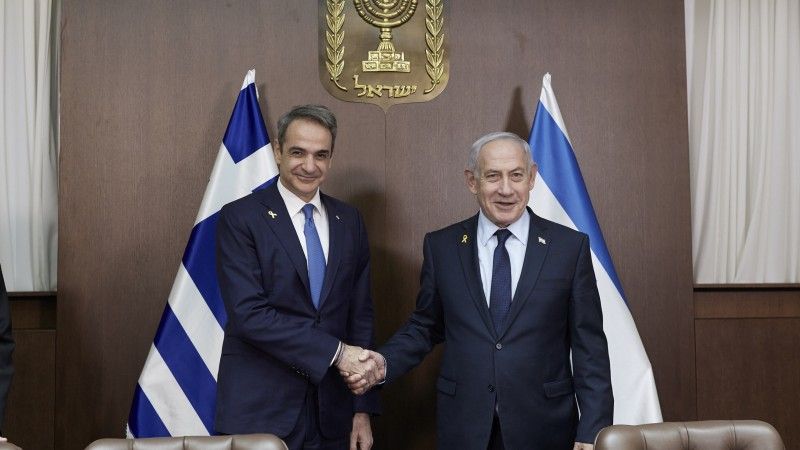
A €650 million deal with Israel is not a routine procurement. It confirms that Greece is building a coherent system of deterrence tailored to a battlefield dominated by drones, precision strikes and saturation attacks.
Israel will supply Greece with Elbit Systems« PULS rocket artillery system, alongside training rockets, precision-guided missiles and loitering munitions. In practice, this package significantly enhances Greece’s long-range fires and introduces capabilities directly aligned with modern operational requirements. However, the importance of this deal lies not in the platforms themselves, but in how they fit into a broader strategic architecture.
Athens is currently undergoing the largest military modernisation process in its history, with plans to allocate approximately €25 billion over the next decade. This shift is not driven solely by traditional rivalry with Turkey, but by a fundamental reassessment of warfare. Experiences from Ukraine, the Middle East and the Sahel have demonstrated that drones, loitering munitions and precision strikes are now central, not auxiliary, to combat operations. Greece is among the few European states that have fully internalised this lesson.
Cooperation with Israel is therefore structural, not transactional. Athens is building its future capabilities around combat-proven Israeli technologies, particularly in air defence and counter-drone warfare. The planned „Achilles Shield” – a multi-layered system integrating short-, medium- and long-range interceptors – is intended to replace the current patchwork of Russian and American systems with a unified, interoperable architecture. The acquisition of PULS and loitering munitions complements this approach by adding an offensive layer to an already evolving defensive system.
At the same time, regional dynamics are accelerating these decisions. Turkey’s rapid development of unmanned systems, missile capabilities and defence industrial capacity creates direct pressure on Greece. In this context, cooperation with Israel becomes a matter of operational necessity. Both countries share similar threat perceptions and have been deepening military and intelligence ties for years, particularly in areas where European solutions remain limited.
Importantly, Greece is not limiting itself to procurement. Alongside foreign acquisitions, Athens is developing domestic capabilities, including counter-drone systems such as Iperion and Telemachus, as well as electronic warfare solutions like Centauros. This indicates a dual-track approach: immediate capability through imports and long-term resilience through industrial development.
At the same time, recent delays in Israeli deliveries to Romania – where drone systems were postponed by several months and triggered financial penalties – highlight growing pressure on defence supply chains. While partly driven by wartime conditions, this case shows that even experienced suppliers may face constraints when demand rapidly increases. For Greece, this reinforces the need to balance foreign procurement with domestic industrial development.
In strategic terms, Greece is building not individual capabilities, but a system. The integration of air defence, counter-drone solutions and long-range fires suggests a shift towards a layered deterrence model adapted to the realities of modern warfare. This places Athens ahead of many European allies, particularly in Southeastern Europe, where similar comprehensive approaches remain limited.
The key conclusion is clear. Greece is not preparing for a traditional conflict. It is preparing for a drone-centric, high-intensity battlefield where speed, precision and system integration will determine outcomes. The deal with Israel is one element of this transformation – but it clearly shows the direction Athens has chosen.


