


- ANALIZA
- WIADOMOŚCI
Leaky sanctions: How Russia is building rockets thanks to the US

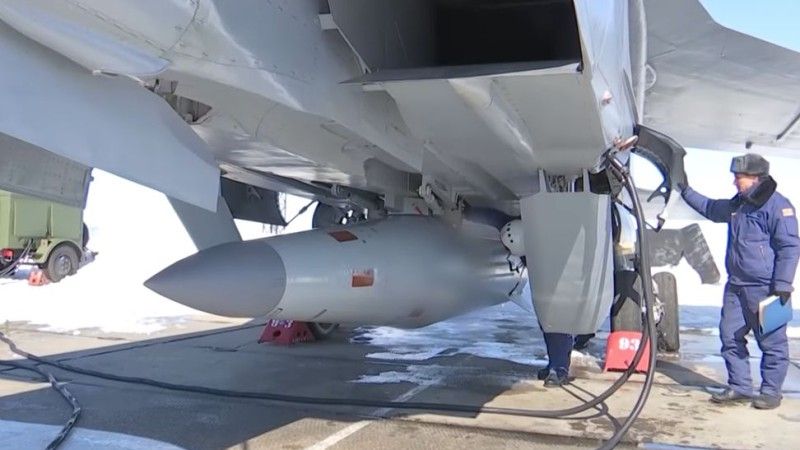
Most electronic components used in Russian Kinzhal hypersonic missiles are sourced from the United States. This indicates that sanctions are not airtight, while also revealing that the Russian industry has become dependent on smuggling.
Smuggled parts
Based on components found in Kh-47M2 Kinzhal air-launched hypersonic missiles, the Ukrainians revealed that out of 197 identified electronic sub-assemblies, as many as 155 (79%) originate from the United States. It also emerged that Russia used only one element produced by its own industry in the Kinzhal (a BA996A1 transistor), one from Belarus, and one from China. This may be seen as a reputational blow to Beijing, as Taiwan supplied 7 sub-assemblies, ranking fourth as a „silent co-operator”.
Japan ranks second, being the source of 17 components (9%), followed by Switzerland in third place with 10 identified sub-assemblies (5%). Among the American parts, the Ukrainians identified: a Geode microprocessor, memory chips, a Field-Programmable Gate Array (FPGA), an analogue-to-digital converter, a transceiver, a 5-bit digital attenuator with 31 dB attenuation, an N-channel MOSFET, and a power module. Japanese components included voltage regulators, integrated circuits, a broadband interference filter, an inductor, and a Murata amplifier.
See also 
Reasons for halting production and Kinzhal combat limitations
The necessity of acquiring various parts from abroad through illegal channels should not be considered the primary reason for the halt in Kinzhal production, which was reported in April 2026. This decision stemmed mainly from the fact that the missile failed to prove itself in Ukraine as a „game-changer”. Yet, this was precisely how the Kinzhal missile was presented by Putin on 1 March 2018. At that time, he unveiled six new weapon systems which he claimed would allow Russia to gain military superiority over Western nations.
Among them was the Kinzhal missile, which, according to the Russians, was supposed to reach speeds exceeding 12,000 km/h and carry a warhead weighing approximately 500 kg. However, this speed turned out to be lower and not sufficient to penetrate air defences based on Western systems. The Ukrainians proved this as early as 4 May 2023, when they shot down the first Kinzhal over Kyiv using an older version of the Patriot battery (not yet equipped with PAC-3 MSE missiles). Considering the high production costs of this weapon system, as well as the complicated method of deployment (requiring a specially modified version of the Russian MiG-31K fighter), the Russians likely concluded that it was more cost-effective to use Iskander-M systems – which utilise very similar missiles.
This is also evident from the combat history of these missiles. It is estimated that the Russians have used over 230 Kinzhals throughout the entire war in Ukraine, with the highest number in 2025 (approximately 100). According to the Main Directorate of Intelligence of Ukraine, as of August 2026, Russia reportedly possessed only about 50 Kinzhals. Thus, for the time being, another myth presented by Putin eight years ago has been debunked.
The information regarding Western components in Kinzhals should come as no surprise. On the special Ukrainian government portal „War and Sanctions”, one can find many more Russian weapon systems containing foreign components, including details on where they were manufactured and installed. Such reliance on Western technology has been identified in 284 weapon systems (including Geran-4, Geran-5, and Klin drones, Lancet loitering munitions, 3M-22 Zircon missiles, as well as Iskander-M and Iskander-K). A total of 6,181 foreign sub-assemblies were found within them.
On one hand, this should be seen as bad news, as it proves that Russia is still able to bypass sanctions imposed on the import of sub-assemblies for the military-industrial sector. On the other hand, it is very positive information. It proves that the Russian industry has practically lost the capability to produce modern electronic components, even for a sector as vital as its own missile armament plants.

Furthermore, the proportion of smuggled sub-assemblies is constantly increasing. In Iskander-M missiles, the Ukrainians identified 140 components, 25% of which originated from Russia and 45% from the United States. In the newer Kinzhals, this ratio has shifted to 5% and 79% respectively.


