












- WIADOMOŚCI
- ANALIZA
Lee Jae-myung’s summit with Donald Trump: Between flattery, strategy, and unresolved questions

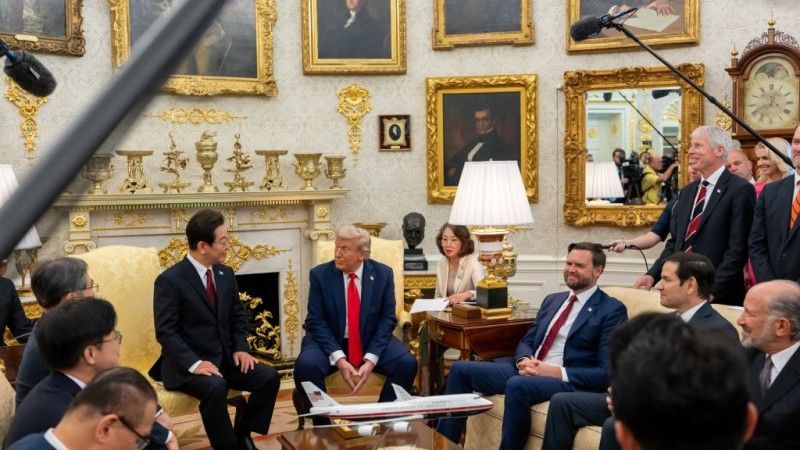
Monday meeting between South Korea’s President Lee Jae-myung and U.S. President Donald Trump in the Oval Office was one of the most anticipated encounters of Lee’s early presidency. Entering Washington under a cloud of uncertainty Lee faced the risk of an embarrassing diplomatic clash. Instead, he emerged with a cautiously defined success. By skillfully employing flattery, framing U.S. priorities as mutually beneficial, and deflecting Trump’s unpredictability, Lee secured a cordial atmosphere and avoided the pitfalls that have derailed other leaders meetings with Trump.
A Diplomatic Tightrope Walk
The stakes were unusually high. Hours before the summit, Trump’s social media comment on „purge or revolution” in South Korea alarmed Seoul’s delegation, as it seemed to echo conspiracy theories about South Korea’s political turmoil following the failed martial law bid by ousted former president Yoon Suk-yeol. The possibility that Lee would be forced to defend himself against such narratives threatened to derail the visit before it began. Yet in the Oval Office, Trump quickly softened his tone, framing it as a „misunderstanding” after Lee explained the legal process surrounding Yoon’s arrest and ongoing investigation.
Lee’s strategy was clear: avoid confrontation, appeal to Trump’s vanity, and tie South Korean interests to Trump’s favored narratives. In this respect, Lee resembled other world leaders – like NATO Secretary General Mark Rutte or UK Prime Minister Keir Starmer – who have discovered that flattery is often the most reliable way to manage the American president.

The Flattery Offensive
Lee’s opening lines set the tone: he complimented the Oval Office décor, praised America’s prosperity, and linked Trump’s leadership to the record-breaking Dow Jones. More substantively, he anchored their discussions on Trump’s personal rapport with Kim Jong Un, repeatedly describing Trump as the indispensable „peacemaker.” Lee’s metaphor – „If you play the role of a »peacemaker,« I will work hard as a »pacemaker« to support you” can be seen as the summit’s most memorable remark.
This rhetoric achieved two goals. First, it elevated Trump, appealing directly to his self-image as the dealmaker who alone could resolve the Korean Peninsula’s intractable conflict. Second, it positioned South Korea not as a dependent ally but as an essential partner enabling Trump’s success. Analysts highlighted how this framing helped ensure that South Korea was not sidelined in future U.S.-DPRK contacts.
Lee’s willingness to joke about building a Trump Tower in Pyongyang and playing golf there further underlined his tactic: place Trump at the center of every scenario while ensuring South Korea remains indispensable to implementation.
Convergence on North Korea
The strongest common ground between the two leaders was North Korea. Trump reiterated his belief that he could manage relations with Kim Jong Un and confirmed his openness to another summit in the appropriate future. For Lee, whose policy emphasizes dialogue and de-escalation, this was an encouraging signal.
Yet, while the atmospherics were favorable, the strategic reality is less certain. North Korea has repeatedly spurned Lee’s overtures and insists it will not relinquish nuclear weapons. Whether Trump can restart dialogue with Kim on terms acceptable to both Pyongyang and Seoul remains unclear. For now, Lee’s success lies in keeping the door open and ensuring South Korea is not excluded from any renewed U.S.-North Korea channel.
Avoiding Flashpoints on Trade and Security
One notable feature of the summit was what was not discussed in detail. Contentious issues such as U.S. troop deployments in South Korea, burden-sharing for defense costs, and unresolved trade frictions were largely sidestepped. Trump did not revive his past accusations that Seoul is „freeloading” on U.S. protection, nor did he demand immediate increases in defense contributions. He instead floated the idea of U.S. ownership of lands of American military bases in South Korea, but left troop levels unaddressed.
A few weeks ago, South Korea and the United States negotiated a trade agreement that requires South Korea to invest $350 billion in the American market. A significant portion of this investment will be earmarked for U.S. shipbuilding. Trump’s remarks that „we love their (Korean) ships” and confirmation that the U.S. would purchase vessels from South Korea can strengthen economic cooperation, but left unresolved questions about tariffs, profit-sharing, and long-term reciprocity.
The „Make American Shipbuilding Great Again” idea, highlighted during the meeting, encapsulates the transactional nature of Trump’s economic diplomacy: South Korea’s advanced shipbuilding industry is expected to bolster U.S. naval capacity, while Korean firms gain lucrative contracts. Still, skeptics warn that such arrangements deepen Seoul’s dependence on U.S. political goodwill.
Strategic Success or Tactical Pause?
Assessments in Seoul largely described the summit as a „success,” albeit a carefully defined one. Lee avoided the nightmare scenario of a public reprimand, won praise from Trump as a „very good representative for South Korea,” and reassured markets by preventing immediate escalation on trade or defense disputes.
At the same time, this success is fragile. The flattery offensive ensured cordiality but did not resolve structural challenges in the alliance. Moreover, Trump’s offhand praise of former Japanese Prime Minister Abe, deeply unpopular in Korea for nationalist positions on history, highlighted the cultural and historical sensitivities that can resurface at any moment.
Conclusion
The Lee-Trump summit was less about breakthroughs than about survival and positioning. By playing to Trump’s ego while subtly advancing South Korea’s priorities, Lee demonstrated a pragmatic style, which is arguably quite appropriate given Trump’s unpredictable diplomacy.
The short-term outcome is clear: Lee avoided confrontation, secured a degree of endorsement for his North Korea policy, and reassured financial markets. The long-term questions are less certain: Will Trump’s professed willingness to meet Kim translate into substantive negotiations? Can South Korea leverage its massive U.S. investment to achieve fairer trade terms? And how long can flattery substitute for concrete agreements on security and alliance management?
For now, Lee’s Washington debut can be counted as a tactical success. But as with all diplomacy involving Trump, the real test will come when charm and rhetoric must confront hard policy choices.
Author: Natalia Matiaszczyk


