












- WIADOMOŚCI
- WYWIADY
- WAŻNE
NATO’s top commander to Defence24: We have a plan for Kaliningrad

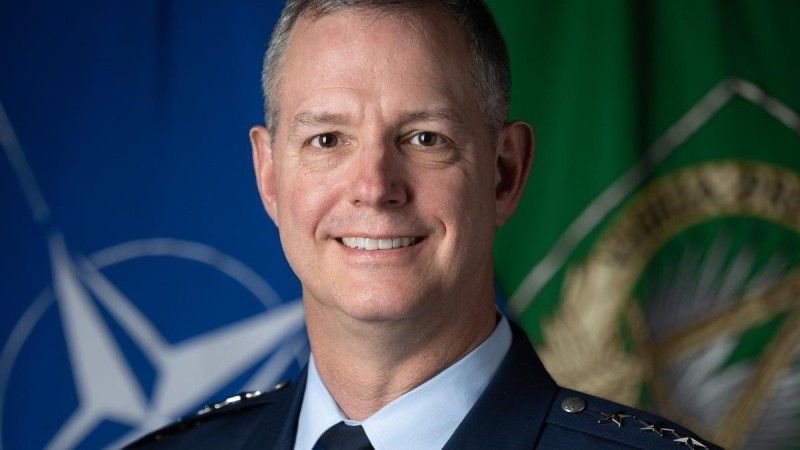
Photo. SHAPE NATO
„We know what actions to take regarding the Kaliningrad Oblast. We have plans prepared,” General Alexus G. Grynkewich, Supreme Allied Commander Europe (SACEUR) and Commander of U.S. European Command (EUCOM), told Defence24.pl. The interview was conducted aboard the aircraft carrier HMS Prince of Wales during the Neptun Strike exercises.
Defence24.pl: You are relatively new in the post of NATO’s top commander. What challenges do you identify for the Alliance in the coming year?
Gen. Alexus Grynkewich, Commander, Allied Forces in Europe: There are always a multitude of challenges in a position like this. I think we are watching very closely some activities we have observed in Europe related to hybrid threats. We recently had sabotage on the railway in Poland — although we still do not know who is behind it, some have their suspicions. Of course, the problem of unidentified drones in Europe keeps recurring. I think that will be one of the things we watch very closely. And of course, we still have the war in Ukraine. We are observing and supporting President Trump’s objective of bringing that war to an end. However, we are aware that no matter how that war ends, Russia will continue to pose a threat to our NATO allies and we must be prepared for everything that may result from that.
What is particularly worrying in Russia’s actions is their adaptation to a new way of fighting. Many types of Western weaponry have been sent to Ukraine and not all proved as effective as initially thought, and some were quickly figured out by the Russians. How do we maintain the Alliance’s technological edge?
That’s a really good question. We have learned a great deal by observing the conflict in Ukraine and seeing how Western weapons systems from various manufacturers perform in that environment. We are continuously drawing lessons from Ukraine regarding the effectiveness of our weapons, the mass use of unmanned systems, and changes in the character of warfare. Our sister command, Allied Command Transformation, under Admiral Pierre Vandier, has a lessons-learned center located in Bydgoszcz, Poland. That center collects and analyzes findings and then passes them on to other NATO entities. There is a lot of work ahead of us, but we are constantly taking action so that we retain the advantage.

Photo. Defence24.pl
In that context, could you point to the directions you consider most desirable in terms of innovation based on Ukraine’s experience?
Certainly. In light of the drone incursions that have recently taken place in Poland, the Baltic states, and Romania, we pay attention to the experiences Ukrainians have shared with us. We test and integrate those experiences and technologies within NATO, and ultimately will implement them so that new systems become part of, among other things, our Operation Eastern Sentry, which aims to provide adequate protection on the eastern flank. This is one of the clearest examples of applying innovations originating from Ukraine.
Is the Alliance currently focused on NATO’s east? In the West some view it that way, for example because of reductions in U.S. presence.
I think the Alliance has always focused where the threat originated. But as the NATO Secretary General has said several times recently, Mark Rutte, today we are all eastern flank countries. The types of threats we see — whether drones or ballistic missiles — can reach anyone in the Alliance, including allies in North America. So, while we are proud of European leadership on the eastern flank, defense requires the combined efforts of all of us.
Now I’d like to ask about logistics in NATO’s eastern area. How do you see logistics during a crisis or war? For example, if Russia decided to attack the Baltic states. And what role will the Baltic Sea play in that phase?
Good question. We have recently conducted several large exercises in which we placed heavy emphasis on logistics — specifically how we would move troops and equipment, both across the continent and over seas and oceans, to reinforce our friends on the eastern flank. The European Union has just presented a military mobility plan, which is a great example of EU–NATO cooperation. We will work to strengthen that area.
As for the Baltic, the Baltic Sea is essential. If you want to move large quantities of goods to the Baltic states, the Baltic Sea is the most efficient way — and we will certainly make use of it, including during crises.
But we have an „unsinkable Kaliningrad.” How do you solve that challenge?
I will not go into details of our military plans or what we would do. But believe me, we have thought through all possible scenarios regarding Kaliningrad and we know how to act at the appropriate time.
I understand. Are we, as an Alliance, ready to face a potential war?
Military professionals will never say we are as ready as we would like to be — we always want to be better. The Alliance has a lot to do. As Ambassador Whitaker said, we must make military spending quickly translate into actual capabilities. Those investments therefore must be made quickly and implemented into the armed forces of various Alliance members. But if we had to fight tonight, we are ready. Absolutely.
Returning to logistics: there is currently debate in Poland about building a central airport, the so-called CPK. What is your view as a NATO commander? Do we need such a large airport? Are current airports sufficient from NATO’s logistics perspective?
I think both things are needed to some extent. Centralization brings efficiency, but in a conflict you must be prepared to disperse and have the ability to operate in a distributed manner. This applies to both airports and logistic routes. We can have a main plan, but we need several contingency plans ready at any time. That builds the resilience of our system as a whole.
Thank you for this conversation.


