












- KOMENTARZ
- WAŻNE
- WIADOMOŚCI
Negotiation of the EU–India free trade agreement

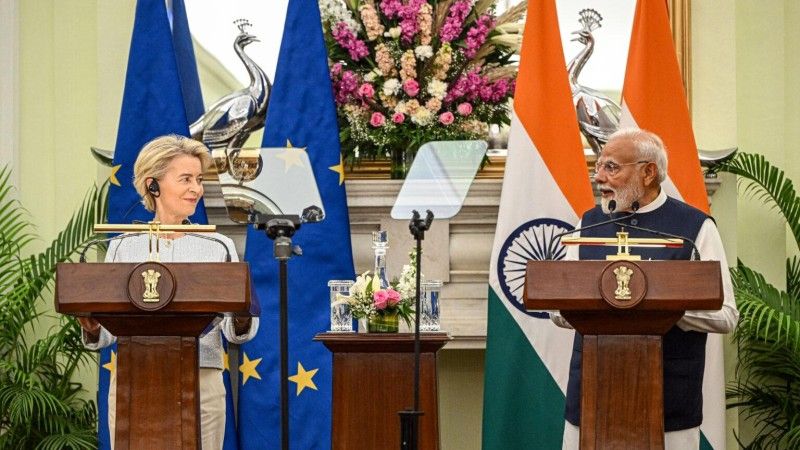
Last week, Brussels hosted another round of negotiations on the Free Trade Agreement (FTA) between the European Union and India. Under the mounting pressure of the Trump administration’s tariff policies, both sides have revived this long-stalled initiative with renewed vigor. There is visible determination in both Brussels and New Delhi to conclude as swiftly as possible. Yet, the European Union’s climate policy and India’s skepticism toward it, remains an obstacle. Despite these differences, officials on both sides maintain that the agreement will be finalized before the year’s end, a milestone that could inaugurate a new chapter in EU–India relations.
The re-election of Donald Trump and his renewed drive to impose tariffs on foreign products have upended global trade dynamics. India, among the countries hardest hit by U.S. measures (see United States – India: „Tough Guys” in high-stakes negotiations, has responded with a sweeping diplomatic offensive since early 2025, seeking to diversify its partnerships. China was one of the first destinations of this new outreach, signaling a tentative thaw between New Delhi and Beijing. Europe, facing similar tariff-related pressures, also turned outward in search of strategic trade allies to offset potential economic losses. Thus, both parties found reason to resurrect the once-abandoned FTA – a project that had languished for years but now seemed newly relevant. Given that the agreement involves the world’s second-largest economy (the EU as a whole) and the fifth-largest (India, but only if you count the EU as a whole, otherwise it is the fourth-largest), its implications extend well beyond the bilateral sphere.
The idea of a comprehensive trade pact between the EU and India dates back nearly two decades, to a very different geopolitical climate. The 2006 EU–India Summit set the stage for negotiations, which began the following year at the working level. The proposed deal aimed to cover a vast range of issues—from trade in goods and services, to mutual investments, customs, competition, intellectual property, sanitary and phytosanitary measures, and sustainable development.
Ambitious though it was, the process soon bogged down in political and structural disagreements. India’s long-standing protectionism, exemplified by high tariffs on European cars, wines, and food products, clashed with EU demands for greater market access. Meanwhile, New Delhi pushed for visa liberalization for Indian citizens; unacceptable for several member states. Intellectual property rights, particularly pharmaceutical patents, became another flashpoint. By 2013, after years of gridlock, negotiations werede facto suspended.
The ascent of the BJP offered a glimmer of hope for revival, but progress remained largely rhetorical – an exercise in „bureaucratic optimism.” Over time, human rights clauses proposed by certain EU members further complicated matters, transforming an already difficult process into a diplomatic labyrinth. Although the FTA occasionally resurfaced in annual summits, concrete progress was elusive.
The geopolitical realignments triggered by Russia’s 2022 invasion of Ukraine renewed interest in the agreement. European firms withdrawing from Russia began eyeing India as a new growth frontier, while India – careful not to alienate Moscow – sought to balance its stance by deepening ties with Brussels. Still, the momentum proved insufficient for a true breakthrough.
It was Trump’s tariffs agenda that ultimately jolted both sides into action. In February 2025, European Commission President Ursula von der Leyen and Indian Prime Minister Narendra Modi publicly committed to concluding the FTA by year’s end. Negotiating teams have since met with unprecedented regularity, culminating most recently in the fourteenth round of talks held in Brussels from October 6 to 10, by Indian delegation led by Piyush Goyal, Minister of Commerce and Industry. „Official optimism” has once again taken hold. AsThe Hindu quoted an unnamed EU official: „I can’t imagine a scenario where we’re not close to or have not concluded the FTA at the end of the year.”
Some long-standing disputes, such as those over intellectual property, have seen partial resolution. Others, like worker mobility and visa regimes, remain contentious. New challenges have also emerged, primarily centered on the EU’s climate agenda. India has voiced strong objections to the Carbon Border Adjustment Mechanism (CBAM), which will impose levies on imports from carbon-intensive producers outside the EU starting January 1, 2026, and to the Corporate Sustainability Reporting Directive (CSRD), which mandates detailed environmental, social, and governance (ESG) disclosures. The EU, however, shows no sign of retreating from these pillars of its Green Deal, while India seeks safeguards for its domestic industries.
For now, political optics and the appeal of announcing a historic pact before the year’s close may well drive both sides toward compromise. Yet, as with all trade agreements, the true impact will lie in the fine print—where the balance between economic ambition and environmental accountability will ultimately be struck.


