












- ANALIZA
- WIADOMOŚCI
SCO Summit – powerful photos and “The World is One Family.”

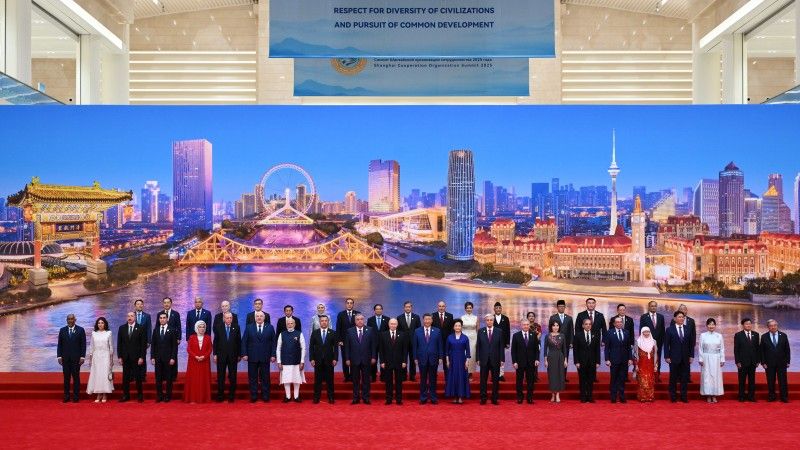
„百闻不如一见” – „It is better to see than to hear it a hundred times” says an old Chinese proverb. The leaders of the countries gathered at the Shanghai Cooperation Organization summit in Tianjin, China, behaved as if guided by the very spirit of this proverb. Images of the leaders engaging in friendly conversation spread across the world, above all those of the most prominent figures in the group — Xi Jinping, Narendra Modi, and Vladimir Putin. But also of Recep Tayyip Erdoğan, Alexander Lukashenko, Masoud Pezeshkian, and Kassym-Jomart Tokayev. Putin riding a car with Modi. Leaders gathered around Xi. Such images from Tianjin were seen across the globe.
The Tianjin summit was the largest in the organization’s nearly quarter-century history. Armenia, Azerbaijan, Belarus, Cambodia, China, Egypt, the Maldives, Myanmar, Vietnam, Laos, India, Indonesia, Iran, Kazakhstan, Kyrgyzstan, Mongolia, Nepal, Pakistan, Russia, Turkey, Tajikistan, Turkmenistan, Uzbekistan, and Malaysia were represented by their respective heads of state or government. In addition, António Guterres, Secretary-General of the UN; Kao Kim Hourn, Secretary-General of ASEAN; and Sergey Lebedev, Secretary-General of the Commonwealth of Independent States (CIS). It was a truly impressive gathering of leaders. Media outlets from around the world not only shared photos but also listed the names and countries present at the summit, which made a strong impression.
At the conclusion of the summit, a joint declaration was adopted that included India’s proposed guiding principle,”One Earth, One Family, One Future,” which refers to the Indian concept of”वसुधैवकुटुम्बकम्” –”The World is One Family.” The declaration also contained a condemnation of the terrorist attack in Pahalgam, which was considered a success for India but posed a problem for Pakistan, which also participated in the summit. In addition to the declaration, many other documents were signed to strengthen cooperation within the SCO, including on combating terrorism, new technologies, artificial intelligence, and multilateral trade.
In terms of public relations, the summit was a huge success for many countries. For China, which strengthened its role as the leader of an alternative bloc to the West. For Russia, which is breaking the isolation resulting from its aggression against Ukraine. Lukashenko’s participation should also be considered in this context, although he certainly didn’t play a leading role in Tianjin, but was nevertheless welcomed with honors. India also noted successes – in addition to its significant and visible influence on the final declaration, it managed to block the full accession of Azerbaijan, a close ally of Pakistan, to the SCO. Modi publicly called on Putin for „peace in Ukraine”, simultaneously emphasizing his country’s exceptionally close ties with Russia.
Modi, playing a key role in Tianjin, simultaneously promoted India’s BRICS presidency in 2026 and the accompanying summit in India. He cannot afford a repeat of the July recent meeting in Rio de Janeiro, where Xi and Putin were absent. On the other hand, China prefers the SCO, where it plays a leading role, to BRICS, which—thanks to India as well—is structured in such a way that no single member dominates the others.
One of the main topics of the summit was, of course, the United States and Donald Trump’s initiative to impose tariffs on individual countries. The message of the leaders gathered in Tianjin was unequivocally anti-American and, more broadly, anti-Western. They demonstrated unity in the face of Washington’s pressure, emphasized excellent relations with Putin, who is unacceptable in the West, and visibly strengthened cooperation within the SCO amidst slogans about the „Global South”. Trump’s policies have already led to a warming in Sino-Indian relations, which – as evidenced by the series of concessions made to India in Tianjin – was very important to China. De-dollarization and the transition to local currencies, or, in China’s version, the yuan, was also one of the summit’s themes.
The question arises, however, as to how much of these pictures and declarations will translate into real cooperation among SCO member states, and how much will be limited to powerful imagery intended to impress commentators, and above all, Trump himself. Conflicting interests among those gathered were temporarily hidden. It’s worth noting that many of the countries present in Tianjin – India, Kazakhstan, and others – usually pursue multipolar policies, and strong declarations toward some countries are often countered by equally strong ones toward others. This will likely be the case this time as well.
The summit was intended to showcase the strength of China, India, Russia, and the „Global South.” And it did, at least in photographs. This is a powerful asset in negotiations with the United States, and it will certainly be used.
Author: amb. Adam Burakowski


