












- ANALIZA
- WIADOMOŚCI
Will the best Czech T-72s be sent to Ukraine? [Analysis]

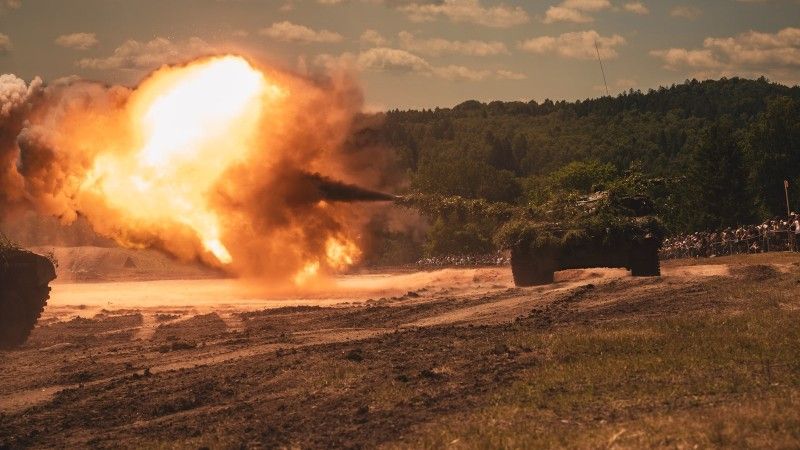
The Czech General Staff will recommend that the government transfer T-72M4 tanks to Ukraine. This follows a media storm over the tanks« overhauls and upgrades, which are due to be completed this year.
Starting from the beginning: on 2nd October, the Czech outletNovinky published an article criticizing large expenditures on the „modernization” of T-72M4 tanks, arguing that spending was ill-timed given Prague’s acquisition of modern Leopard 2A8s and receipt of Leopard 2A4s. The article pointed out that both the Ministry of Defence and the Czech military had previously classified these vehicles as obsolete and in need of replacement by newer platforms, namely the German Leopards. Opposition MPs joined the critique, accusing the current ministry leadership of wasting public funds.
In response, the Czech Ministry of Defence issued a statement noting that the decision to proceed with work on the T-72M4s was made long before the full-scale war in Ukraine and long before the offer to procure Leopard 2A4s from Germany. The ministry emphasized that the upgrade and overhaul decision was taken at a time when the army lacked funds to buy new vehicles, and that modernizing existing equipment was the only viable way to keep the armoured force operational.
Plans were eventually scaled back to a minimum option limited to the refurbishment and shallow modification of the T-72M4 tanks (and the VT-72M4 CZ recovery/support vehicles). Halting the process now, after much of the work has already been carried out, sizeable advance payments made, and required components procured, would itself be wasteful. The ministry’s statement concluded that, after audits assessing how the modernization funds were spent, Chief of the General Staff Karel Řehka intends to recommend transferring the tanks to Ukraine in line with the country’s security interests.
The contract referenced by the Czech MoD and the media was signed in 2020 with VOP CZ and covered only overhauls and shallow modifications of 30 T-72M4CZ tanks (including three command variants) and three VT-72M4 CZ ARVs. Its value at the time was stated as PLN 183.15 million. Under the contract, the vehicles were not only to be restored to operational condition but also to receive replacements for discontinued components, for example, parts of the fire-control system, and new communications systems. The upgrades were intended to keep the tanks serviceable at least until 2030.
The 2020 decision to refurbish them was urgent: most of the fleet was non-operational or lacking full capability, which had sharply reduced the readiness of the Czech land forces. The situation was so poor that Prague simultaneously reactivated about 20 older T-72M1s from storage to rapidly restore the army’s training capacity. Those T-72M1s were later among the last to be handed over to Ukraine.

Photo. Adam Hauner / Wikipedia
It’s worth noting that the decision to refurbish the T-72M4s and reactivate the T-72M1s followed the failure to acquire „interim” tanks that would have modernized the fleet and allowed retirement of the older T-72M1s. Prague considered either the Israeli M60T Sabra (a deep modernization of the M60A1) or used Spanish Leopard 2A4s (which had reportedly also been proposed to Poland). The Spanish Leopards were, however, in such poor condition that both the Czechs and the Poles abandoned the idea. (Some of those Spanish tanks subsequently entered Ukrainian service after extensive overhauls.)
Thus, in 2020 the Czechs were left with 30 T-72M4s scheduled for return to full operational status by 2025 and roughly 86 T-72M1s (possibly including some T-72Ms) held mainly in equipment reserves. Funds were insufficient to change course quickly. The Czech defence procurement focus also shifted toward procuring successors for the DANA 152 mm self-propelled howitzer (model 77) and for BVP-1/2 infantry fighting vehicles.
It should be remembered that, until a decade or so ago, Prague envisaged modernizing somewhere between 100 and 300 tanks to the T-72M4 standard, but those plans were cancelled due to budget cuts. The limited scope of the eventual modernization left many Czechs: the cost did not appear commensurate with the capability gains, though that higher price was driven in part by carrying out work on a far smaller batch than originally planned.
Fast forward to 2022: the Czech Republic was probably the first country to send T-72M/M1 tanks to Ukraine after the Russian invasion. These came from Czech deep storage reserves, further depleting Prague’s modest stocks. In several batches, roughly 40 tanks were sent to Ukraine. Germany sought to fill the resulting gap by offering Prague 14 Leopard 2A4s and a single Bergepanzer 3 recovery vehicle under the Ringtausch program.
The offer was accepted (noting that Czech aid to Ukraine began many months before the German Ringtausch concept was developed). The Czechs later sent additional T-72 batches, bringing the total to 62 by April 2023. In February 2024 Germany again offered Ukraine 14 more Leopards 2 and another Bergepanzer 3 in exchange for Czech military assistance; Prague was also given the option to buy an additional tranche of those Leopards (but without recovery vehicles).

Photo. Czech Armed Forces/X
A contract valued at €161 million was signed in December 2024, closing the book on Czech procurement of Leopard 2A4s to replace donated T-72M1s. Deliveries are scheduled through the end of 2026. The vehicles, some sourced from Switzerland, are intended as interim platforms (to be held in reserve and used for reservist training), with the Leopard 2A8 being the Czech Army’s long-term main battle tank. That procurement encountered some bumps, but by early September the program had been brought to conclusion. Meanwhile, the last T-72M1s were phased out and sent to Ukraine.
Viewed in that light, the domestic media uproar in the Czech Republic was poorly founded. Work on the T-72M4s began years ago, and stopping it now solely because Leopard 2A4s and A8s have been obtained would be irrational on multiple levels. The T-72M4s remain useful to the Czech Army until all used Leopard 2s are delivered (at least 23 of the 42 purchased Leopards have been received so far). Delivery of the new A8s will still take several years.
So, will the best Czech T-72M4 tanks, together with VT-72M4 CZ ARVs, likely be sent to Ukraine? The military will make that recommendation, but it is unclear how politicians will respond. Recent elections brought a new governing party with a markedly different stance toward support for Ukraine, so a refusal to transfer additional tanks is plausible. If politicians reject the transfer, the vehicles are expected — in line with prior forecasts — either to be placed in deep reserve or sold (for example to an intermediary who might later pass them on to Ukraine).

Photo. Adam Hauner / Wikipedia
The T-72M4 is a Czech modernization of the Soviet T-72M1 developed between 2003 and 2006 by Israel’s Nimda, Italy’s Finmeccanica-Selex Galileo, and Czech VOP CZ. The program focused on improvements to firepower, mobility and survivability to bring the tank closer to contemporary Western systems. The main armament remained the 125 mm smoothbore 2A46M gun, paired with a 7.62 mm PKT coaxial machine gun and a .50-calibre NSW heavy machine gun mounted on the turret roof. The modernization included the Selex Galileo TURMS/T fire-control system.
Explosive reactive armour modules (DYNA, DYNamic Armour) were fitted to the hull and turret front, significantly increasing protection against single shaped-charge warheads. The upgrade also added automatic fire-suppression and CBRN protection systems. The original W-46 diesel (780 hp) was replaced with a western Perkins Condor CV 12 1000 TCA diesel producing 1,006 hp, mated to an Allison XTG-411-6N automatic transmission. This enabled a top speed of 64 km/h at a combat weight of about 48 tonnes.

Photo. Radek Vršecký/ CC BY-SA 4.0


