- WIADOMOŚCI
- WYWIADY
Navantia's Submarine Ambitions: AIP Tech And Export Plans

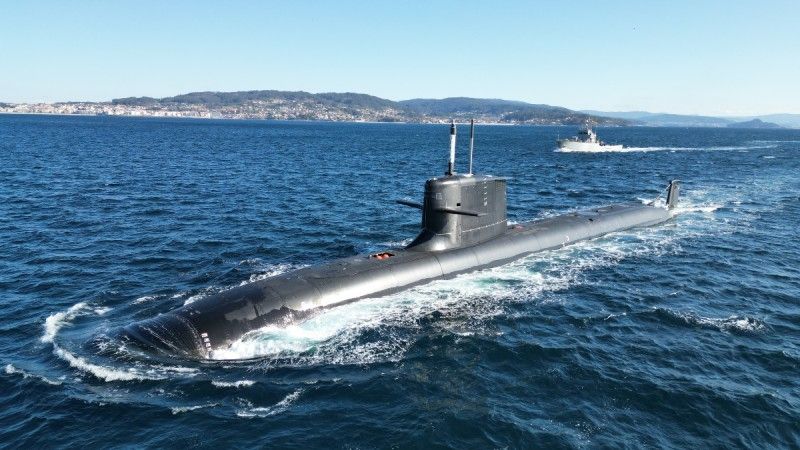
Photo. Armada / X
Navantia will soon reach a major milestone deliver a second Isaac Peral-class submarine to the Spanish Navy. Despite this success, the shipyard is not resting on its laurels. Long-term plans are being formulated to ensure the continued development of the S-80 Plus project.
I recently had the pleasure of interviewing Commander Fernando Aguirre Pastor of the Spanish Navy (Armada). The Commanding Officer of the Spanish submarine Narciso Monturiol (S-82) for the duration of the sea trials gave a detailed overview of the capabilities offered by the brand new Isaac Peral-class. Needless to say, Spanish sailors are eagerly awaiting the delivery of three more boats to complete the transformation of their submarine force.
In anticipation of the launching ceremony of Narciso Monturiol I took the opportunity to talk with Jose Luís Saez Hernández, Submarine Business Development Manager at Navantia. Their naval shipyard in Cartagena is tasked with building all four boats of the class. We discussed the progress of the S-80 Plus programme, as well as Navantia’s long-term development plans and their search for export opportunities, both in Poland and in other parts of the world.
Programme on track
Antoni Walkowski, Defence24.pl: Jose Luís, what is the current stage of the S-80 Plus programme? Are deliveries to the Armada proceeding on schedule?
Jose Luís Saez Hernández, Submarine Business Development Manager, Navantia: We are at a decisive and very special moment. The S-81 Isaac Peral submarine, the first of its class, has already completed operational qualification and is fully operational under the Spanish Navy to fulfil our national defence and international commitments. Meanwhile, the S-82 has begun setting its systems for operation, and we plan to launch this summer. The S-83 is currently in the construction and integration phase, and we can highlight the embarkation of the AIP system in section 3. According to the baseline agreed with the Spanish Navy, the program’s main milestones are expected to be achieved.
Cosme García (S-83) will be the first ship of the class to be fitted with AIP. Is this going to influence the delivery date?
As indicated previously, the milestones of the S-83 are being achieved as planned, in line with the baseline. Navantia has considered the unique aspect of the integration and testing of the AIP system, incorporating a full section test in a simulated operational environment for a final system integration verification prior to joining the hull sections. Nevertheless, it is worth noting that the testing phase for the third unit is anticipated to be slightly more extensive compared to that of the S-82 due to the incorporation of these additional verifications.

Photo. Navantia
At what stage will Isaac Peral (S-81) and Narciso Monturiol (S-82) be refitted with BEST AIP? Will this process involve cutting the pressure hull?
S-81 and S-82 will be refitted with BEST AIP in their respective first overhauls. It is worth noting that both are already fitted with the structural and LOX tanks. Although the AIP system has been designed to be embarked and disembarked through the logistic hatch, all the options have been evaluated, and we will follow the most efficient alternative when this time comes.
BEST is unique in that it uses bioethanol as a source of hydrogen to power the fuel cells. Why was this system chosen over other methods of H2 storage?
Third-generation AIP systems break the diving endurance limitation of former generation systems by embarking liquid fuel instead of pure hydrogen stored in heavy metal hydrides, dramatically increasing energy density onboard and avoid the complexity of managing gaseous hydrogen. Shipbuilders have been working on several third-generation AIP concepts based on different liquid fuel options: methanol, ethanol and diesel.
In general, reforming to produce hydrogen with alcohol fuel is known to be more durable and robust in comparison with hydrocarbon fuels such as diesel, which need to be ultra-pure for efficient reforming. Methanol is less energy dense than ethanol, which makes it easier to reform. However, methanol is known to be highly toxic and carcinogenic, so it becomes a safety hazard in case of accidental spillage or leakage.
Navantia selected bioethanol as the fuel for its AIP system due to its strategic, operational and environmental advantages over alternatives. Bioethanol is organic, safe, easy to manage, cheap and readily available worldwide, making it logistically superior and more sustainable. It is liquid at ambient temperature and pressure, simplifying refuelling without specialised infrastructure. This choice also aligns with Navantia’s commitment to innovation, energy sovereignty, and environmental sustainability.

Photo. Navantia
Specialised tools
How did the sailors adapt to the NAVANTIS digital training system? How useful was it for them prior to Isaac Peral being launched?
NAVANTIS provides the Spanish Navy with a highly valued advantage: a cutting-edge, immersive training environment that enhances crew readiness for S-80 submarines. The Spanish Navy appreciates its ability to simulate real operational conditions using advanced virtual technologies. This not only improves the quality of training and safety but also reduces costs and vessel use. NAVANTIS is the most effective way to familiarize crews with the S-80 submarine before advancing to platform (SIMPLA) and tactical (SIMTAC) simulators for training in operational procedures.
Isaac Peral (S-81) is now commissioned in the Armada. What kind of feedback are you receiving from the end users?
The S-81 crew have highlighted the excellent depth control of the submarine through the Steering & Diving Control System (SDCS) and the great performance of the Integrated Platform Management System (IPMS). They also speak positively of the Integrated Combat System (ICSC) that provides superior situational awareness and tactical advantages. This advanced system integrates cutting-edge sensors, weapons, and command and control functionalities, ensuring optimal performance in different operational scenarios.
The submarine’s Sonar Suite, which was developed by Lockheed Martin, is another standout feature praised by the crew, offering exceptional detection and tracking capabilities.
The S-80 Plus class is being offered for export, not just in the Orka programme. Can you disclose which submarine tenders Navantia is participating in?
In addition to the Orka programme, export opportunities in new markets are opening. Navantia is participating in short-term programmes of interest such as the Canadian Patrol Submarine Project (CPSP). We are also evaluating potential long-term opportunities not awarded yet in other countries in Europe, Asia and Middle East.
Long-term development
Does Navantia have a plan to develop and further improve the S-80 Plus for export customers? Are you planning to integrate any new weapon systems on these ships?
Indeed. Navantia is already working on the evolution of the S-80 platform that focuses on enhancing specific capabilities like Special Forces Operations. However, this is not a separate export project, but rather a continuous evolution of the same S-80 platform, already proven at sea. Because of that, Poland can leverage the existing production line to accelerate and de-risk the Orka programme.
In 2020 Navantia announced the Balit project, which aimed to substitute the existing Tudor lead-acid batteries with LFMP cells from Saft. Is this ongoing?
The Balit project laid the groundwork for Navantia’s ongoing evaluations. Navantia is now assessing the installation of lithium-ion batteries (LIB) in combination with the BEST AIP system in the future evolution of the S-80 platform, provided that these enhancements meet customer requirements. Navantia is working closely with different potential LIB suppliers. This evaluation aims to further improve the submarine’s performance, endurance, and operational capabilities, ensuring it remains at the forefront of technological innovation.

Photo. Armada / X
What are your competitive advantages in international tenders? Does the S-80 Plus have a selling point that no other AIP submarine can match?
I would like to highlight the BEST AIP system and core systems like IPMS (Integrated Platform Management System) or ICSC (Integrated Combat System Core). From my point of view they are the most valuable equipment of the S-80 submarine. The third-generation AIP system, developed by Navantia, reduces the indiscretion ratio (IR) to zero for weeks, enhancing the submarine’s stealth. Moreover, the high level of automation on board significantly reduces the crew size, ensuring the safe management of all onboard systems.
Is the S-80 Plus integrated with or capable of operating unmanned underwater vehicles?
Navantia and the Spanish Navy are working to equip the S-80 submarines with the capability to deploy unmanned underwater vehicles (UUVs). Thanks to the weapon handling equipment and open architecture systems, implementing these vehicles on board will be relatively easy. This capability was not initially included in the Spanish Navy’s requirements for the S-80 Programme, but it will be implemented in the short term according to their operational needs.