- ANALIZA
- WIADOMOŚCI
Tilting at windmills. Polish president takes up political fight in green transition

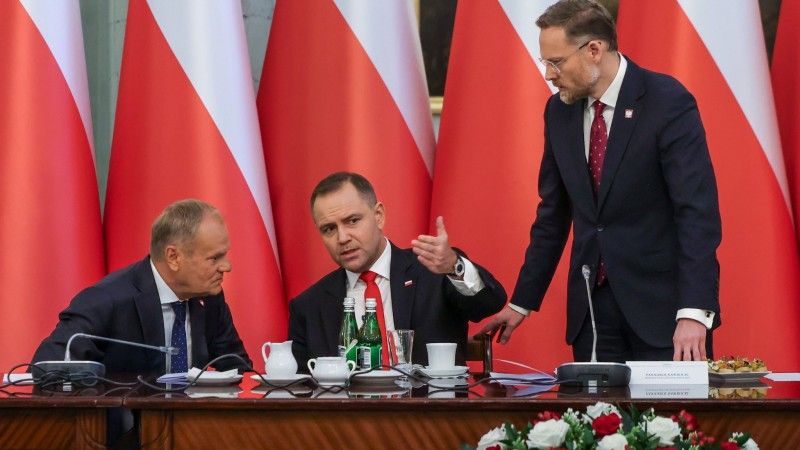
Polish President Karol Nawrocki vetoed the long-awaited amendment to the wind farm law, which aimed to accelerate the development of onshore wind energy in Poland. The energy law has become a political battleground, with substantive and technical arguments taking a back seat.
The Wind Farm Act, adopted in 2016 during the Law and Justice (PiS) administration that supports the current president, introduced the so-called 10H rule. Among other things, the Act established a minimum distance between wind turbines and residential buildings equal to ten times the height of the turbines, including the blades. This solution effectively froze investments in wind turbines in Poland. In early 2023, an exception was added to the rule, allowing turbines to be constructed at a minimum distance of 700 meters.
The neverending story of wind energy law
In November 2023, the Civic Coalition and Third Way parties submitted a draft amendment to the wind farm law to the Sejm, lower house of the Polish parliament, sparking much controversy. The issue of possible expropriations for wind turbine construction aroused the most emotion. Although legal discussions on the real possibility of expropriations remain unresolved, the issue has sparked considerable controversy.
The issue of amending the Wind Farm Act resurfaced in 2025. The amendment abolished the 10H rule, which was introduced in 2016, and stipulated a minimum distance of 500 meters between wind turbines and buildings. The minimum distance a turbine could be installed from the border of a national park was 1,500 meters, and from specific Natura 2000 areas, it was 500 meters.
This restriction applied to areas designated as Natura 2000 sites, which were created to protect bat and bird habitats. Some local communities expressed concern that the turbines would be too close to their homes.
The ruling coalition did everything in its power to ensure the passage of the wind farm bill, which is necessary for energy security. An amendment was introduced to the bill concerning the creation of a participatory fund. Participants in this fund would be owners and co-owners of buildings and residential premises located within 1,000 meters of newly built turbines. Therefore, the wind farm operator will be required to contribute 20,000 PLN to the fund for each 1 MW of installed wind turbine capacity.
Political move went wrong
Meanwhile, the ruling coalition resorted to political blackmail by adding a provision to the wind farm law amendment that freezes electricity prices until the end of the year. Former Polish President Andrzej Duda called this behavior „blackmail,” and the opposition PiS party strongly condemned the political move.
The current president, Karol Nawrocki, has begun using boxing rhetoric in the Presidential Palace. Throughout his presidential campaign, Nawrocki criticized the European Green Deal, declaring at the same time that he wants to protect the environment and acknowledging global warming. He also promoted Polish coal as an essential energy resource and criticized the growth of renewable energy sources. Therefore, it should come as no surprise that he vetoed the amendment to the wind farm law, thereby strengthening the PiS voter base ahead of the upcoming parliamentary elections.
”Many people in Poland, including social activists, protested against this law. I stand with society, not with those who want to mix energy prices with lobbying activities. Clearly, people do not want wind turbines near their homes. Reducing the distance to 500 meters is not socially acceptable,” declared President Karol Nawrocki.
Need for wind
”The president’s decision is disastrous because it means that people living near wind farms will not benefit from the participatory fund that has been created. The law was accepted by local communities and municipalities, and it addressed the challenges of the transition,” declared Energy Minister Miłosz Motyka.
The law guaranteed that the final decision on the construction of a wind turbine (at a distance of 500 m or more) belonged to the municipal council—the administrative body closest to the residents« needs. „It did not force anyone to build wind farms,” he pointed out. Moreover, according to the latest poll, 64 percent of Poles support onshore wind energy.
Additionally, the wind farm bill has gained significant support from Polish business and labor groups. They have confirmed that Polish companies require low energy prices, which can be achieved in the long term through increased investment in onshore wind energy. Polish companies supply 60 percent of the sector’s supply chain. Famur offers its own wind turbine gearboxes. The company recently purchased a license to manufacture entire turbines and plans to replace European suppliers, such as those in Germany.
The government is currently trying to circumvent the presidential veto by repowering existing wind farms and expediting environmental decision-making for contracted wind farms. Technical changes can be made inside the turbine to increase its power by up to 30 percent.
Although many commentators argue that energy, like defense, should be kept away from political disputes, it seems that in Poland, energy has now become a main element in the battle between political opponents. It is a hot potato being passed from hand to hand, and the citizens and economy of this rapidly developing country stand to suffer the most. This is about energy security, after all.