












- WIADOMOŚCI
A brand new phenomenon. Finnish lawyer on mysterious tankers and their anchors

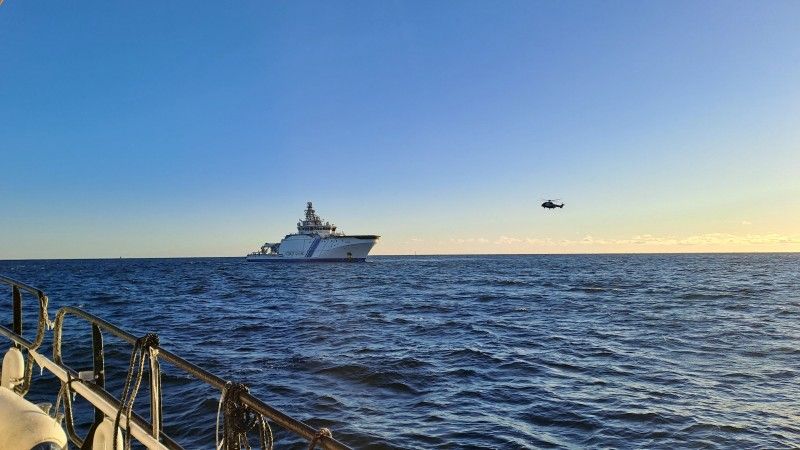
Photo. @Merivartiosto/X.com
There are undeniable similarities between the Eagle S and Fitburg cases. Both ships have left Russian ports and dragged the anchors behind, which damaged the sea infrastructure. The key issue is whether Finland had criminal jurisdiction in the matter and in Fitburg case, law enforcement authorities must first examine specifically where the alleged acts were committed, professor Tatu Hyttinen from University of Turku commented for Defence24.com.
When asked whether the Fitburg case would end like the Eagle S, Professor Hyttinen stated that it was not a foregone conclusion, and the Eagle S issue itself had not yet been finally resolved. On Christmas Day 2024, the tanker Eagle S, sailing from St. Petersburg, damaged submarine telecommunications and power cables between Estonia and Finland, dragging its anchor behind it.
More mysterious damage
The vessel was detained by Finnish authorities, and charges were brought against its officers. However, a Helsinki court dismissed the proceedings, ruling that Finland had no jurisdiction over the case because the suspected crimes occurred within Finland’s exclusive economic zone, outside Finnish territorial waters.
As Professor Hyttinen explained, the Eagle S case is not legally binding – it will now be up to higher courts to determine whether Finland has jurisdiction in the matter. A year after the Eagle S anchor incident, a very similar situation occurred involving the Fitburg, which also sailed from St. Petersburg – on New Year’s Eve, December 31, 2025. The crew of this cargo vessel consists of citizens of Russia, Kazakhstan, Azerbaijan, and Georgia, and the ship sails under the flag of Saint Vincent and the Grenadines. This ship – just over a year after the Eagle S incident – also dragged its anchor, damaging a cable belonging to the Finnish operator Elisa. As reported by the Polish Press Agency (PAP), the incident occurred in Estonia’s exclusive economic zone. The ship was brought towards the southern coast of Finland, near Helsinki.

Two members of the Fitburg crew were arrested by Finnish authorities, and two others were banned from traveling. The investigation is being conducted in cooperation with Estonia.
But this isn’t the end of the mysterious infrastructure failures in the Baltic Sea in recent days. On Sunday, January 4th, Latvian authorities reported damage to a fiber-optic cable in the Baltic Sea belonging to a private operator and running to Lithuania. The cable between latvian Liepāja and the Lithuanian town of Palanga may have damaged a ship, which, according to the armed forces, passed the infrastructure and then changed course, Latvian investigators reported. Neither the ship nor the crew have been detained so far, but police are not ruling out any scenario, also investigating the case for deliberate destruction or damage to the public telecommunications network, as reported by the PAP.
Brand new phenomenon
In thie Fitburg case, law enforcement authorities must first examine specifically where the alleged acts were committed. And this, for example, may differ from the Eagle S case. In other words, each case is unique, and it is not possible to conclude from the Eagle S case alone how the Fitburg case should be resolved.
Tatu Hyttinen
Maailman paras viranomaisyhteistyö toimii saumatta kaikkina aikoina ja kaikissa oloissa.
— Rajavartiolaitos (@rajavartijat) January 3, 2026
Rajavartiolaitos käynnisti toimet Fitburg-aluksen pysäyttämiseksi. Raja jatkaa poliisin vedenalaisen tutkinnan tukemista erityisosaamisella ja -kalustolla.
Video: Poliisi ja RVL pic.twitter.com/caFbNsVsvd
„In both cases, the issue at hand is specifically a matter of criminal law (such as aggravated criminal damage) rather than a military operation. In other words, this is being investigated as a normal criminal case, even though the act itself is atypical,” he added.
When asked how the authorities of Finland and other countries situatedy by the Baltic’s coast should respond to incidents that could be linked to hybrid warfare, he stated that „At least in international waters, it is more difficult to intervene in criminal matters (and therefore states do not necessarily have the authority to seize a ship, for example)”. He added that it is obvious that we are currently dealing with a completely new phenomenon: dropping anchors.
If we assume that this is not a case of damage but rather some kind of hybrid operation, criminal law may have a role to play. But perhaps it is justified to try to prevent this kind of activity in advance. And, of course, for the sake of prevention, it may be justified to engage in cooperation between states (the Baltic countries, Poland, Finland, Sweden, Denmark, and so on), as is apparently already being done.
Tatu Hyttinen


