












- WIADOMOŚCI
- ANALIZA
Paris burns after PSG


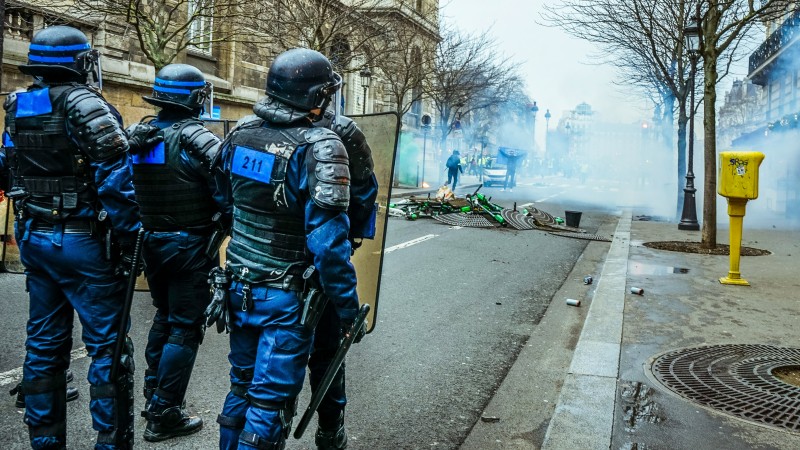
The riots in Paris after Paris Saint-Germain’s Champions League victory should not be reduced to football emotions. Burning cars, hundreds of arrests, clashes with police and thousands of officers on the streets are not an accident in the life of the French capital. They are another sign of a deeper urban crisis in which major sporting events, New Year’s Eve, protests and national celebrations can quickly become a stage for violence, criminal networks and street gangs.
The scale was serious. Around 20,000 people gathered on the Champs-Élysées, cars were set on fire, shops and restaurants were damaged, the Paris ring road was blocked, and police had to prevent further escalation around symbolic locations such as the Parc des Princes and central Paris. French authorities deployed thousands of officers, but still recorded hundreds of arrests across the country, including a large number in the Paris region. This is why the problem cannot be described as a few „excited fans”. In Paris, a mass gathering increasingly becomes a cover under which different actors can operate: hooligans, local criminal groups, young men seeking confrontation, and people who use chaos to attack the police or destroy property.
This violence has a geography. It is linked to areas, rivalries and micro-territories inside the city. Names such as RD4/4FP in Beaugrenelle, Balard/Modigliani-Balard, Riquet/Stalingrad, Curial-Cambrai/Michelet, Scène 13 around Porte d’Italie and Corvisart, or drug networks around Rosa Parks, Porte d’Aubervilliers, Goutte d’Or and Château Rouge show that Paris has a real infrastructure of street violence. These are not necessarily mafia-style organisations with a clear hierarchy. They are fluid, territorial, youth-based or drug-linked environments. Their strength lies in presence, mobility, local reputation and the ability to use violence quickly.

The mechanism is always similar. A football victory, New Year’s Eve or a protest creates the crowd. The crowd creates anonymity. Anonymity creates opportunity. In this environment one can attack the police, burn a car, film the act, steal, settle a local rivalry, disappear into the group and later turn the footage into street reputation. This is why fireworks, knives, cars, police lines and social media become part of the same urban ritual. Violence is no longer only destruction. It is also communication.
The drug dimension is equally important. In parts of north-eastern Paris, the street is not only a public space. It is a market. Where crack, cocaine or heroin are sold openly or semi-openly, control of the pavement means control of money. And where money depends on territory, violence follows. This is why drug networks must be analysed together with youth gangs and hooligan groups. They all benefit from the same conditions: weak control over specific micro-zones, rapid mobilisation, distrust of the police and the possibility of hiding inside a larger crowd.

France is now discussing facial recognition, fan zones and restrictions on the sale of fireworks. These measures may help during large events, but they will not solve the root problem if the state does not break the mechanisms that produce violence: illegal migration that is not properly controlled, failed integration, social dependency without responsibility, local criminal economies, drug markets, the culture of impunity in crowds and the normalisation of burning cars as a political or social ritual. When a state accepts disorder, does not penalise it effectively and loses control over parts of urban space, it becomes the victim of its own hesitation.
Paris still remains a global capital of culture, tourism, luxury and sport. But there is also another Paris: one of knives, gangs, drug points, burnt cars and young men who treat confrontation with the police as a form of public identity. The problem is not that violence sometimes happens. The problem is that it has become predictable. Match, celebration, New Year’s Eve, protest — and again the same images. France can deploy more police each time, but unless it restores authority, controls migration, dismantles street economies and punishes violence consistently, Paris will continue to live between postcard beauty and ritual fire.


