












- WYWIADY
- WIADOMOŚCI
Russia, China and Iran could strike simultaneously. Europe would be at the centre of the crisis [INTERVIEW]

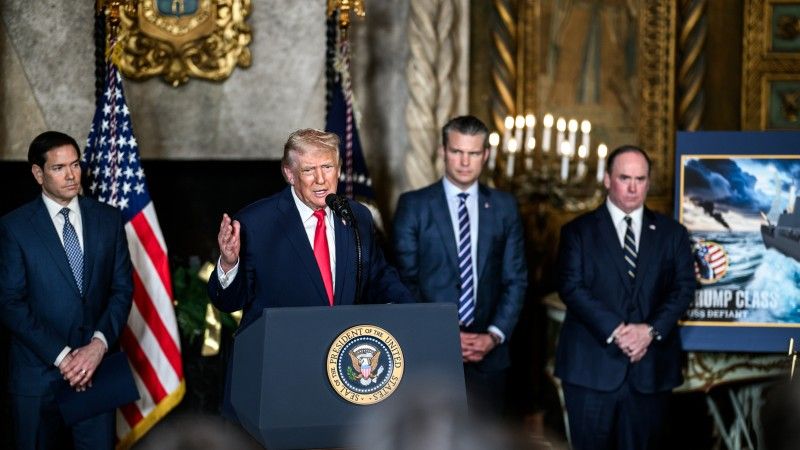
Photo. Daniel Torok / White House
Russia, China and Iran are no longer three separate threats, but increasingly form a coordinated axis that could trigger simultaneous crises in Europe, the Middle East and the Pacific. An overstretched U.S. Navy could ultimately be forced to choose which ally to defend, Capt. James Fanell, former Director of Intelligence for the U.S. Pacific Fleet, tells Defence24.
U.S. Navy's warship count has been cut in half
Jędrzej Graf: I’d like to begin our discussion by looking at the situation in the Middle East through the lens of your extensive experience. Here in Warsaw, our focus is understandably on Ukraine, but we are seeing an increasingly strong connection between the conflicts in the Middle East, Russia’s actions and developments in the Pacific. What are the key linkages here, and what are the implications of events in the Middle East and Iran’s activities for the Pacific region and for our part of Europe?
Capt. James Fanell (Ret.): The most important link between Iran and the Pacific is the impact on the United States Navy as a global force. It raises a fundamental question of scale: do we have enough capacity to be in two or three places at once? Do we have enough aircraft carriers, enough destroyers and, importantly, enough missiles in our storage facilities?
From my perspective, the strategic point is that this situation exposes and exploits the reduced size of today’s U.S. Navy. When I was commissioned in 1986, the United States Navy had roughly 600 ships and submarines. Today, we struggle to maintain even 300. Over the course of 40 years, we have effectively cut the U.S. Navy in half while the Chinese navy has continued to expand.
The Chinese navy has undergone the fastest expansion in modern naval history, going from a brown-water coastal force to the largest navy in the world. Yet despite this dramatic reduction in the size of our own fleet, we have not reduced our global commitments. We are still trying to cover the Middle East, Europe, and the Pacific with half the assets, and as a result, we are stretched to the breaking point.
Following on from that, cutting the fleet from 600 ships to 300 represents an enormous structural shift. How did we reach this point of vulnerability?
We have to look at the post-Cold War period. After World War II, we built a comprehensive national-security system—with institutions such as the Office of Net Assessment—designed to look 30 years into the future and ensure that we would never again be caught by surprise. That system was focused on peer competitors. But after 1990, the dominant idea became the “end of history.” Both political parties pursued the so-called peace dividend.
We began closing bases and, more importantly, shutting down shipyards that had provided us with reserve industrial capacity. During the 1990s, maintenance, repair, and overhaul costs began rising sharply as the infrastructure aged and contracted. Then 9/11 happened, and for the next two decades our strategic priorities shifted almost entirely toward land-based counterterrorism and special operations.
The Navy was treated as a “transportation service” or as a provider of strike assets for joint land-attack operations. Our military-industrial complex lost its long-term maritime focus and became obsessed with immediate, low-intensity conflicts. We essentially forgot that the United States is, at its core, a maritime power dependent on free access to the seas. That neglect has left us with an industrial base that is now unable to keep pace with our competitors.
The “Jointness Tax” weakened the U.S. Navy
Politically, it seems that the neoconservatives were so confident in U.S. hegemony that they believed our existing capabilities would be sufficient, while China quietly built up its own. Has this doctrine of “jointness” actually undermined the Navy’s service-specific requirements?
The Goldwater-Nichols Act of 1986, although intended to improve coordination, ultimately imposed a “jointness tax” on the Navy. It gave the Army and Air Force equal, and in some cases dominant, influence over naval requirements. For 30 years, those of us serving in the Pacific submitted assessments warning that the threat from China was growing rapidly.
Those warnings were not simply about the number of hulls. They also concerned advanced technologies and cognitive warfare. Pacific-focused requirements were frequently overlooked within the Pentagon hierarchy because they did not fit the land-centric narrative of “jointness.” Today, we are paying the price. We are now unable to effectively secure a critical maritime strategic line of communication such as the Strait of Hormuz, even against a non-peer adversary.
Instead of pursuing a proactive maritime strategy, we have entered a defensive, zero-defect political era. The fear of losing a single ship or several hundred sailors prevents us from seizing the initiative. That lack of political will, combined with shrinking resources, means we operate reactively rather than from a position of dominance. We have lost the edge that defined the U.S. Navy’s presence for decades.

Photo. Mehr News Agency (CC BY-SA 4.0)
The Middle East is weakening deterrence against China
Looking specifically at the Middle East, how are current force deployments affecting our ability to deter China?
Every day that USS Gerald R. Ford or another carrier remains on an extended deployment in the northern Arabian Sea is a day taken out of that ship’s service life. Scheduled maintenance and training cycles are deferred, creating enormous backlogs and degrading sustainment across the fleet. The Ford’s recent deployment of more than 300 days was an extraordinary feat of endurance, but it leaves a major hole in future readiness.
China is watching this very closely. They understand our maintenance cycles just as well as we do. They see our carriers tied down responding to Houthi drones or threats from Iran. That reinforces their belief that a “window of opportunity” is opening for action against Taiwan. Our deterrence posture in the Pacific is effectively being weakened by these extended regional commitments.
If we cannot manage a regional crisis without exhausting our global carrier fleet, then we lose the ability to project power where it matters most. The cascading effects of these deployments will be felt for years as our ships enter prolonged maintenance cycles that our limited shipyard capacity already struggles to handle. Our adversaries exploit these distractions for maximum strategic advantage.

The “Golden Fleet” and the crisis facing U.S. shipyards
How do you assess the “Golden Fleet” programme intended to rebuild the Navy, and is the U.S. defence industrial base actually capable of supporting expansion on such a massive scale?
The announcement of the “Golden Fleet” initiative in late 2025 marked the first time since Reagan that a president had made the Navy a priority as a primary instrument of national power. Moving oversight of shipbuilding to the Office of Management and Budget under Russ Vought represents a major bureaucratic shift. It means shipbuilding is now a presidential mandate, rather than simply a Navy request.
The proposed $1.5 trillion increase over ten years is intended to rebuild infrastructure that was lost during the 1990s. But the reality is that we have only about seven shipyards capable of building major warships, while China has dozens. That industrial imbalance is our single greatest vulnerability. You cannot simply “print” new ships when you do not have the dry docks or the skilled workforce to build them.
That is precisely why we are seeing a push for “allied shipbuilding” with partners such as Japan and South Korea. Hanwha’s involvement in the Philadelphia Naval Shipyard is an essential first step. We have to leverage our allies’ industrial capacity to bridge the gap while we rebuild our own domestic shipyards. This is a race against time, and it will require enormous and sustained investment.
Large warships have not become obsolete
When it comes to the Chinese threat, some still argue that large warships are obsolete in the age of drones. What types of ships should the United States focus on, and how do you assess China’s technological progress, particularly its aircraft carriers such as Liaoning and Fujian?
The idea that drones make large warships obsolete reflects a misunderstanding of geography. The Pacific is not the Black Sea; distances there are measured in thousands of miles. You cannot maintain sustained military superiority across those distances with small drones alone. We need capital ships, destroyers with deep magazines and aircraft carriers with enough resilience to operate in contested environments.
Look at China’s progress. They started with Liaoning, which they purchased from Ukraine under the pretext of turning it into a “floating casino.” They studied it, rebuilt it, and used it to master carrier operations. But they did not stop there. They built Shandong, and now they have Fujian, equipped with electromagnetic aircraft-launch systems, or EMALS.
That technology had previously been exclusive to our Ford-class carriers. They are also building the Type 076, an amphibious assault ship designed to operate drones and likewise equipped with EMALS. They are integrating drones into a fleet of large warships, not replacing those ships with drones. Moreover, they are ahead of us in missile technology; their supersonic and hypersonic anti-ship missiles are both more advanced and more numerous than our subsonic Harpoon missiles.

From your perspective, why might China decide to conduct a military operation against Taiwan within the next two or three years, and how is that reflected in its defence spending?
Xi Jinping has been very clear about achieving the “Great Rejuvenation of the Chinese Nation” by 2049. He sees “reunification” with Taiwan as an absolute prerequisite for achieving that goal. If they wait until the 2040s, they run the risk of a failure that would overshadow the centenary celebrations. Acting within what I call the “Decade of Concern” from 2020 to 2030, the Chinese Communist Party wants to ensure that any decision to use military force around 2030 leaves the People’s Liberation Army enough time to accomplish the mission, and enough time for the rest of the world to forget about it, just as the West moved on after Tiananmen Square and later flocked back to Beijing to watch the opening ceremony of the 2008 Olympics.
Their spending reflects that sense of urgency perfectly. While U.S. military budgets have fluctuated, China has consistently increased its defence spending by roughly 7–8 percent annually for three decades. They have prioritised the People’s Liberation Army Navy as the principal instrument of their global influence. They are producing four or five warships for every one we build, creating an enormous numerical advantage.
One noteworthy approach they are pursuing is the “Anaconda Strategy.” It is a slow strangulation designed to strip Taiwan of its sovereignty incrementally, day by day. Since 2020, they have crossed the “median line” and used the China Coast Guard to assert that these are internal Chinese waters. They employ cognitive warfare to convince the Taiwanese that U.S. assistance is too far away to matter.

Photo. Wang Yu Ching / Office of the President of the Republic of China / Flickr
What would the geopolitical consequences be if the United States and the West were to “lose” Taiwan?
It would be a strategic catastrophe of the highest order. Taiwan is the “unsinkable aircraft carrier” of the First Island Chain. If China takes control of it, its nuclear-powered attack submarines—its SSNs—would gain immediate, unimpeded access to the deep waters of the central Pacific. That would fundamentally alter the security calculus for Japan, the Philippines, and even Hawaii.
Economically, more than 50 percent of global container traffic passes through the Taiwan Strait. If Beijing can turn it into a “toll road” or close it at will, it will effectively hold the global economy hostage. There would be a domino effect as regional allies concluded that the U.S. security umbrella had collapsed. The entire postwar order in the Pacific would disappear virtually overnight.
Losing Taiwan would also mean losing critical semiconductor infrastructure, delivering a major blow to Western technology and defence industries. This is not simply about a small island; it is about the gateway to the Pacific and the future of global maritime trade. Without Taiwan, the United States would be pushed back to the Second Island Chain and beyond, and in doing so would lose its status as a Pacific power.
Is there a possibility that conflicts involving Russia, China, and Iran could be synchronised in order to overwhelm the U.S. response?
I am convinced of it. We are no longer dealing with three separate problems; we are facing a coordinated axis. Xi Jinping is the “puppet master” behind this alignment. China provides the dual-use technologies and financial support that allow Russia’s war machine in Ukraine to continue operating. They are the silent partner in the destruction of Europe’s security architecture.
At the same time, China is the principal buyer of Iranian oil. That revenue directly funds Houthi and Hezbollah attacks that tie down our Navy in the Middle East. They are deliberately creating a multi-theatre dilemma for the United States, knowing that our current 300-ship fleet cannot be everywhere at once. It is a strategy of exhaustion and overstretch.
They want us so depleted, and our ammunition stocks in Europe and the Middle East so drawn down, that we have nothing left for the Pacific. By synchronising these crises, they force Washington into impossible choices about which allies to abandon. It is a sophisticated, global-scale operation designed to break American hegemony through a thousand cuts, both large and small.
See also 

Finally, looking at U.S. policy, do you see pro-Navy sentiment growing to the point where the “Golden Fleet” initiative can be sustained?
That sentiment is growing, but I worry about its long-term durability. President Trump is leading this initiative, but you do not build a navy in a single presidential term. It requires decades of consistent funding and industrial planning. What we lack today is a modern equivalent of Senator Carl Vinson, a lawmaker with the deep, bipartisan authority needed to protect Navy budgets over a twenty-year period.
We have to stop treating the Navy as discretionary spending and start treating it as the fundamental insurance policy for our nation’s survival. If we do not commit now to a ten-year rebuilding of our maritime power, we will cede this century to China. Political will has to translate into multiyear contracts that give shipyards the certainty they need to expand.
When you pour a foundation, you have to wait years before you can build on top of it. Rebuilding our shipyards and our fleet works exactly the same way. It requires a national commitment that extends beyond election cycles. Without that commitment, the “Golden Fleet” will remain a vision rather than a reality, and our maritime dominance will continue to erode until it is too late.
Thank you very much.
During his active-duty career, Capt. James Fanell served as the senior military intelligence officer for China at the Office of Naval Intelligence. He also served as Director of Intelligence for the U.S. Pacific Fleet and Seventh Fleet, as well as for the Kitty Hawk Carrier Strike Group. Since retiring from active duty, he has authored numerous publications on China and maritime power.


