












- WIADOMOŚCI
Polish satellites launched. The military will gain new capabilities

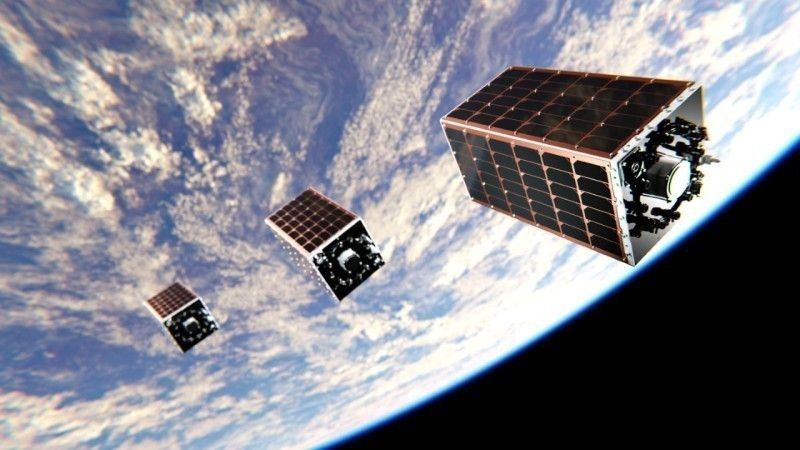
On November 28 SpaceX launched the Transporter-15 mission. A total of 140 payloads were carried aboard the Falcon 9 launch vehicle, including satellites developed by Polish entities. Of particular importance to the Polish Armed Forces is the first radar satellite contracted under the MikoSAR program.
SpaceX’s flagship rocket lifted off at 7:44 p.m. Polish time from the Vandenberg U.S. Space Force Base in California. Aboard the Falcon 9 were: a satellite from ICEYE, a constellation of three PIAST satellites, and one developed by the Wrocław-based company SatRev.
Liftoff of Transporter-15! pic.twitter.com/LJurU40GNP
— SpaceX (@SpaceX) November 28, 2025
According to available information, all satellites developed by Polish entities have successfully established two-way communication with Earth.
A Revolution for the Polish Armed Forces
The satellite developed by the Finnish-Polish company ICEYE is an extremely important payload from the perspective of the Polish Armed Forces. It is the first unit to be in the full, sovereign ownership of the Polish military. It is also the first of three satellites equipped with a Synthetic Aperture Radar (SAR), contracted by the Ministry of National Defence under the MikroSAR program. The agreement was signed in May 2025.
As the lead contractor, ICEYE is responsible for delivering the space segment. WZŁ-1, as a consortium member, will provide the ground segment along with a trailer-mounted satellite antenna. The contract also includes an option for the purchase of three additional satellites and a Mobile Ground Segment. The total value of the contract amounts to PLN 860 million gross.

Photo. POLSA
It is worth emphasizing that ICEYE’s radar satellites can capture imagery with a resolution of 25 cm, regardless of time of a day or weather conditions. This will significantly enhance the versatility and effectiveness of the Polish Armed Forces reconnaissance system, enabling a more comprehensive understanding of the operational situation.
“As for the next satellites, we want them to reach orbit in 2026. (…) We want to deliver more of our satellites to the Polish Armed Forces, but the final decision on this matter is not ours to make. I would like to emphasize that cooperation with the Ministry of National Defence has been exceptionally good. It is a fully engaged partner, aware of its needs and ready to develop them, especially in light of the threats we are observing,” said Rafał Modrzewski, CEO and co-founder of ICEYE, in an interview with Space24 editorial team.

The PIAST Project
As part of the Transporter-15 mission, a constellation of three satellites from the PIAST (Polish ImAging SaTellites) project was also placed into orbit. The PIAST-S1, PIAST-S2, and PIAST-M units were built on the proprietary Hypersat platform developed by Creotech Instruments. The project is led by the Jarosław Dąbrowski Military University of Technology, with consortium partners including Creotech Instruments S.A., the Łukasiewicz Research Network – Institute of Aviation, PCO S.A., the Space Research Centre of the Polish Academy of Sciences, and Scanway S.A.
The PIAST project aims to leverage the potential of cooperation between scientific institutions and private enterprises in developing solutions critical to national security and defense. It is co-financed by the National Centre for Research and Development under the SZAFIR program initiated by the Ministry of National Defence.

Photo. Wojskowa Akademia Techniczna w Warszawie
The satellites will capture imagery of specifically designated targets. “The PIAST mission satellites are equipped with small telescopes, which limits their ability to capture high-resolution images. However, Polish scientists have improved the quality and detail of the data obtained by developing algorithms based on artificial intelligence,” emphasizes the Military University of Technology.
“All key technologies related to the PIAST satellites were developed in Poland. We have control over the entire imaging chain, including the satellites, ground station, data collection center, and processing algorithms. (…) Particularly valuable are the capabilities for precise targeting, determining and predicting satellite positions under GNSS (Global Navigation Satellite System) signal interference, encrypted communications, the use of high-thrust propulsion, and a compact design without deployable mechanical components,” explained Brig. Gen. (Ret.) Adam Sowa, head of the PIAST project on behalf of the Military University of Technology, in an interview with PAP.
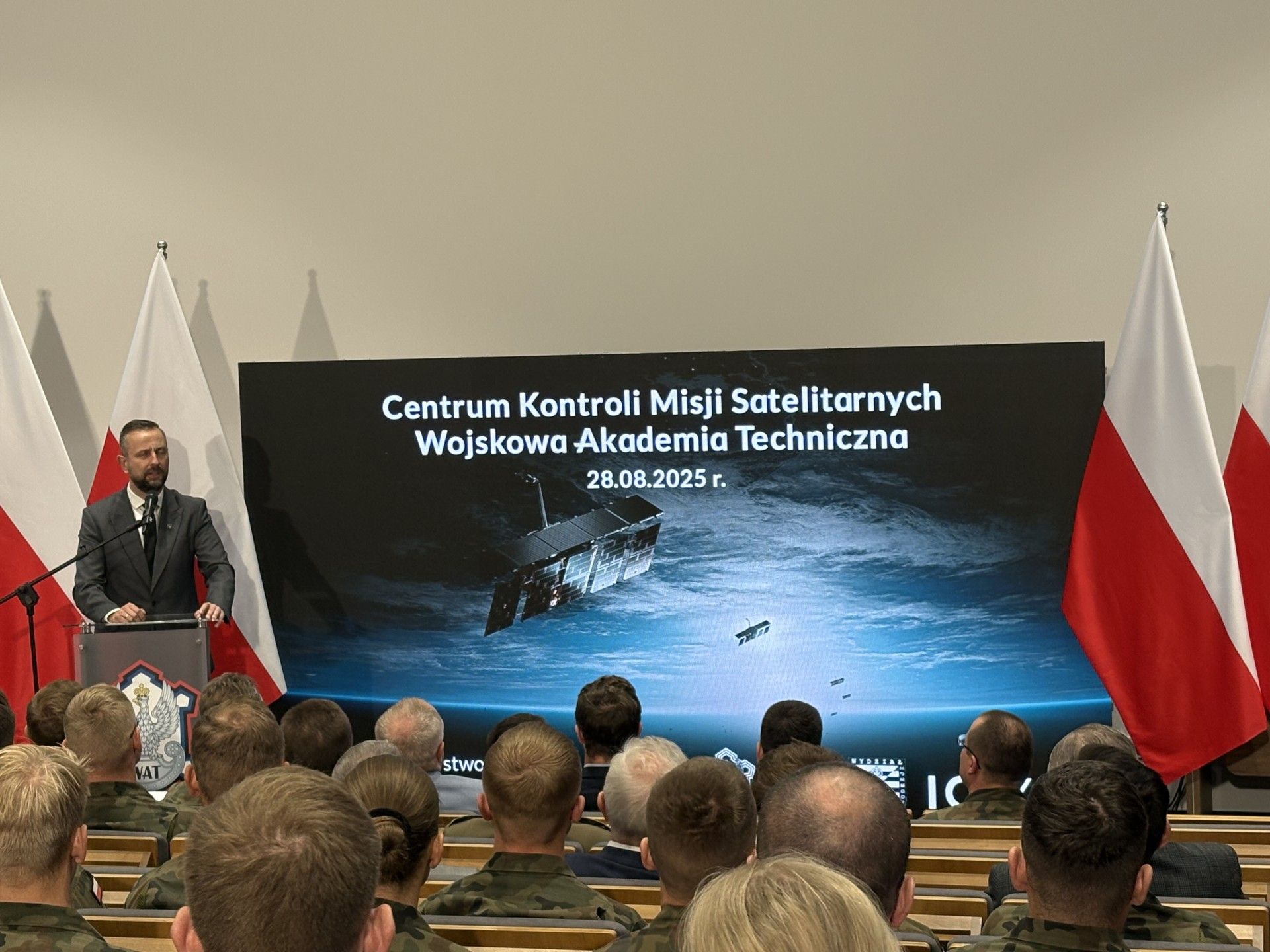
In this context, it is worth recalling that as part of the PIAST project, the Military University of Technology’s Satellite Mission Control Center was also established. The infrastructure enables full autonomy in satellite operations—from monitoring and management to data analysis—without relying on foreign solutions or external entities.
More Polish Contributions to the Transporter-15 Mission
It is worth noting that another satellite developed by a Polish space sector company was also aboard the Falcon 9 as part of the Transporter-15 mission. This was the PW6U nanosatellite developed by SatRev, designed for data collection that can be widely applied—from agriculture and forestry to energy and infrastructure.
Since 2016, SatRev has been developing technologies enabling rapid acquisition and analysis of satellite data, including building its own mission control center in Wrocław, satellite subsystems, and ground stations in Poland and Oman. In total, the company has so far placed several of its own and partner satellites into orbit.
However, this is not the end of Polish contributions to the Transporter-15 mission. It should be noted that for the OTTER mission, organized by the German Aerospace Center (DLR), the company Scanway provided its optical payload. The Wrocław-based firm thus prepared as many as four products for this specific mission. “This is our record. (…) We’re keeping our fingers crossed for all the payloads,” emphasized Jędrzej Kowalewski, CEO of Scanway S.A.
Building Sovereign Capabilities
By the end of next year, additional Polish satellites will reach orbit, including units contracted under the MikroGlob program. The agreement between the State Treasury – Armament Agency and Creotech Instruments S.A. was signed on December 20, 2024. Under this contract, the military acquired four micro-class optoelectronic satellites. The total value of the order amounts to approximately PLN 556.7 million gross.

It is evident that in recent years, Poland has significantly increased its investment in developing sovereign space capabilities. In the face of growing geopolitical tensions and rapid technological progress, this direction is not only justified but indeed essential if the country aims to effectively strengthen its security. Until now, allied capabilities have been the main pillar. That situation is now changing.
There is an increasing emphasis on technologies developed by domestic engineers, which translates into building genuine technological independence. In the coming years, Poland has the potential to become one of the key European nations possessing its own autonomous satellite reconnaissance systems. In the context of the tense situation on NATO’s eastern flank, the presence of Russian forces in Belarus, and the ongoing war in Ukraine, this is particularly significant.


