












- ANALIZA
- WIADOMOŚCI
NATO prepares for PSYOPS [OPINION]

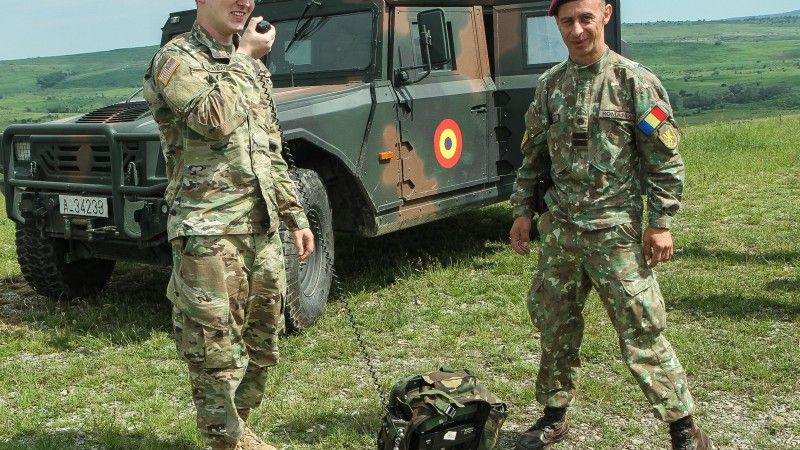
Photo. Sgt. Richard Wooten, 126th Theater Public Affairs Support Element, public domain.
PSYOPS capabilities must be seen as an important element of the defensive system of the Polish state. At the same time, we should consider how certain issues are handled by our allies, but also by adversaries/rivals. That gives a picture of the importance of investing in PSYOPS capabilities in the future, especially in the context of plans to strengthen our Armed Forces. First, let us look at how so-called PSYOPS are approached in selected NATO countries.
When thinking about the contemporary PSYOPS space, we must not forget that we do not operate in a vacuum but in an environment shaped by the activity of our allies as well as potential adversaries/rivals. First of all, it must be stated plainly that within NATO there is a group of states with highly developed PSYOPS toolkits leading the way in developing these capabilities. These include, of course, the United States, and within the European pillar of NATO also the United Kingdom, Germany and Italy. The Americans naturally boast the largest inventory of PSYOPS units, but also the development of doctrinal support and tools, including their digitization. At this point it is worth referring to the official characterization of the PSYOP soldiers the Americans seek and to a specific definition of their mission.
The American path from PSYOPS to PSYWAR
In official messaging it is said that candidates for PSYOPS service are „assessed and selected for intellect, critical and analytical thinking skills, adaptive capacity and psychological resilience.” It is recognized that they must be people able to be educated in highly diverse environments, covering influence tools, language, cultural and religious aspects in selected theaters of operations. Today they must understand the dynamics of new forms of communication, hence the ability to influence by classical means (radio, television, leaflets, etc.) but also via modern formats, including social media.
It is worth again citing the official U.S. description, which notes that military personnel engaged in PSYOPS „analyze the operational environment, physical objectives and target audiences; advise on psychological effects; plan influence options; develop activities and messages targeted at psychological vulnerabilities; optimally time actions and messages; and assess the effectiveness of influence. Operating in small, autonomous teams, PSYOP units conduct military information support operations; deception activities in support of objectives designated by the Department of War; support building partner influence capabilities for partner forces; and, at the president’s request, provide informational support to civilian authorities.”
This short public statement highlights the importance of PSYOPS resources for the entire U.S. armed forces, but also more broadly for the state apparatus in the event of a variety of scenarios (from conventional conflict to counter-insurgency (COIN) actions, counter-terrorism and Military Operations Other Than War (MOOTW) — a common category after the Cold War).
The information domain requires U.S. commanders to be flexible, to understand its rules and to be capable of creating their own messages as well as steering/influencing others. In the era of current tensions on the U.S.–Venezuela line, it should be noted that lessons from the post-Vietnam era have come from that region, for example attempts to isolate the information battlefield during the invasion of Grenada (1983) and later Panama (1989). The pinnacle of these capabilities naturally became the ability to control messaging during the Gulf War in 1990–91 and the first phase of Operation Iraqi Freedom in 2003 (later messaging, e.g. due to the emergence of new media such as Al Jazeera and new channels of strategic-level communication, was contested).
Most importantly, in analyzing the approach of this power, one sees that the Americans are doctrinally continually evolving alongside the new needs of the operational and information environment. In recent years they prepared to conduct Military Information Support Operations (MISO) at every level, from tactical to strategic. Regarding MISO, the U.S. Army clarified that MISO „involve providing selected information to foreign audiences to influence their emotions, motives, reasoning and behavior of governments and citizens. This may include cyberspace activities and advanced communication techniques via any media.” It was also specified that this may include deliberately deceiving enemy forces during combat (deception) using a range of PSYOPS tools. Currently the U.S. uses the term PSYWAR (Psychological warfare), which today has joined PSYOPS, MISO, earlier efforts to win „hearts and minds,” and still earlier classical elements of wartime propaganda from the world wars.
Note that it was not by chance that the U.S. Army perspective was discussed: it is the ground forces and the Special Operations Forces (SOF) that derive from them which possess the most significant PSYOPS/PSYWAR resources in the United States. Interestingly, in 2024 the PSYWAR School was reactivated (originally the John F. Kennedy U.S. Army Special Warfare Center and School). It is said that the PSYWAR School trains and qualifies U.S. Army Psychological Operations (PO) personnel for missions associated with special operations worldwide. It is added that this is the only such qualifying course in military occupational specialties (MOS) under the Department of War. Thus, the PSYWAR School trains and qualifies all military personnel in PSYWAR.
Importantly, this concerns operational military resources and a developed reserve pool intended to strengthen PSYWAR if forces are expanded. Curiously, should new needs arise, for example in the U.S. Navy, certain PSYWAR capabilities could appear there, though they are not as visible as in the land forces (note the Naval Reserve Atlantic Fleet PSYOP Audiovisual Unit). Regarding the U.S. Air Force, note the existence of the 193rd Special Operations Wing stationed at Harrisburg International Airport (Pennsylvania), which provides the only airborne platform for psychological operations in the Department of War, using EC-130J Commando Solo aircraft.
Returning to the U.S. Army, let us focus briefly on active units only, indicating two groupings (according to the current situation, although with forthcoming changes within the U.S. land forces, changes in PSYWAR units are also highly likely):
- 4th Psychological Operations Group (Airborne), which includes: 4th Psychological Operations Battalion (Airborne), 3rd Psychological Operations Battalion (A) (Media Dissemination Battalion), 6th Psychological Operations Battalion (Airborne), assigned to the geographic command European Command (EUCOM), 7th Psychological Operations Battalion (Airborne), assigned to the geographic command African Command (AFRICOM), 8th Psychological Operations Battalion (Airborne), assigned to the geographic command Central Command (CENTCOM).
- 8th Psychological Operations Group (Airborne), including: 1st Psychological Operations Battalion (A) — supporting Southern Command (USSOUTHCOM), 5th Psychological Operations Battalion (A) — supporting Indo-Pacific Command (USINDOPACOM), 9th Psychological Operations Battalion (A).
It should also be added that the Americans have the ability to rapidly reinforce PSYWAR forces with reserve units that were called up, for example, for operations in Iraq and Afghanistan. In the event of a major conflict, the U.S. therefore has the ability to expand its PSYWAR operations. This is one of the undisputed challenges for our country as well, being aware that a crisis or war may require us to develop and quickly incorporate national military PSYOPS resources.
Germany and information warfare
The Germans have placed their PSYOPS capabilities within the Zentrum für Operative Kommunikation unterstützen die Operationsführung (ZOpKomBw). Germany is distinguished by a much more restrictive approach to operation-related issues in this area, which is undoubtedly a consequence of historical experience and the specifics of the political system’s control over the armed forces. According to the official description, ZOpKomBw military personnel support operational commands at national and international levels for various deployments of Bundeswehr units. It is noted that „like a civilian media structure, the ZOpKomBw team analyzes the population situation in deployment areas and engages target groups using printed, audio, video and other materials, including online channels. As part of a direct communication strategy, the Centre conducts planned and targeted conversations with local populations to achieve desired effects.”
To this end, these specialists possess comprehensive knowledge of communication objectives and understand local cultural circumstances and the specific communication habits of target groups. This enables the Bundeswehr to use the information environment as a military operational space. Assigned support tasks include disseminating information about soldiers via radio and maintaining soldier morale through television programs.” The unit’s tools also include Radio Andernach and the Bundeswehr-TV channel (BWTV). On the German side one sees a focus primarily on information (operative kommunikation) and creating potentially positive messaging during deployments in environments that may face hostile disinformation campaigns.
However, one must remember that German resources are highly professional and visible in the NATO space. It is even argued that the German component may today be the most important element for such activities in the European NATO area.
Italy's vision of aPSYOPS unit
In the Italian Armed Forces the focus is primarily on forces concentrated in the 28º Reggimento „Pavia,” which is part of the Brigata Informazioni Tattiche. This tactical formation is unique because its potential is built around PSYOPS and operational communications (comunicazioni operative) in the information domain, but it also contains elements related to intelligence (HUMINT and IMINT) and electronic warfare (EW). Again, one can observe that in many NATO countries there is an adaptation of how PSYOPS assets are positioned to the national vision of integrating tools from multiple domains. The Italians emphasize synergy between informational and cognitive warfare, broadly supported by intelligence capabilities, EW and cyber.
Official information refers to an operational communications battalion (comunicazioni operative) composed of several companies. Italian troops are capable of conducting activities with classical communication means, including press, radio and TV, but also new Internet-based forms of communication. Italian PSYOPS, like those of other countries discussed, have many deployments as part of foreign missions where Italian contingents have been present. However, the Italian side is considerably less inclined to boast about its capabilities and is much more laconic in specifying details related to information-domain tools. One can speculate that the proximity of PSYOPS to intelligence and EW tasks does not help transparency regarding the activities of the 28º Reggimento „Pavia.”
France wants to win battles before they are fought
Equally interesting is the French approach to PSYOPS, which, like Germany and the United Kingdom, frames its activities through the prism of operations in the information domain and influence operations (opérations militaires d’influence). It should be noted that for France the information domain is one of the key new spaces for state activity and tools and institutions are being created accordingly. Beyond the military, one example is VIGINUM, the French service for monitoring and protecting against foreign digital interference, which has confronted, for example, Russian influence operations at critical moments for France. Within the French armed forces, since 2012 a key role has been reserved for Le Centre interarmées des actions sur l’environnement (CIAE).
Interestingly, CIAE for several years sought its place between intelligence and cyber, ultimately falling under the specialist Commandement des actions spéciales Terre (CAST). CIAE’s resources are dedicated at tactical, operational and strategic levels. The French note that „contemporary conflicts in the world show that wars are also won through the state’s capacity to influence. Recognized as a strategic function in the 2022 National Strategic Review (Revue stratégique nationale), »influence« (l’influence) allows one to affect perception during operations through knowledge and understanding of the information and human environment.” This ties into the popular French saying about having the capacity to „win the war before the war.” Thus, for the French it is necessary to view holistically the capabilities of special operations forces, CIMIC, cyber and influence forces — or, in simpler terms, PSYOPS. In this last case, the emphasis is rather on the concept of „lutte informatique d’influence (L2I) et la formation à l’influence.”
CIAE, as officially indicated, uses experts in information-combat fields in influence, information environment analysis, but also multimedia production, psychological actions and civil-military relations (CIMIC). A three-part cycle is described: CIAE is tasked with learning, analyzing and understanding the information and human environment for operations; then CIAE must trigger effects that influence attitudes and behaviors through impacting perceptions; and finally CIAE must train soldiers designated for influence activities, pass on knowledge about information warfare within the armed forces, and raise decision-makers« awareness of the importance of these concepts. The latter element is worth emphasizing because it has great significance for any armed forces. Above all, because our own troops are and will be in the orbit of hostile operations in the information domain. Not to mention the growing need to raise awareness of these issues among components responsible for command, and in the political decision-making space of national defense.
Looking at the U.S., it is also worth pointing to another NATO country whose soldiers already serve in Poland: the United Kingdom. In this case the core of PSYOPS capabilities is the 77th Brigade Information Operations. However, an important caveat should be noted: the British prefer to use the term Information Operations, and they also refer to influence and to military strategic effects. In any case, the British do not hide that by investing in the 77th Brigade’s IO capabilities they seek the necessary adaptation to warfare under new information-domain conditions. They note that „war is evolving dynamically, and the ability to compete in the information space is key. We must develop our capabilities and find new ways of operating to confront our adversaries.” Note that the tactical formation discussed is a hybrid unit composed of regulars and reservists with specialist skills for operating in the information environment.
The armed forces are officially and explicitly assigned the following objectives: the ability to build partnerships and also to conduct operations beyond the state’s borders; capabilities with respect to the information environment and the development of means to obtain advantage in that space; the identification, development and conduct of information operations, independently or in cooperation with partners, in order to gain advantage over actual or potential adversaries; and audience analysis to ensure the most effective actions supporting military objectives. It should be noted that the British side emphasizes a very important aspect of activity in the information domain, which points to the synergy between PSYOPS units and intelligence structures. It is stated plainly that, quote, „by using intelligence to understand audiences and systems, to analyse networks and identify intelligence opportunities, the Brigade has a range of means to achieve effect.” In short, when looking at PSYOPS one must also see the cyber domain and a number of elements relating to the state’s intelligence and counterintelligence capabilities and those of its armed forces.
Within the 77th Brigade attention is drawn to the 5 Information Operations Task Force, whose soldiers are the most expeditionary and have the ability to deploy Planning and Liaison Elements and, most importantly, Tactical PsyOps teams—supporting operations of the United Kingdom’s armed forces as well as allied/coalition operations in the tactical PSYOPS space.
The 5 IOTF is made up of professional soldiers and officers from all services and all branches who are trained to use unconventional equipment, processes and techniques in order to exert targeted forms of pressure on the United Kingdom’s adversaries. The second element of the Brigade is the 101 Information Operations Task Force (101 IOTF). Members of 101 IOTF are recruited by seeking experts in: photography, video and post-production, journalism, marketing and communications, media relations, disinformation, influence, and also media monitoring. Increasingly indispensable are experts with knowledge of social media, digital content creation and online influence activities—especially as the military faces growing requirements to respond to changes in information technologies, including the use of, for example, AI tools.
Ukrainian military intelligence has reported adding sixteen people to the list of propagandists. Its composition is said to include: 201st Company, which fields a specialist-hybrid subunit covering OSINT collection, data innovation and digital information activities (per the unit description). It is officially stressed that it is highly trained in online communications, security and analysis. The soldiers serving there are characterized by language skills and cultural knowledge. 202 Company is a specialized hybrid subunit producing high-quality video, audio and graphic materials. Interestingly, it is said bluntly that „drawing on a wide range of creative skills from regular soldiers, reservists and specialist reserve soldiers, it is a creative agency in uniform.”
Another important element is the 6 Military Intelligence Battalion—also a hybrid unit supporting the 77th Brigade but also the Army Special Operations Brigade and the 6th (UK) Division. Its presence is intended to provide the intelligence support necessary for planning and conducting unconventional and information operations. In this case audience analysis is performed in the information domain, as well as analysis of systems and the entire information environment. Importantly, they have a cell for conducting OSINT (open-source intelligence).
A change in mindset is a must
In conclusion, we must remember that having well-developed PSYOPS/PSYWAR resources today is undoubtedly an element that cannot be omitted when constructing armed forces, primarily because of the new operational environment. This is happening in an increasing number of NATO countries, although it must be honestly stated that not all of them are well prepared for the new requirements of the information domain, and, narrowing the focus to PSYOPS/PSYWAR/information activities themselves, military potential within NATO states often revolves around tactical problems rather than higher-level considerations. That said, soldiers (and civilian experts as well, their importance in the information domain is huge) are compelled to respond simultaneously in the cognitive, virtual and real dimensions. At the same time, the complexity of the information domain must be increasingly recognised, where achieving interoperability between PSYOPS, CIMIC, cyber, intelligence and counterintelligence, and even special operations forces, is essential. It should be remembered that PSYOPS are to a large extent offensive rather than defensive, and thus can produce effective influence on an adversary at relatively low cost.


