












- ANALIZA
- WIADOMOŚCI
Russia bets on drone forces. Will Ukraine lose its edge? [REPORT]

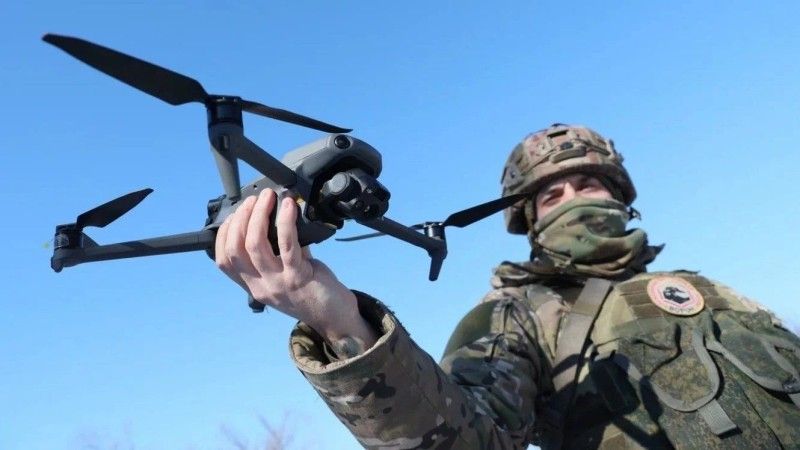
Photo. Russian MoD
The creation of a new branch of armed forces branch in Russia has been heralded for a long time. In the autumn of 2025 it was officially announced that they are already functioning. Yet there is still very little reliable information about the Russian Unmanned Systems Forces.
It is worth starting with history and terminology. Even in Soviet times many types of unmanned flying systems were developed there (Russian: беспилотных летающих аппаратов, abbreviated БпЛА — in Poland commonly called bezzałogowe statki powietrzne, abbreviated BSP). They were used mainly for reconnaissance. After the collapse of the USSR most of them were withdrawn from service and numerous military units that had operated them were disbanded. In the following decades the Russians did not stop working on new types of drones. Those also were mostly intended for reconnaissance tasks, but strike variants were also developed.

Photo. Russian MoD
Until recently, however, they were not mass-produced or widely fielded in the Russian army. At the brigade or division level of the ground forces, the airborne forces and the naval infantry, companies (and sometimes platoons) of UAVs were formed. The number and types of platforms they operated varied, and in some tactical formations these were thinly manned subunits. The only exception was the Navy, which in the Northern Fleet had an entire regiment of that type. This is the 216th Regiment of Unmanned Flying Vehicles (Russian: 216-й полк беспилотных летающих аппаратов), which is garrisoned at the Severomorsk-2 airfield. Organizationally it was part of the 45th Air and Air Defense Army, and now, after organizational changes, part of the 7th Mixed Aviation Corps. It was formed on 1 December 2016 and equipped with medium-range Forpost platforms and short-range Orlan-10s.
Work on unmanned ground and naval vehicles in Russia continued all the time, but without major scale or mass deployments into service. In those domains Russia’s lag behind the rest of the world was most visible.

Photo. Russian MoD
Everything changed with the aggression against Ukraine in 2022. The Ukrainian army, being decisively smaller and theoretically much weaker than the Russian one, very quickly began to use first flying drones, and later surface and most recently even underwater drones on a mass scale. The front in the Russian–Ukrainian war stabilized fairly quickly and both sides moved into positional warfare. Air defences were substantially expanded on both sides of the front, which forced a drastic reduction in combat flights by aircraft and helicopters over areas held by the opponent. This was also caused by the very small number of Ukrainian aircraft capable of flying and operating.
These factors elevated the importance of unmanned systems. Initially, the greatest successes were on the Ukrainian side. Their mass production in Ukraine enabled attacks on an ever larger scale and, above all, on targets located progressively deeper inside Russia. At that stage of the war the Russian army had not developed methods of countering drones, and shooting them down with conventional air-defense systems was often ineffective and, above all, costly.
Over time, the situation in the drone war began to change and the Russians quite quickly made up for their lag relative to the Ukrainians. They began importing drones from Iran, but above all they expanded their own manufacturing industry. Currently both sides of the conflict possess large numbers of unmanned aerial vehicles as well as new methods and means of countering them. Practically every day both sides carry out dozens or hundreds of mutual attacks. Some are conducted en masse, at the same time using hundreds of drones, while others are carried out on a much smaller scale. #PHOTO[ id: 1811336 | desc: Russian Unmanned Systems Forces. ]
Over the last four years Ukraine has also significantly developed unmanned maritime vehicles and has put a lot of effort into unmanned ground vehicle work. On the surface version they have repeatedly attacked Russian afloat targets. Recently Ukraine even used an underwater vehicle to attack a base in Novorossiysk, which struck the quay close to moored submarines. As with aerial platforms, Russia has also intensified its work on maritime and ground unmanned systems. Particularly in the latter field the Russians are testing and publicly showing quite a number of unmanned vehicles.
In Poland and other countries supporting Ukraine the media are dominated by reports and footage of Ukrainian unmanned systems operations. This may give the false impression that the Russians are not doing the same. Meanwhile Russian media continuously show the other side of the conflict, that is, Russian unmanned attacks.
The intensive development of new means of combat has forced organizational changes on both sides. Ukraine created the Unmanned Systems Forces of the Armed Forces of Ukraine (Ukrainian: Сили безпілотних систем Збройних Сил України), and in Russia the Unmanned Systems Forces (Russian: Войска беспилотных систем) were formed.
The newly created Russian Unmanned Systems Forces are a new branch of the military, troops, but not an independent branch like the Airborne Forces or the Strategic Missile Forces. They are a type of troops similar to, for example, the Engineer Troops or the Electronic Warfare Troops. It is not yet known at what level the headquarters directing the Unmanned Systems Forces is placed. Whether it is a command (Russian: Командование) or rather a directorate (Russian: Управление). It is also unknown to whom the commander or head of these forces reports. One can only suppose that he likely reports to the Chief of the General Staff of the Armed Forces of the Russian Federation. The names of the people at the top of these forces are also uncertain. Allegedly the commander is Yuri Vaganov, but he is a civilian, a businessman and the founder of Russian volunteer unmanned forces. His deputy is said to be Colonel Sergey Ishtuganov.
Ultimately, the Russian Unmanned Systems Forces are to combine the activities of all kinds of platforms — flying, surface and ground-moving.

Photo. Russian MoD
Available information indicates that the Russians are organizing a whole range of new units of these forces. The largest among them are independent regiments of unmanned systems (Russian: отдельный полк беспилотных систем), at the military district and fleet level. So far, for example, the following are known:
- 7th Independent Regiment of Unmanned Systems of the Central Military District;
- 65th Independent Regiment of Unmanned Systems of the Leningrad Military District;
- 71st Independent Regiment of Unmanned Systems of the Moscow Military District;
- 75th Independent Regiment of Unmanned Systems of the Southern Military District;
- 77th Independent Regiment of Unmanned Systems of the Eastern Military District.
At a lower level independent battalions of unmanned systems (Russian: отдельный батальон беспилотных систем) are being formed. They are being created, among others, in armies, in airborne division formations and in a tank division that is independent in the Central Military District and does not report to any army. So far, for example, the following are known:
- 1st Independent Unmanned Systems Battalion of the 5th Combined Arms Army of the Eastern Military District;
- 2nd Independent Unmanned Systems Battalion of the 41st Combined Arms Army of the Central Military District;
- 3rd Independent Unmanned Systems Battalion of the 6th Combined Arms Army of the Leningrad Military District;
- 6th Independent Unmanned Systems Battalion of the 25th Combined Arms Army of the Moscow Military District;
- 11th Independent Unmanned Systems Battalion of the 51st Combined Arms Army of the Southern Military District;
- 15th Independent Unmanned Systems Battalion of the 90th Tank Division of the Central Military District.
Some units have already admitted to having such battalions, e.g., the 7th Air Assault Division and the 104th Air Assault Division, but their sequential numbers are not yet known. It is also unknown whether such battalions will be formed in the new naval infantry (marine) divisions.

In divisions and brigades of the ground forces the „old” companies (or platoons) of unmanned „apparatuses” still function. Such subunits, which are not military units in themselves, also operate in other types of formations that are part of the Armed Forces of the Russian Federation as well as in a number of volunteer units operating at the front. It is not yet clear whether they will be developed into the size of independent battalions and whether the word „apparatuses” in their names will be replaced by the word „systems.”
It appears that units at the central level fall directly under the headquarters or directorate of the Unmanned Systems Forces. These include, among others:
- The Rubicon Center for Advanced Unmanned Technologies (Russian: Центр перспективных беспилотных технологий „Рубикон");
- The 924th State Center for Unmanned Aviation (Russian: 924-й Государственный центр беспилотной авиации).
It includes centers — for example, a center for the training of unmanned aviation specialists and a center for research, combat employment and military testing of unmanned aviation.

Photo. Russian MoD
Unmanned systems — called unmanned systems or unmanned platforms in our usage — are undoubtedly the future of warfare. Their development will continue to be rapid and will cover further areas of the armed forces. Advances in electronics and programming (sometimes referred to as artificial intelligence) are currently so great that in the future there will be no wars without the mass use of such systems. Work on ever newer systems for military applications is underway practically all over the world. The current war in Ukraine is unfortunately a vast testing ground for these systems. Many defense companies are closely watching the technical aspects, and many armies worldwide are drawing lessons regarding drone employment tactics and, consequently, their structural organization.


