












- WIADOMOŚCI
Revamped Staatsräson: Merz’s Germany hardens tone on Israel

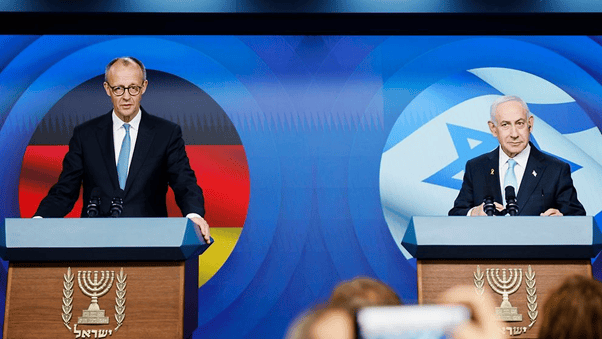
Photo. bundesregierung.de
From “never negotiable” to new red lines: Merz is recalibrating Germany’s historic bond with Israel. Is the era of unconditional support over? Inside Berlin’s major policy shift.
While the German government continues to treat Israel’s security as a cornerstone of its foreign policy, Berlin is adopting a noticeably sharper tone. Chancellor Friedrich Merz has recently warned against a protracted war with Iran, condemned annexation plans in the West Bank, and stated that the scale of civilian suffering in Gaza can no longer be justified under the guise of counter-terrorism.
This shift is particularly notable given that Merz entered the chancellery as a conservative with a deep, instinctive affinity for Israel. To be clear, Germany has not discarded former Chancellor Angela Merkel’s 2008Staatsräson doctrine, which established Israel’s security as „never negotiable.” Both Merz and Foreign Minister Johann Wadephul continue to firmly defend Israel’s right to self-defense and reiterate Berlin’s strategic objective of neutralizing Iran’s nuclear and missile threats. These recent developments, therefore, represent a strategic recalibration rather than a fundamental policy rupture.

On March 6, Merz warned that “an endless war is not in our interest” as the U.S.-Israeli campaign against Iran widened. On March 10, he said there was “clearly no joint plan” to end it swiftly and called annexation steps in the E1 area of the West Bank “a big mistake” that would further damage a two-state horizon.
These were not isolated remarks. In May 2025, Merz said the harm done to Gaza’s civilians could no longer be justified as part of the fight against Hamas and that Germany had to speak out when humanitarian law was violated. Wadephul soon added that Berlin’s historic support for Israel must not be instrumentalised for the conduct of the Gaza war.

Wadephul’s March 10 visit to Israel showed the new dual track. He demonstrated clear solidarity following the recent Iranian missile attacks, which included touring a strike site in Beit Shemesh alongside Israeli Foreign Minister Gideon Sa’ar. Yet, he has simultaneously maintained pressure regarding the humanitarian crisis in Gaza, ongoing settlement expansion in the West Bank, and the escalation of radical settler violence.
While the core tenets of Merkel’sStaatsräson remain fundamentally intact, its practical application has evolved: Germany continues to fiercely defend Israel’s security, but it now draws a sharp distinction between ensuring the state’s survival and granting unconditional approval of its government’s policies.


