












- WIADOMOŚCI
Ukraine: F-16s Fighting Like in World War II

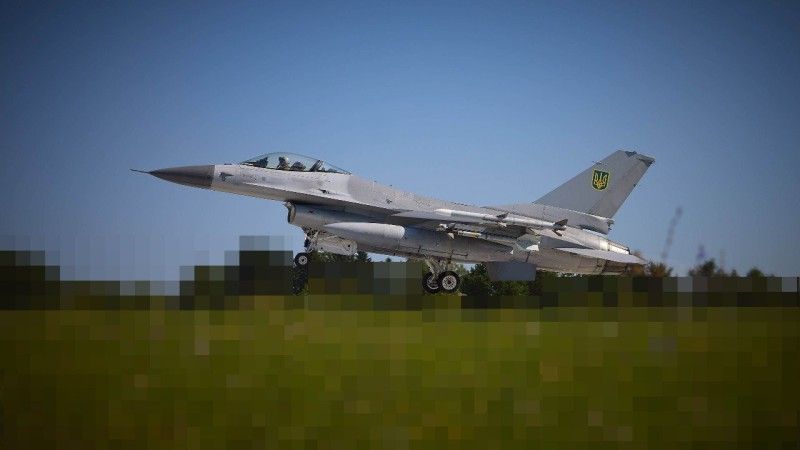
Photo. Ukrainian Air Force
Ukrainian F‑16 fighter pilots continue to employ their onboard cannons to take down Russian Shahed drones. They sometimes succeed, but it’s an extremely risky tactic for both aircraft and crews.
Ukraine is under almost daily attack by hundreds of Shahed drones. To counter them, alongside air-defense forces equipped with surface‑to‑air missiles such as ASRAAM, Sparrow or R‑73, mobile gun units armed with small arms, 23 mm autocannons, and man-portable air‑defense systems, a few (but effective) artillery systems like Gepard and Skynex, and, more recently, interceptor drones, manned aircraft are also deployed.
Among these are MiG‑29 fighters, Mi‑8/17 and Mi‑24 helicopters, as well as Western jets, including the F‑16. To counter the Iranian‑Russian drones, they primarily use short‑range air‑to‑air missiles like the AIM‑9 Sidewinder, but, as it turns out, not exclusively.

A video circulating online first shows the destruction of a Shahed, then you hear it being riddled by a multi‑barrel cannon and the roar of a jet engine. Almost certainly this is an F‑16 engagement (Kyiv has no other Gatling‑gun‑equipped fighters).
Video of an F-16 shooting down a live Shahed strike UAV with its M61A1 six-barrel 20mm Gatling gun. Wait for the audio to reach the ground -- gun first then warhead detonation.#OSINT #UkraineRussiaWar pic.twitter.com/PZYgHnqKHp
— OSINT Intuit 🇺🇸 🇨🇦 🇬🇧 🇺🇦 🇮🇱 🇬🇪 (@UKikaski) July 13, 2025
This confirms that, to protect their infrastructure and population, Ukrainians still resort to the very risky tactic of shooting drones with cannons. It’s dangerous because maneuvering to line up on a slow, boundless unmanned target risks damaging the combat jet with shrapnel from its warhead. Ukraine has already lost at least two F‑16s this way. The footage shows a daytime engagement, which should be easier than one at night.
Ukrainian F‑16s have almost certainly not been integrated with laser‑guided APKWS rockets, unlike some U.S. aircraft of the same type (deliveries of those rockets have been diverted to the Middle East). Had Ukraine received APKWS in an air‑to‑air configuration, an F‑16 could carry not six but eighteen rockets, fourteen of which are inexpensive, about $50 000 apiece, nearly ten times cheaper than a Sidewinder and over twenty times cheaper than an AMRAAM.

Photo. Staff Sgt. William Rosado/ USAF
The lack of precision-guided armament forces Ukrainian pilots to combat the so‑called „flying bombs” Shaheds, much like the German V‑1s, with the same kind of guns British (and Polish) pilots used during the defense of Britain in World War II. In other words: simply by using their cannons.

Photo. Crown Copyright/MOD UK
The method of shooting down Shaheds (even with a modern M61 Vulcan) bears many similarities to tactics flown by pilots in Gloster Meteors and piston engine Hawker Tempests, who also engaged V‑1s using the older Hispano‑Suiza 20 mm guns. Back then, too, destroying V‑1s with cannons was considered perilous. Let us hope that the aid packages President Trump has promised Ukraine will include not only long‑range weapons but also simpler defensive rocket armament for F‑16s, so Ukrainian pilots won’t have to resort to World War II tactics.


