












- ANALIZA
- WIADOMOŚCI
Arms Race 2026. NATO Summit signals Canada’s strategic reorientation

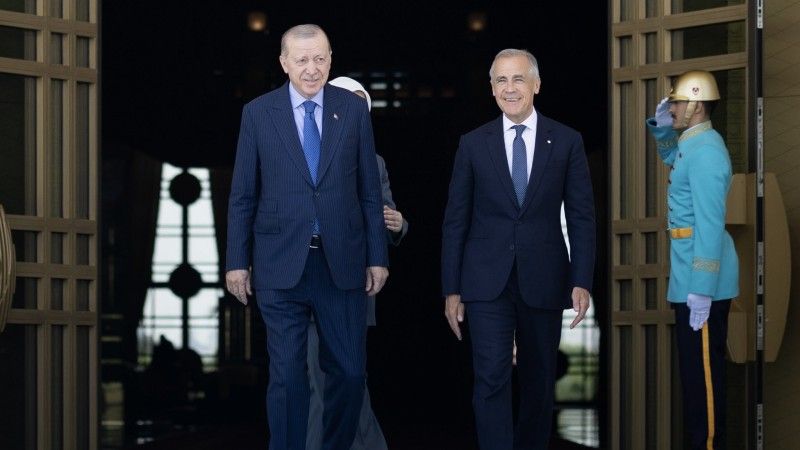
Photo. @MarkJCarney/X.com
The NATO summit in Ankara marked a notable shift in Canada’s defence policy. Under Prime Minister Mark Carney, Ottawa arrived with an ambitious agenda that contrasted sharply with the approach of previous governments.
During the summit, Carney declared: “The threats facing us today are real, and they will be met by a Canada prepared to defend our interests, our citizens, and our Allies. We are rapidly scaling our capabilities through historic investments in new submarines, icebreakers, aircraft, and cyber defences, while strengthening our partnerships with Allies around the world. Today, we are a stronger, more capable member of NATO with greater ability to advance its mission of collective security. This is a strong, confident Canada taking full responsibility for our defence, for a more secure and more prosperous world.”
The statement reflects a visible change in tone. Whereas the previous government under Justin Trudeau resisted committing to NATO’s 2% spending targets, Carney’s government is presenting Canada as a more active contributor to collective security and a country willing to shoulder a greater share of the Alliance’s burden.
Ottawa has pledged to meet NATO’s new benchmark of investing 5 per cent of GDP in defence by 2035. More importantly, the government is seeking to shape the Alliance’s future through new institutional initiatives rather than simply increasing military spending.
Among the most significant announcements in Ankara was Canada’s proposal to establish the Defence, Security and Resilience Bank (DSRB), a new multilateral financial institution designed to mobilise private capital for defence investment. The bank aims to secure a triple-A credit rating, enabling it to provide low-interest financing for defence projects, particularly for governments and companies that struggle to access affordable capital.
According to the Canadian government, the DSRB would provide long-term financing for defence, security and resilience projects across Allied supply chains while also offering loan guarantees to commercial lenders supporting defence manufacturers. Ottawa estimates the institution could ultimately mobilise as much as $134 billion in financing, addressing one of the principal obstacles facing defence industrial expansion: access to affordable capital.

The proposal, however, enters an increasingly crowded landscape of Western defence financing initiatives.
As Defence24 has previously reported, the DSRB might overlap with several existing projects. The European Union’s Security Action for Europe (SAFE), launched in 2025, was created to help member states rapidly increase defence spending, strengthen Europe’s industrial base and support joint procurement of military equipment.
The Canadian proposal also bears similarities to the United Kingdom’s Multilateral Defence Mechanism (MDM), an initiative supported by the Netherlands, Finland and Poland. The MDM seeks to facilitate multinational procurement, reduce acquisition costs and accelerate defence investment through an independent international financing mechanism.
The apparent overlap between the Canadian and British proposals prompted Ottawa and London to issue a joint statement emphasising that the two initiatives should be viewed as complementary rather than competing.
“The efforts of the countries supporting the DSRB and the MDM have a high degree of complementarity and, taken together, can improve defence investment throughout the supply chain,” 10 Downing Street said two days after the MDM was unveiled.

Before the summit, Canadian officials had indicated that as many as 10 countries would join the DSRB as founding members. Ultimately, Albania, Belgium, Greece, Latvia, Luxembourg, Romania, Türkiye and Ukraine joined Canada in launching the initiative. Notably absent from the founding membership are Canada’s fellow G7 partners. Nevertheless, Ottawa insists the institution remains open to additional participants. Some policymakers, including U.K. Chancellor of the Exchequer Rachel Reeves, a leading political advocate of the MDM, have suggested that the MDM and the DSRB could eventually be integrated or merged due to their complementary mandates. While the London-led initiative focuses on joint defence procurement, the Ottawa-led initiative is intended to provide long-term financing for defence and resilience investments.
Both institutions are expected to become operational in 2027.
Whether the proliferation of defence financing mechanisms ultimately strengthens Allied capabilities or creates unnecessary institutional duplication remains an open question. What is already clear, however, is that Canada’s role within NATO is changing. Rather than simply responding to Alliance initiatives, Ottawa seems to be seeking to design them.


