












- WIADOMOŚCI
- WYWIADY
ESA Director: Poland is becoming an emerging space power [INTERVIEW]

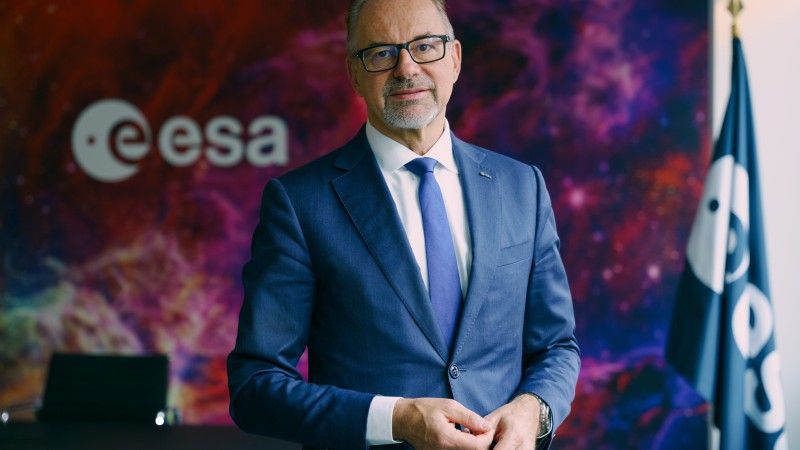
Photo. ESA
„Poland is now moving from being a relatively new member of the ESA community to a much more mature player, with growing expertise and a strong desire to engage further. What I particularly appreciate about Poland is its ambitious, forward-looking strategy. There is a clear determination to modernise the country rapidly and decisively.” – said Josef Aschbacher, Director General of the European Space Agency, in an interview with Space24.pl.
Mateusz Mitkow, managing editor of Space24.pl: The ESA Council at Ministerial level will take place in November 2025. What are the key ambitions and priorities that you would like Europe to adopt during this event?
Josef Aschbacher, Director General of the European Space Agency: The top priority is to significantly increase Europe’s investment in space. Space is strategic for many reasons – it underpins security, technological sovereignty, and it is also a powerful driver of economic growth.
Today, however, Europe is underinvesting compared with other major economies. Globally, public space funding amounts to approximately 122 billion euro. Out of this, Europe contributes about 10%, while the United States accounts for roughly 60%.
If you add up the GDP of ESA Member States, Europe represents more than 20% of global GDP. Yet, our space investment accounts for only about 10% of global spending, compared with 15% five years ago. This shows two things: first, that the trend is downward, and second, that Europe is not investing in space at a level that reflects the strength of its economy.
If we fail to address this, we risk losing talent, industrial capacity, and technological excellence in the space sector. Given how strategic space has become, we must ensure that Europe has the necessary strength and autonomy in space technologies.
The upcoming Ministerial Council meeting will be a key opportunity to raise Europe’s space funding. It is through this high-level political format that ESA proposes new programmes and initiatives, to which Member States subscribe. The funding committed by Member States then flows back into their economies through competitive industrial contracts. It is a very effective system but one that now needs renewed ambition. Europe must step up, catch up, and elevate its overall engagement in space.

How important is international cooperation, including with countries outside Europe, for ESA?
International cooperation is our hallmark. ESA is recognised for its technical excellence and capabilities, and for being a trusted and reliable international partner.
We cooperate with many international partners around the world, including the United States, Japan, Australia, New Zealand, South Korea, the United Arab Emirates, India, and Canada. Our track record of success, the strength of Europe’s space industry, and our ability to deliver on commitments make ESA an attractive partner for countries worldwide.
A good recent example is Australia. Just a few weeks ago, the Australian government gave the Australian Space Agency a mandate to negotiate a comprehensive framework agreement with the European Space Agency. They have looked closely at the cooperating state agreement that ESA has with Canada and were inspired by the strong and productive partnership that Canada enjoys within ESA. Australia is now exploring how it could establish a similarly beneficial framework for cooperation with us.
This clearly shows that ESA’s reputation extends far beyond Europe and that European space expertise and industry are highly valued on the global stage.
Poland has increased its involvement in ESA in recent years. How does the Agency assess the progress of the Polish space sector and its potential?
Poland joined ESA about 13 years ago. It always takes some time to build up expertise and excellence, but Poland already had an active space sector before becoming a member. Since joining ESA, the country’s capacity and capabilities have grown significantly.
I know the Polish space industry very well. We have been working together for many years across a range of programmes. Before becoming Director General, I was responsible for Earth observation, so I am very familiar with that field. I can say with confidence that the Polish industry has developed strong expertise and has built up impressive capabilities in recent years.
Poland is now moving from being a relatively new member of the ESA community to a much more mature player, with growing expertise and a strong desire to engage further. What I particularly appreciate about Poland is its ambitious, forward-looking strategy. There is a clear determination to modernise the country rapidly and decisively.
Space plays a key role in this process, as it represents the cutting edge of technology, and drives many of today’s most important innovations. ESA is the perfect vehicle to help Poland achieve these goals. Poland’s investment in ESA is a very smart decision: on the one hand, it builds strong expertise in high-tech areas that foster innovation; on the other, it firmly anchors Poland within the European context. Through ESA, Polish industry can quickly become part of major European programmes and projects, strengthening both national capabilities and Europe’s collective space ambitions.
I think it is truly remarkable that Poland has significantly increased its contribution since the last Ministerial Conference. Of course, there is also the success of astronaut Sławosz Uznański-Wiśniewski, who flew to the International Space Station a few months ago. His mission has helped raise visibility and public awareness of how space contributes to our daily lives.
I see Poland on a very steep upward trajectory as an emerging space power. While still in the development phase, the country is rapidly catching up and building real strength within the European space ecosystem. These are very good and forward-looking decisions by the government and national institutions, supported by a fast-growing industrial base that continues to expand and mature.

What are the European Space Agency’s expectations of Poland in the context of the upcoming Ministerial Council?
A few days ago, I had a very productive discussion in Brussels with the Polish Minister of Finance, Mr Andrzej Domański. Poland clearly has a strong ambition to leverage space as a means to advance the country and embrace the modern era of technology. The goal is not only to provide society with valuable data and information from space infrastructure but also to rapidly strengthen Poland’s technological capabilities. Overall, the strategy and agenda are highly promising.
Poland has a strong engagement in defence. Space and defence are closely interconnected – each relies on the other. Given this close relationship, and Poland’s role as a strong NATO partner, it is entirely logical for the country to also become a strong space nation. Strengthening Poland’s capabilities in space complements its defence role and reinforces its strategic importance within Europe.
This aligns closely with Poland’s priorities, driven by the government, to position the country as a strong partner within Europe and to strengthen its own capabilities. The aim is not only to defend national interests from a defence and security perspective but also to boost industrial development through innovation and space technology.
These objectives complement each other perfectly. Poland could greatly benefit from a strong subscription to ESA programmes at the upcoming Ministerial Council meeting. Increasing its contribution to match its economic strength and strategic ambition would accurately reflect Poland’s role both economically and in the space sector.
Recently, the Prime Minister of Poland announced that ESA plans to establish a new centre in Poland. Could you share at what stage the discussions currently stand, and what would this centre mean for ESA and Europe?
As announced by the Prime Minster, Poland has a strong ambition to establish a centre focusing on space security dual-use as well as resilience and crisis response. I also discussed this matter with the Minister of Finance, Mr Andrzej Domański, during our recent meeting.
I don’t want to pre-empt the negotiations that still need to take place, but I’m very happy to see Poland’s strong engagement and I fully support this ambition. Of course, any formal decision for ESA to take part in establishing a centre in Poland would have to be approved by ESA’s Member States.
In the context of the current geopolitical situation, there is increasing discussion about the use of space for security and defence purposes. What are ESA’s priorities in this area?
By nature, space is dual use: space technologies serve both civilian and defence purposes. A few simple examples illustrate this well. Rockets can launch satellites for either defence or civilian applications. Weather forecasting, while vital for agriculture and everyday life, is equally essential for the defence community. There are many other cases where space technologies are applied across a broad range of users and sectors.
At ESA, we have been working in this dual use context for many years. More recently, however, our Member States have asked us to develop a dedicated programme that focuses more specifically on defence-related applications. This initiative is called European Resilience from Space \[ERS\]. It aims to enhance intelligence, surveillance, and reconnaissance capabilities from space using very high-resolution optical and radar data to monitor developments in and around Europe.
This programme is currently under discussion with our Member States and will be presented as a proposal at the upcoming Ministerial Council meeting, where it will be open for subscription. I sincerely hope that Poland will be among the strong supporters of this initiative, as I know these issues are of high strategic priority for the country.

What role could Poland play in the European Resilience from Space programme you mentioned?
Indeed, we hope that Poland will play an important role in the European Resilience from Space programme.
For example CAMILA is a very promising and interesting initiative. We have already agreed to develop it for Poland: a contract was signed earlier this year, and we are currently in the development phase, working in close collaboration with Polish industry. As an intergovernmental organisation, we ensure that funding is reinvested in the industries of the contributing countries. In the case of CAMILA, which is funded by Poland, this means the funding is directed back to Polish industry – through a competitive process. This approach guarantees that we secure the best possible technical offer for the implementation of a constellation like CAMILA. At the end of the process, we will hand over the satellites to Poland, which will become the owner and operator. It will be up to Poland to decide how they wish to use them.
Leveraging national programmes such as CAMILA is a key aspect of the proposal I’m presenting at the Ministerial Council with the European Resilience from Space programme: We are inviting countries to contribute their infrastructure through a pooling and sharing approach. Poland would always remain in control of their assets, whether it’s CAMILA or any other satellites, but could share unused capacity with other countries such as Germany, France, Italy, or others. This pooling and sharing approach can be complemented by additional satellites to increase observation frequency, providing more frequent data for a wide range of applications, including defence, disaster management, and other societal needs.
The European Commission is developing, within its own framework - the Multiannual Financial Framework - a programme called European Earth Observation Governmental Service [EOGS]. ESA’s European Resilience from Space will support the preparation and acceleration of EOGS in cooperation with the European Commission.
This marks the beginning of a new collaborative programme involving the Commission, ESA, and Member States. Participating countries will retain full control of their assets, share capacity with others as needed, and benefit from new investments that will be added on top of existing resources.

Are there any new initiatives or programmes under consideration that could further strengthen the participation of Polish companies and research institutions in ESA projects?
There are many initiatives and programmes that could strengthen the participation of Polish companies and research institutions in ESA projects. For example, in Earth observation, we have the FutureEO programme, which develops satellites for scientific research and commercial applications. Poland can also contribute to the Copernicus programme, which ESA implements in collaboration with the European Union, as well as to the European navigation system Galileo. Polish expertise is highly valuable in this context. We have programmes in telecommunication and in satellite communication. ESA’s strong space transportation programme ensures Europe’s guaranteed access to space and the ability to launch satellites. This is key to Europe’s independence and autonomy as a space power.
We also have programmes in human and robotic space exploration, from activities in low Earth orbit, including experiments on the International Space Station, to future missions to the Moon and Mars. ESA also conducts missions aimed at exploring the Solar System and the broader Universe, addressing questions such as the search for life and the fundamental understanding of cosmic phenomena. These initiatives offer opportunities for Polish industry and research institutions to contribute to and benefit from cutting-edge space technologies.
Another area of interest that Poland could engage in is planetary defence. ESA runs programmes aimed at protecting Earth from asteroids. For example, the Hera mission is already underway, and a new mission, Ramses, has been proposed to study an asteroid that will approach Earth in 2029 and investigate how it interacts with Earth’s gravitational forces. These missions provide critical knowledge to better understand these celestial bodies and to prepare for any potential future threats.
There are many programmes currently in the pipeline or open for subscription. Over the past two years, we have discussed and developed these initiatives with Poland and all ESA Member States. As an emerging space nation, Poland is rapidly increasing its capabilities and maturity, and I am confident that there are several areas where Poland can play a key role. I therefore look forward to a strong contribution and active participation from Poland at the upcoming Ministerial Council meeting.

Natural disasters, conflicts and cyberattacks have shown that Europe’s security increasingly depends on satellite data and infrastructure. How is ESA preparing to enhance the resilience of its systems and to support Member States in crisis situations?
Space provides crucial solutions to many problems on Earth. One key example is the ability to respond quickly to crises such as floods, fires, earthquakes, or other natural disasters by providing high-resolution satellite imagery – typical response time requirements would be around 30 minutes or even less.
This is precisely what we are aiming to achieve with the European Resilience from Space programme. We are developing a constellation of satellites to monitor the planet and provide data with a high reactivity, revisit rate and fast delivery. For instance, last year Poland experienced severe flooding with significant damage. In such cases, timely satellite imagery allows authorities to assess the situation, track its development, prevent further damage, save lives, and support emergency services in reaching those in need as quickly as possible.
At the same time, this same constellation concept also addresses security and defence needs. The programme is designed to serve both civilian and defence applications, providing critical data to support multiple communities across Europe.
Looking ahead to the next decade, what is your vision for Europe’s place in space?
I believe Europe should be a leading space power, matching its economic weight on the global stage. Europe’s GDP represents a significant share of the world economy, and our investments in space should reflect that.
Space is an increasingly important part of everyday life. From morning to evening, we rely on space technologies in countless ways: when driving our cars, communicating, making payments with our bank cards, checking the weather, or even when farmers plan their planting and harvesting using satellite data.
Because space technologies are so essential, I believe Europe must be at the forefront of developing space systems and applications that bring real benefits to people. Investing in space is not just about exploration and discovery. It’s about innovation, security, and improving the quality of life here on Earth.
Thank you for the interview!


