












- WIADOMOŚCI
From Italian waters to Poland: Lessons from shipborne F-35 operations [REPORT]

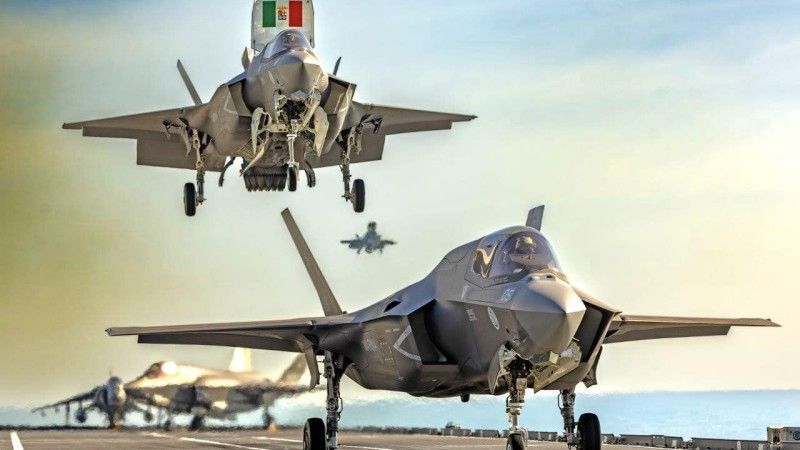
Photo. Marina Militare
Defence24.pl had the pleasure of visiting Italy’s only aircraft carrier — ITS Cavour. This is a truly exceptional vessel, and it is now supporting the security of NATO’s eastern flank. And it is doing so without leaving the Mediterranean.
Italy's only child
The Italian Navy is one of the few NATO navies to operate an aircraft carrier. That ship is Cavour (hull number C 550), a vessel approaching 20 years of age, which entered service with the Marina Militare in 2008. Since then, it has been the flagship of Italy’s naval forces, with Taranto as its home port. Formally, the ship is classified as a light aircraft carrier. That said, this in no way diminishes the role or the missions this vessel can perform.
With Cavour, the Italian Navy possesses, alongside the United States, the United Kingdom and France, a fully fledged expeditionary airpower capability based on carrier aviation far beyond its own national borders. These unique capabilities not only serve Italy’s national interests, but also ensure Italian participation in NATO collective defence, including on the Alliance’s eastern flank, without the need to commit permanent expeditionary forces.
Italy’s Carrier Strike Group tradition is relatively young, having been established in 2022 in response to Russia’s full-scale invasion of Ukraine. Since then, the group has taken part in numerous training activities under NATO exercises, including Mare Aperto, Medstrike, Nest 25 and Neptune Strike 2025. In 2024, the Italian CSG took part in a long-range Indo-Pacific deployment.
In its standard configuration, the group consists of an aviation-capable ship (ITS Cavour, although this could also be the helicopter carrier Trieste, from which STOVL F-35B fighter aircraft can operate), escort vessels in the form of destroyers and frigates with an emphasis on anti-submarine warfare, and replenishment ships. In addition, depending on the mission, the group may also be reinforced with other assets — submarines, mine countermeasure vessels, patrol aircraft, or air-to-air refuelling aircraft.
Until 2024, Cavour was Italy’s largest ship. That year, with the entry into service of ITS Trieste, measuring 245 metres and with a full-load displacement of 38,000 tonnes, it was overtaken. Cavour is 244 metres long and 34 metres wide. The flight deck alone is more than 180 metres long and is topped by a ski-jump ramp. Its displacement is around 30,000 tonnes. Propulsion is provided by four AVIO gas turbines with a combined output of 118,000 hp, allowing the ship to make 28 knots, although its economical speed is 16 knots. At that speed, it can cover 7,000 nautical miles. Without replenishment, the ship can remain at sea for 18 days. An additional source of electrical power, and at the same time auxiliary propulsion, is provided by six diesel generators.

Photo. Defence24.pl
Cavour’s crew numbers more than 400 sailors and officers. A further 200 personnel support the air wing. However, the Italian carrier’s capabilities are far greater. What sets it apart is its multi-role nature. In addition to serving as a „floating airfield”, Cavour can also operate as an amphibious assault ship. Beneath its lower deck, below the aircraft hangar, there is a cargo space capable of carrying up to 24 Ariete main battle tanks or up to 50 lighter armoured personnel carriers. More than 400 marines can also be accommodated on board. Its aircraft hangar measures 134 metres in length and 20 metres in width, and is divided into four sections. It can support up to four AV-8/F-35B aircraft or eight helicopters. Aircraft and helicopters are lifted to the flight deck by two special elevators. Stores, including fuel and munitions, are moved via two cargo lifts.
Another distinctive feature of Cavour, compared with other carriers, is the type of aircraft it operates. In total, up to 22 aircraft and helicopters can be based on board. In the case of the Italian ship, these include both the ageing AV-8B Harrier II Plus and the modern fifth-generation F-35B Lightning II multirole aircraft, capable of short take-off and vertical landing. To accommodate fifth-generation aircraft, the ship underwent a major refit in 2019, including replacement of the flight-deck surface with a thermally resistant layer. The temperature produced by the exhaust of a landing F-35B engine is so high that it could literally burn through a standard steel deck.

Photo. Defence24.pl/Mariusz Marszałkowski
The crew we spoke to during the visit highly praised the ability to operate these two aircraft types, describing their capabilities as „complementary”. The Harriers are intended to carry out direct combat missions, making use of numerous weapons pylons and their long range when fitted with external fuel tanks, while the F-35B is meant to remain in reserve at higher altitude, scanning the airspace with its sensors and, via the Link 16 datalink, designating targets for the Harriers. This is an interesting concept that is also being promoted for the Polish FA-50GF/PL light fighters and F-16C/D multirole aircraft.
According to the Italian pilots, „one F-35, thanks to its technological sophistication, can replace five other, older aircraft types.” As for the Harriers, their time is drawing to a close. They will soon be completely replaced by the F-35B.
The ship is comparatively well armed for self-defence. Its defensive weapons include three 76 mm Oto Melara Strales automatic guns — the same type that will equip Poland’s future Miecznik frigates — three 25 mm guns and 30 VLS cells (2 x 16 VLS) in Sylver launchers for Aster 15 short-range missiles.
There is also a hospital on board, which can, under certain circumstances, accommodate 20 patients, including eight requiring intensive care. The hospital has two operating theatres, X-ray rooms and a CT scanner. In peacetime, the ship’s medical complement consists of one doctor and four nurses. If necessary, the medical team can be rapidly expanded. There is also a dental clinic on board.
ITS Cavour, together with two escort ships — the frigate ITS Virginio Fasan and the destroyer ITS Caio Duilio — is currently taking part in Neptune Strike. The exercise is designed to test NATO interoperability in joint operations involving carrier-based aviation operating from NATO carriers — the Italian ITS Cavour, the French Charles de Gaulle and the Spanish Juan Carlos I. The exercise involves combined air operations over ranges in Poland, Bulgaria and Romania. The forces are training, among other things, for air superiority missions, reconnaissance sorties and strike missions against land targets. In principle, the participating forces are assigned to NATO’s Joint Force Command in Naples. It is NATO commanders who decide how these forces are to be employed.
What is worth emphasising is that the exercise is intended to demonstrate the Alliance’s ability to operate in areas of interest over NATO’s eastern flank from distant waters, well away from the threat. This aspect often escapes public attention. Carrier forces make it possible to commit assets that do not need to be „declared” and do not have to be taken into account by an adversary planning offensive operations against the Alliance. In practice, NATO forces can count on fighter support based in the Mediterranean or the Adriatic, far from any potential front line.
Italian Hospitality
We reached the Italian carrier by NH90 helicopter operated by the Italian Navy, which had departed from the Guardia di Finanza air base in Bari. After around 50 minutes in the air, we landed on the ship’s deck. Following a short safety briefing, we were given an air display featuring F-35B and AV-8B Harrier fighters. After the flying display, we were shown around the ship — including the officers« mess, where we had the opportunity to speak with the commander of the Italian CSG, the carrier’s commanding officer and other crew members. We were also shown the ship’s hospital. We visited the aircraft hangar, where firefighting drills were under way. We then moved to the heart of the ship: the Command Information Centre (CIC). That is where the ship’s „air traffic control tower” is located, where weapons are controlled, the airspace is monitored and air operations are planned. It is the most closely guarded space on the ship. Finally, we arrived on the bridge, where a typically Italian refreshment awaited us, together with a glass of sparkling wine.
After leaving the ship, the helicopter pilot made three circuits over the entire carrier group, allowing us to photograph and film the ships from above with the doors open.
ITS Cavour was the third NATO aircraft carrier the author has had the pleasure of visiting. Previously, Defence24.pl, as the only Polish editorial team, had the opportunity to go on board the American aircraft carrier USS Gerald R. Ford and the British HMS Prince of Wales. The author would like to thank JFC Naples and the crew of ITS Cavour for organising the visit and for their extraordinary hospitality.


