












- WIADOMOŚCI
- WYWIADY
“Israel Is winning militarily but losing politically and ideologically” [PART 1 of the INTERVIEW]

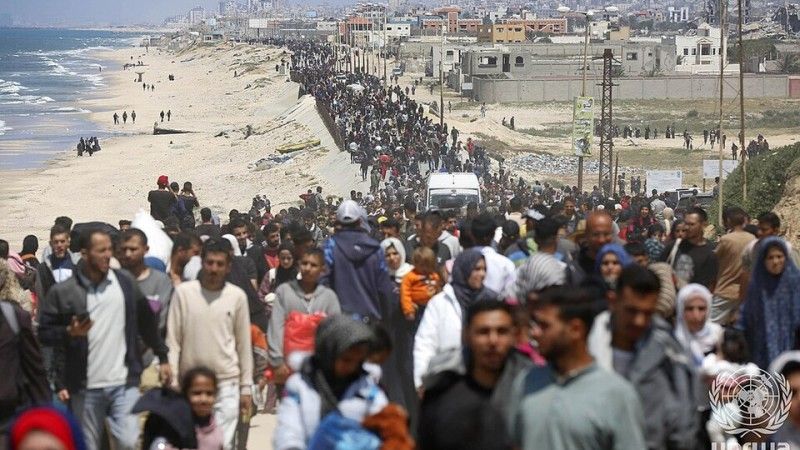
Photo. Ashraf Amra / Wikimedia Commons
Defence24 talks to Ami Ayalon, retired Admiral of the Israeli Navy, former head of the Shin Bet (1996-2000), and former Labour Member of the Knesset, about contemporary Israeli society, the progressive erosion of democracy in the country, and the future of Prime Minister Netanyahu.
In our previous conversation, I mentioned the documentaryThe Gatekeepers, released in 2012. It portrays Israel as a country winning battles but gradually losing the larger war. Fourteen years later, has the situation changed? I have the impression that it has become even more difficult for Israel.
Yes, I think the situation has become even more difficult. When I spoke in the film about „winning every battle but not winning the war,” I wanted to explain to Israelis and to everyone watching that there are limits to military power. Today this is much clearer than it was then.
To understand this, we need to distinguish between the nature of war and the character of war. Carl von Clausewitz wrote about this in On War. The nature of war does not change because it is rooted in human behavior: people use violence to solve conflicts. As long as human beings exist, this basic reality remains the same.
But the character of war changes from one era to another because of revolutions in technology and culture. When technological and cultural revolutions combine, warfare changes fundamentally.
For centuries, wars were what we might call „Clausewitzian wars.” Their purpose was decisive military victory. You defeated your enemy on the battlefield and then imposed political conditions on the loser. This was true through both World Wars.
After the development of nuclear weapons and the rise of democratic culture, this logic changed. During the Cold War, decisive military victory became impossible because a nuclear war would destroy the world many times over. Instead, the superpowers created a system of mutual deterrence.
In the end, the West achieved victory in the Cold War not through military conquest, but through ideas and values. As Joseph Nye argued in his concept of „soft power,” the Fall of the Berlin Wall was not caused by American missiles, but by people who wanted to adopt Western values and ways of life.
Since the collapse of the Dissolution of the Soviet Union, most conflicts have not been wars between states, but between states and ideological organizations. This is especially true in the Middle East. In these wars, military victory alone is insufficient because organizations such as Hamas, Hezbollah, ISIS, or Al-Qaeda do not surrender in the traditional sense.
Even if you win militarily, you may still lose politically and ideologically. That is the core problem Israel faces today. Militarily, Israel has achieved extraordinary successes against Hamas, Hezbollah, and Iran. But winning military engagements is not the same as winning the war itself.
Today wars are fought in two dimensions. One is the military battlefield. The other is the battlefield of ideas and ideology. Military power cannot defeat an idea. To win the second battle, you need what we now call soft power — the ability to project hope. Without giving people hope for a different future, you cannot truly defeat your enemy.

Let me ask about Israeli society itself. How has it changed over the past fourteen years? It seems as though a much more extreme narrative dominates public life, and figures like Itamar Ben-Gvir have entered the mainstream.
I would not say that this narrative is fully mainstream, but Israeli society is deeply fragmented. Former President Reuven Rivlin described Israeli society as divided into „four tribes,” meaning four different communities with fundamentally different understandings of reality.
About 20 percent of Israeli citizens are Arab Palestinians. Another large segment consists of Haredi Jews – ultra-Orthodox communities that often do not fully recognize the legitimacy of the secular Israeli state because, in their view, the Messiah has not yet come. There are also secular Israelis and religious Zionists, some of whom believe that conflict itself has a religious meaning.
Israel’s divisions are intensified by broader global transformations. Across liberal democracies, two revolutions have reshaped politics: the communications revolution — the internet, media, and social networks — and globalization, which has transformed demographics through mass migration.
We have seen these tensions throughout Europe and the United States, including events like Brexit. Israel is affected by the same forces, but in an even more intense way because Israel itself is fundamentally a society of immigrants.
At the same time, Israel faces another unique problem: permanent war. I often quote James Madison, who warned that democracy struggles to survive under conditions of endless conflict. During war, societies tend to prioritize security over civil rights and freedoms.
Historically, democracies accepted temporary restrictions because wars eventually ended. But twenty-first century conflicts often have no clear endpoint. Hamas does not surrender. Hezbollah does not surrender. ISIS did not surrender. Once there is no decisive end to war, the emergency mindset becomes permanent.
This creates a gradual erosion of democracy. Courts begin to legitimize exceptional measures. Rights, especially minority rights, become weaker. In Israel this first affects Palestinians — both Palestinian citizens of Israel and Palestinians living under Israeli control in the occupied territories. In fact, we doesn’t care about all the Palestinians under our military control.
There are also structural problems within Israel’s political system. Political leaders increasingly focus on electoral survival rather than long-term democratic principles. Today, almost no major Israeli politician is willing to openly say that they would form a governing coalition with Arab political parties. As a result, we are creating a form of an apartheid within the Israeli society.
I often refer to an important essay by Brian Michael Jenkins of the RAND Corporation called Incremental Tyranny. He argued that democracies do not collapse overnight. They disappear gradually, „in small bites.” Years later, people suddenly realize that the democracy they once knew no longer exists. That is the danger Israel faces today.
See also 

You once said that many Israelis no longer see Palestinians as a people. Combined with the way the IDF is conducting the war in Gaza, this raises serious concerns. How do you assess the changes within the Israeli military and Israeli attitudes toward Palestinians?
The situation in Gaza is extremely complex. I am not trying to justify what Israel is doing, but I can try to explain it. When young Israelis enter military service, they are taught to see Hamas as an enemy. Soldiers are sent to war in order to fight and kill, not to negotiate. If states want negotiations, they send diplomats, not soldiers.
Because many terrorists do not wear uniforms, soldiers often perceive every individual as a potential threat. Acting out of a genuine sense of danger, this leads to widespread casualties. While our forces may not be to blame for the chaotic nature of urban warfare, we still bear responsibility. We are responsible for the humanitarian crisis unfolding under our watch, especially now that we possess the power to end it. Having successfully achieved the government’s stated military objective—dismantling Hamas as a military organization—the continuation of this crisis rests on our shoulders.
The second issue is the nature of Hamas itself. Hamas is not like the Palestinian Authority. It is a radical Islamist organization that fundamentally rejects Israel’s right to exist. Hamas also deliberately embeds itself within civilian areas and uses civilians as human shields.
Several years ago, I read material on Hamas’s own websites describing this strategy openly. Hamas understands that it cannot defeat Israel conventionally on the battlefield. Instead, it seeks to draw Israeli forces into densely populated urban areas where civilian casualties become inevitable. Hamas believes that the resulting destruction and suffering will generate international pressure against Israel.
This creates an almost impossible battlefield. Israeli soldiers fight in one of the most densely populated areas in the world against fighters who often do not wear uniforms and who operate beneath civilian infrastructure.
Hamas built a vast tunnel network under Gaza, yet ordinary civilians were largely excluded from these shelters. In many cases only Hamas operatives had access to them.
Again, I am not justifying Israeli actions. I am explaining the reality Israeli soldiers face: a brutal urban battlefield combined with an enemy leadership willing to sacrifice its own civilian population in order to remain in power.
See also

What, in your opinion, has been the result of Benjamin Netanyahu’s long period in power?
Netanyahu has been Israel’s Prime Minister for roughly sixteen years, and during that time he has fundamentally reshaped the country.
In my view, he has systematically weakened Israel’s legal and institutional framework. Israel’s political system already concentrates enormous power in the hands of the prime minister. The prime minister appoints ministers and can dismiss them at will. As long as the governing coalition maintains a parliamentary majority, the legislature has very limited ability to constrain executive power.
Israel also lacks several safeguards common in other democracies. We do not have a formal constitution. We do not have a second parliamentary chamber like a senate. And because Israel is still a relatively young state, democratic traditions are less deeply rooted than in older democracies.
When the judiciary is weakened under these conditions, the balance of power collapses. That creates the danger of authoritarianism. In my opinion, Israel today is not far from that reality.
You mentioned the erosion of Israeli democracy. How serious is the situation today?
Our former Supreme Court president, Aharon Barak, said publicly a few months ago that Israel is no longer a liberal democracy. In his view, the legal system has already lost the power to stop this process. Unfortunately, I think this reflects reality.
Today, Israel is governed by a coalition that does not represent the majority of Israelis. Polls consistently show that between 60 and 70 percent of Israelis believe that Prime Minister Benjamin Netanyahu makes decisions primarily according to his personal political interests rather than the interests of the state.
This perception became even stronger after Netanyahu’s corruption trial began. For years now, his legal situation has become a central issue in Israeli politics. Even many of his own voters believe that his main objective is political survival.
When people abroad look at figures such as Itamar Ben-Gvir or Bezalel Smotrich, they often assume these views represent the majority of Israeli society. In reality, these parties represent roughly 10 percent of the population. However, because of Israel’s coalition system, small parties can exercise enormous leverage.
The ultra-Orthodox parties support the coalition because they depend heavily on state funding. Religious nationalist parties support it because they seek annexation of the occupied territories. These groups do not necessarily share the same ideology, but each of them has much to lose if the government collapses.
This is why the coalition survives despite broad public dissatisfaction. There is now a profound gap between the majority of Israelis and the government that rules them.

Would you say that political survival is Netanyahu’s primary objective today?
Not simply the primary objective. I would say it is the only objective.
I’ve known Netanyahu for decades. When I ran the Shin Bet during his first term, my mandate was to know this country’s political reality inside and out. That meant knowing secrets you could never publish, including what his ministers, and even his family, actually thought of him behind closed doors. Back then, he was different: deeply intelligent and highly sophisticated. But as Lord Acton noted, there is an undeniable correlation between power and corruption. Netanyahu has spent fifteen of the last sixteen years in power, and it has changed him.


