












- ANALIZA
- WIADOMOŚCI
Was Ankara NATO’s summit of summits?

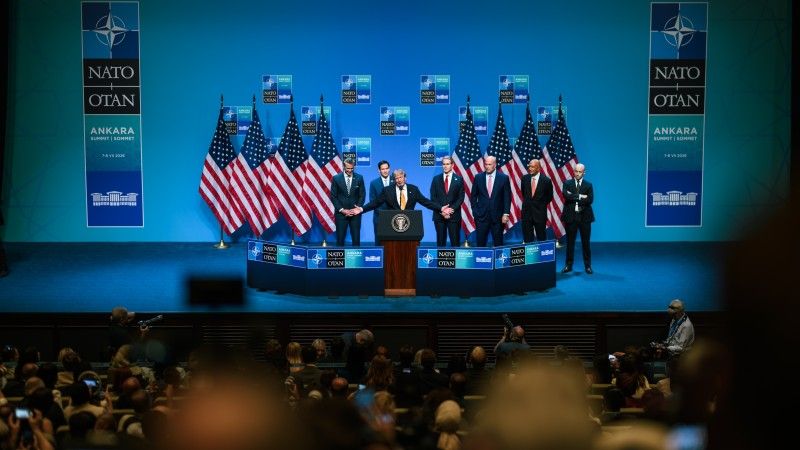
Photo. @WhiteHouse/X.com
More than a month after the NATO summit, it is now possible to put aside the theatrics of the summit and some of the world leaders and assess Ankara more coolly. Was Ankara a historic NATO summit? If by “historic” we mean a moment when the Alliance changes the course of events, rather than simply putting up flags, smiling for the cameras and publishing a communiqué full of grand words, the answer is far from obvious.
The Ankara summit was supposed to demonstrate the unity of the West and its strategic determination. The question is whether it actually demonstrated NATO’s strength, or once again proved that in this club even a group photo requires reconciling divergent interests.
NATO still together, but without illusions
The biggest success? NATO did not fall apart. It sounds like a pretty low bar, but before the Ankara summit it was by no means obvious that the Alliance would clear it. Trump was attacking European allies, the US and Europe differed over Iran, nobody knew what would happen next with American troops in Europe, there was the whole dispute over 5% of GDP, plus Greenland and, of course, Ukraine. After two days, Article 5 was reaffirmed, the 5% target was maintained, Ukraine received a multi-year commitment to support, and Trump confirmed that the US would remain in NATO. So, a success? Yes. A triumph? Easy there, let’s not get carried away. It was more a successful survival of yet another Trump storm than the beginning of a new era of transatlantic harmony.
NATO after Ankara is already a somewhat different NATO. For decades, the arrangement was simple. The US provided strategic security, while Europe contributed some money, troops and good intentions. Now it increasingly looks as though America remains the Alliance’s greatest military power, but its commitment is less predictable, meaning Europe and Canada must build much greater capabilities of their own. NATO is beginning to resemble a two-pillar structure rather than a building resting on one very large column flying an American flag.
And here comes Trump’s biggest paradox. He wanted Europe to pay more. Europe apparently decided that if it was going to pay more anyway, it might as well start building its own military power. The 5% of GDP target is therefore more important than it looks on paper. If it is actually implemented, Europe will have more ammunition, missiles, air defence, drones, stockpiles and troops, as well as greater capacity to wage war without immediately picking up the phone and calling Washington: “Could you send us something?”
This does not, of course, mean a European NATO without America. It means something much more realistic: a Europe that, for the first time since the end of the Cold War, is seriously preparing for a situation in which the US will not always be the first and primary guarantor of its security. And that is a strategic change of truly major proportions.

Ukraine got a lot, but not what it was waiting for
Ukraine also came out of Ankara better than might have been expected, although without a membership card. NATO committed to €70 billion in military assistance, equipment and training for Ukraine in 2026, while maintaining at least a comparable level in 2027. Trump also agreed, among other things, to the possibility of Ukraine producing Patriots. How durable this promise will be is something we are about to find out. Ankara gave Ukraine political commitments and an important technological promise, but unfortunately it did not solve the problem. Regardless of what happens now, this is important because it is intended to change the very logic of support. Ukraine is supposed to become less exclusively a recipient of Western weapons and increasingly part of Europe’s production and security system. In other words, instead of waiting forever for deliveries, it is increasingly supposed to produce what it needs itself. For a country at war, that is quite a sensible business model.
And what about Ukraine’s NATO membership? There was no breakthrough here. Ankara did not bring a decision saying: “Ukraine will become a NATO member.” The summit was not used to begin the accession process. For Ukraine, membership remains a long-term goal, while for Trump the priority is ending the war and reaching an agreement with Russia.
Russia is threatening
Russia is probably the summit’s biggest strategic loser, although not because NATO has just “defeated” it. Moscow was instead counting on a classic scenario: Trump versus Europe, followed by the collapse of unity, less aid for Ukraine and a weaker NATO. Instead, it got higher European spending, continued support for Ukraine and further strengthening of NATO’s eastern flank. Not exactly a successful summit outcome for the Kremlin.
Russia reacted very harshly to the Ankara summit, but its response was also quite characteristic. The Kremlin simultaneously tried to threaten escalation and portray NATO as divided. The Kremlin’s official message was that NATO was preparing for war with Russia. Maria Zakharova described the summit decisions as a continuation of the militarisation of Europe, the expansion of NATO’s defence capabilities, preparations for a conflict with Russia and further arming of Ukraine. The Russians warned that such actions could have “catastrophic consequences” for the entire world. Moscow does not treat the 5% of GDP decision as simply an increase in military budgets. It presents it as a long-term preparation by the West for confrontation with Russia.
But there is a catch. European money does not turn into increased military capabilities over a weekend. Ammunition production, missiles, air defence and new military units require years. If Moscow therefore concludes that its window of opportunity is closing, it may try to use precisely the coming years to maximise its gains. The summit may therefore simultaneously strengthen deterrence and increase pressure on Russia to act faster. Geopolitics, as usual, knows no simple endings.
The biggest problem, however, remains the perception of the US. Trump reaffirmed NATO and Article 5, but his policy has shown the allies something that no declaration can completely conceal. Washington may be with them today, but tomorrow its priorities may look completely different. And deterrence does not work solely because of tanks and missiles. It also works because an adversary believes that when something serious happens, the allies will actually respond together. If that certainty weakens, someone may decide it is worth testing just how much it has weakened.

Turkey holds the cards
Against this backdrop, Turkey – as host of the summit – also came out a winner. Ankara demonstrated that virtually everyone needs it. The US needs Turkey, Europe needs it, NATO needs the Turkish military, Ukraine needs its position on the Black Sea, and Russia has to take it very seriously. This strengthens Erdoğan’s position as a political swing player between the West and the non-Western world. And once the emotions have subsided, this perhaps becomes clearer than it was during the summit itself.
Turkey’s biggest gain was enhancing Ankara’s importance within NATO. Erdoğan primarily gained a strong position at the table. Turkey no longer looks merely like NATO’s southeastern flank, but increasingly like a country without which it is difficult to shape a new security architecture.
The second, very concrete gain is the defence industry. Turkey wants NATO to reduce barriers to arms trade between allies, because if Europe is going to spend gigantic amounts of money on defence, Ankara is more than happy to help it spend that money. The Turkish industry already has a fairly strong portfolio: drones, ammunition, missiles, vehicles, ships and electronics. Turkey wants to go deeper into the European defence market.
Turkey’s position vis-à-vis the US has also improved. In the background are the S-400s, the F-35s and the long-running dispute over restrictions on the Turkish defence industry. If Ankara actually manages to resolve the S-400 issue and return to the F-35 programme, Erdoğan will be able to add a rather impressive result to his scorecard.
Most importantly, however, Turkey has gained a very strong negotiating argument. It is difficult to build a stronger European defence without it. NATO’s second-largest army, Ukraine, the Black Sea, the straits, the defence industry, military experience and drones all matter. Ankara can simultaneously be a NATO member, a partner of Ukraine and a dialogue partner for Russia.
Erdoğan clearly does not intend to stop at NATO. Turkey is simultaneously building its position in the Middle East, as demonstrated by the new arrangement with Saudi Arabia and Pakistan. Ankara is trying to make itself indispensable everywhere.
Turkey came out of the summit with something far more valuable to Erdoğan: greater negotiating power, greater opportunities for its own defence industry, and the argument that if Europe wants to build its defence capabilities, Turkey should also have a seat at the table.
From Poland’s perspective, Warsaw and Ankara have an increasing number of shared interests: a strong NATO, their own defence industries and as much strategic freedom as possible. That is potentially quite a sensible reason to talk to each other – apart from the fact that both sides like doing things their own way.

Poland: Time to turn billions into capabilities
The balance for Poland is positive, although it is difficult to call it a revolution. Europe will rearm, the eastern flank will remain one of NATO’s most important defence areas, Ukraine will continue to receive support, and Poland will strengthen its position as one of the Alliance’s key military powers. The Eastern Shield and the development of military infrastructure have a chance to become even more deeply integrated into NATO’s broader defence system.
But greater security also comes with a bigger bill. Poland can no longer assume that simply “being close to the US” will be enough. We need our own capabilities that allow us not only to deter, but also to conduct military operations for the first weeks or months before the entire allied mechanism begins operating at full strength. That is why spending 5% of GDP on defence is not merely a cost for Poland. It is also the price of greater strategic autonomy. The only question is: how long can we afford it, and how much of a burden can the economy carry?
What matters most, however, is what we do with that money. Poland cannot limit itself to being the biggest customer in Europe’s arms race. New spending should serve to build our own industry, infrastructure and operational capabilities. Otherwise, instead of strengthening security, we will primarily be strengthening foreign manufacturers.
For Poland, Ankara was probably a better summit than could have been expected just a few weeks earlier. Europe has begun rearming, Poland has found itself at the centre of NATO’s eastern flank, and its military importance has clearly increased. Now Warsaw must turn this position into concrete capabilities: its own forces, production, logistics and infrastructure, rather than merely more contracts and invoices.
Poland no longer needs to convince NATO that the eastern flank is important. Now it needs to convince its allies that this awareness should be backed by money, troops and equipment. And at the same time, it must make sure that at least some of the money allocated to European defence stays in Poland. Because in geopolitics, there really is no room for promotional discounts.

NATO after Ankara
The Ankara summit was a successful operation to preserve NATO unity, but it is difficult to regard it as a strategic breakthrough. Its significance does not boil down to a single decision. More important is that it accelerated the process of moving the Alliance away from a model based primarily on the dominant role of the US toward one in which Europe must become a much stronger pillar of collective security.
Ankara did not solve NATO’s most important problems. It did not end the war in Ukraine, settle the issue of the Russian threat, or answer the question of how large the US presence in Europe will be in five or ten years. Nor did it solve the “Trump problem”. But it did something important: it bought the Alliance time and created conditions in which Europe can begin building greater self-reliance.
That is why the significance of Ankara will be determined not so much by the declarations made in 2026 as by their consequences, which will only become visible around 2030–2035. Then we will see whether increased defence spending actually translated into larger and better-equipped forces, ammunition stockpiles, missiles, air defence and a stronger defence industry. If so, Ankara may be regarded as the beginning of the rebuilding of Western power after the era of the “peace dividend”. If not, it will remain another summit at which Europe announced grand plans and then returned to its old habits.
Paradoxically, the biggest consequence of Ankara may therefore be taking away from Europe the comfortable belief that its security will always primarily be someone else’s problem. NATO survived, but it ceased to be a given. Europe received a lesson that an alliance is not a subscription to security, and American support should not be treated as a guaranteed service included in the package.
This is not about turning away from the US. America remains the most important military power in the West, but Europe increasingly needs its own contingency plan. In other words, it would be good to have our own umbrella before we start checking whether the American one will have time to open.
Ankara also demonstrated a broader shift. The world increasingly resembles a system in which one power maintains the global order less and less. The US remains the strongest military player, but China is expanding its economic and technological influence, Russia is trying to rebuild its sphere of influence, Turkey is pursuing its own policy with increasing confidence, and the Gulf states are building their own security arrangements. It increasingly resembles a system of several centres of power primarily looking after their own interests. In other words, we are returning to the old model of a balance of great powers – only now with drones, satellites and cyberwarfare.
The most important conclusion from Ankara is therefore the growing strategic autonomy of Europe. NATO survived, Ukraine is becoming increasingly integrated into the European security system, Russia did not get the collapse of the West it wanted, and the US remains crucial, although less predictable. The Alliance did not die. The era in which everyone could pretend that its future was obvious simply came to an end.
Ankara was therefore not a historic NATO success. It was rather successful crisis management that accelerated the Alliance’s historic transformation. And perhaps that is precisely why we will only understand its true significance several years from now.


