- ANALIZA
- WIADOMOŚCI
The Ankara summit was not a breakthrough, but NATO preserved unity

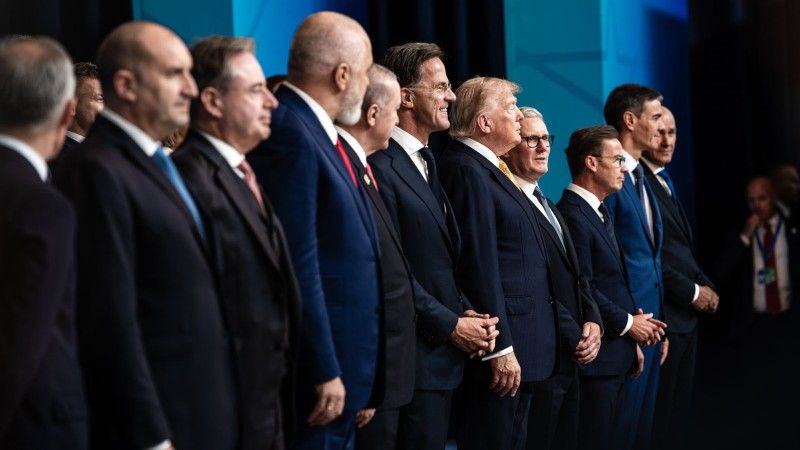
Photo. @SecGenNATO / X.com
A great deal was said before the event in Türkiye. After all, this was NATO’s major return, after more than two decades, to the territory of one of its key members. Two extreme scenarios dominated the debate: either the Alliance would fracture, or it would emerge stronger than ever, with additional support from Ukraine, the Indo-Pacific and the Middle East. Neither happened. NATO did not move decisively in either direction, but it preserved the unity that remains so crucial in the face of Russia’s war against Ukraine, the conflict with Iran and many internal fractures, including over Greenland, defence spending and relations with Russia.
The Ankara summit had many positives. First, the Defence Industry Forum took place, opening the door for several hundred companies from around the world to become involved in military cooperation between allies. Co-production, new technologies and concepts for multinational formats all featured strongly on the first day of the event. NATO needs as many initiatives of this kind as possible. Promoting weapons systems and looking for partners ready to become involved is one way to strengthen the Alliance.
Bilateral talks were equally important, as they opened the door to many potentially productive agreements. It should be emphasised that these meetings involved not only NATO members, but also Ukraine, countries from the Indo-Pacific and partners from the Middle East. A NATO summit has never been as global as this one. This matters because it creates space for cooperation with further partners in the coming years. Beyond those already mentioned, South America and Africa should also be taken into account. The Alliance’s security concept now has a global dimension, so it must be discussed on a global scale.
No single leader dominated the summit. From the beginning, many looked to Trump or Erdoğan as the natural figures who could take control of the event, yet neither fully seized the initiative. In practice, the summit had a fairly general character, especially given the war in Ukraine and the conflict in the Middle East. It underlined the key elements that have been discussed among allies throughout the past year. The expectations remain unchanged: more money for defence, the symbolic 5% target, although for many even 3.5% by 2035 will be a challenge, faster weapons production and the building of strategic responsibility in each region where allies are present. In Europe’s case, this means responsibility for the Old Continent.
Despite the absence of one dominant leader, it is possible to identify the main political beneficiaries of the summit. Türkiye gained the most, presenting its own security vision, showcasing the potential of its defence industry and confirming that it is difficult today to have a serious conversation about NATO without Ankara. The United States remained at the centre of attention, because all allies were watching Washington’s decisions and trying to understand how far the Americans would be willing to maintain their engagement in Europe. Ukraine kept its place on the agenda and received political support in its struggle with Russia. Poland also came out positively, consistently raising the issues of the eastern flank, support for Ukraine and the need to strengthen the Alliance’s defence capabilities.

This is where Europe’s problem becomes visible. None of the European leaders took the initiative. Chancellor Merz and President Macron adopted a very general and standard position: support for Ukraine, the need for European unity and rearmament. But they did not try to engage too strongly or enter into a decisive political exchange with Trump or Erdoğan. If they cannot do that, how are they supposed to compete with Putin or Xi? Meloni’s reaction was missing; in practice, she disappeared. Spain and Portugal were on the margins, and the Balkans were not particularly active. Sweden positioned itself strongly, while Finland was much less visible. Central European countries achieved some of their objectives, but did not move to a higher level that would allow them to dominate the summit from the European side. Europe wants to present itself as a monolith, but it is not one. It also lacks a leader able to carry the room.
The summit took place, all leaders attended, and they confirmed that there is readiness to cooperate on security. That is the most important message. At a time of crises and many tensions between NATO members, such meetings build trust and help manage disputes. Further support for Ukraine, the possible deployment of forces to Greenland, American support in the Strait of Hormuz and threats towards Taiwan all remain on the agenda. The meeting in Ankara did not magically solve these problems. Nevertheless, it gave expression to the Alliance.
Today, the point is no longer that everyone must agree with everyone else. National interests and the personal motives of selected politicians dominate. To compete with Russia and China, and to maintain essential internal cooperation, NATO has to accept the moves made by Türkiye, the United States and France. Modern NATO must be flexible. It is also reaching out with proposals for cooperation with Japan, South Korea, Australia, Ukraine, Qatar and Saudi Arabia, among others, so the challenges will only grow.
See also 

Allies met in Türkiye. They demonstrated that they are ready to talk and that they have concepts for cooperation. This may not seem like much, but sometimes maintaining the status quo is enough. Not every summit has to be a breakthrough. Sometimes the absence of a breakthrough is itself a lesson from which valuable conclusions can be drawn. NATO countries had the chance to see up close who really cares about unity and agreement. That is the starting point for the next year.
We will see how many of the promises can be implemented before the next summit, which is scheduled to take place in Albania next year.