












- WIADOMOŚCI
Geran-4 drone upgraded. Chinese engine removed

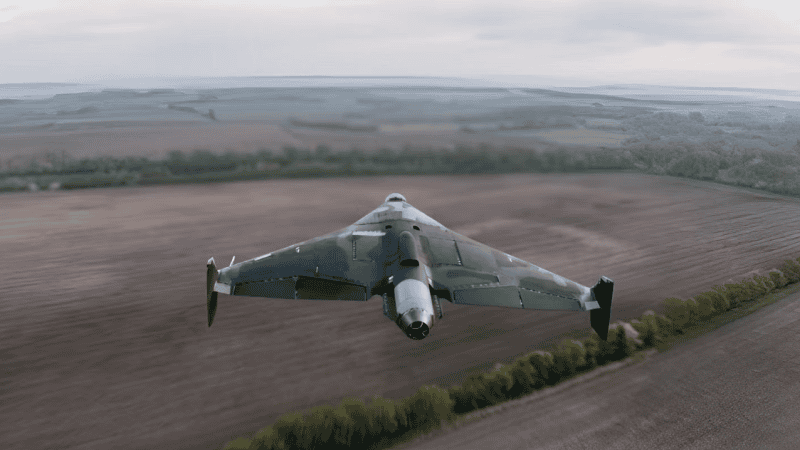
Photo. Russian MoD
Russia has introduced another modification of the Geran-4 jet-powered unmanned aerial vehicle. According to information from Ukrainian military intelligence, the modernised machines have been used by Russian troops since autumn 2026.
The new version features, among other things, an additional autonomous navigation system, a magnetometer to increase the accuracy of the inertial system, and a new warhead designed to destroy specific infrastructure elements. Changes also involve the propulsion. The Chinese Telefly turbojet engine has been replaced by a Russian equivalent produced in Alabuga. Other electronic components largely correspond to the solutions used in previous Geran models.
Magnetometer intended to increase navigation accuracy
An interesting change is the use of a new module referred to by Ukrainian intelligence as MOKH. Its key element is the PNI5GA magnetometer manufactured by the American company PNI Sensor. The PNI5GA is a precision magneto-inductive sensor integrated with the SADRA inertial navigation module. The purpose of this solution is to reduce errors occurring during the operation of the inertial system, primarily gyroscope drift. The inertial system allows for determining position and flight direction without the need for an external signal. However, its problem is the accumulation of errors over the flight’s duration. Even small measurement deviations can, after some time, translate into a significant difference between the UAV’s actual position and the position calculated by its onboard computer. A magnetometer can help mitigate this problem by providing additional information about the machine’s orientation relative to the Earth’s magnetic field.
The Russians have gone even further, as the new configuration also features the Susanin system. This is an entirely different type of navigation: instead of measuring the machine’s movement or using the magnetic field, the system utilises images from an optical camera. The computer compares the currently viewed terrain with a previously saved reference image and, on this basis, can determine whether the UAV is on the correct route. The system can correct navigation based on what it actually sees, rather than relying solely on GPS or inertial system data. According to Ukrainian military intelligence, a similar system has also been applied in the new Geran-5 in the K5 version.

KRSN warhead for bridge destruction
Changes have also affected the warhead itself. Along with increased navigation accuracy, the Russians have modified the way the Geran-4 is intended to affect the target. The new version uses the KRSN warhead, described as a special cumulative-cutting charge. Its design has been prepared with the aim of destroying specific structural elements rather than just hitting the target with a blast wave and shrapnel.
In a classic high-explosive fragmentation warhead, the explosion spreads over a larger area, causing a shockwave and a large number of fragments. A cumulative-cutting charge works differently. Appropriately shaping the explosive material allows for the concentration of detonation energy to form a jet acting on a small area. This makes it possible to pierce, cut, or severely damage a selected structural element.
According to Ukrainian intelligence, the KRSN is primarily intended for attacking bridge structures and overhead power line pylons. In the case of a bridge, damaging a specific load-bearing element may be enough to take the crossing out of service. Similarly, for power lines, the target may be a specific pylon, the damage of which leads to the interruption of an entire section of infrastructure.

Chinese Telefly replaced by Russian engine
Alongside the other changes, the Russians have also replaced the Geran-4’s power source. The Main Intelligence Directorate (HUR) reported that the previously used Chinese Telefly turbojet engine has been replaced by a Russian equivalent, the production of which has been localised in Alabuga. Ukrainian intelligence has not yet provided the designation of the new unit, its manufacturer, or exact parameters. It is known, however, that it is the same type of engine – a small turbojet unit.
Jet propulsion is one of the elements that distinguish the Geran-4 from earlier, slower UAVs in this family. In HUR documentation regarding previous versions of the Geran-4, two Chinese Telefly engines were identified: the LX-WP-160 and the TF-TJ2000A. It is not yet known whether the Russian engine is a direct copy of one of the Telefly models or a design developed based on them. HUR refers to it only as a “localised” Russian equivalent. Interestingly, the engine replacement did not lead to a redesign of the entire UAV. Other electronic and structural modules remained unchanged and are the same as in previous versions of the Geran. This fact alone shows that the new engine is structurally and capability-wise similar to its Chinese counterparts.
See also 

What is the Geran-4?
The Geran-4 is a Russian long-range unmanned aerial vehicle, which is a development of the Geran-2 strike drone family. The design belongs to the category of loitering munitions and is intended for conducting attacks on ground targets. Compared to older variants, the Geran-4 has received a modified structure and a new propulsion system, which has increased its performance and operational capabilities.
The basis of the Geran-4’s propulsion is a turbojet engine, which replaced the piston engine with propeller drive used in previous versions. The drone has a delta-wing configuration, with a large fuselage characteristic of the Geran family, housing the warhead, fuel system, and avionics. The UAV is equipped with a navigation system that enables flight along a programmed route and strikes on targets located at a significant distance from the launch site. The Geran-4 can carry a 50 kg high-explosive fragmentation warhead, or in the variant equipped with a heavier TBBCh-90 thermobaric warhead, the payload mass is 90 kg.


