


- WIADOMOŚCI
- KOMENTARZ
Germany, Netherlands jointly upgrade EW capabilities. New Hensoldt 'Störpanzer' vehicles

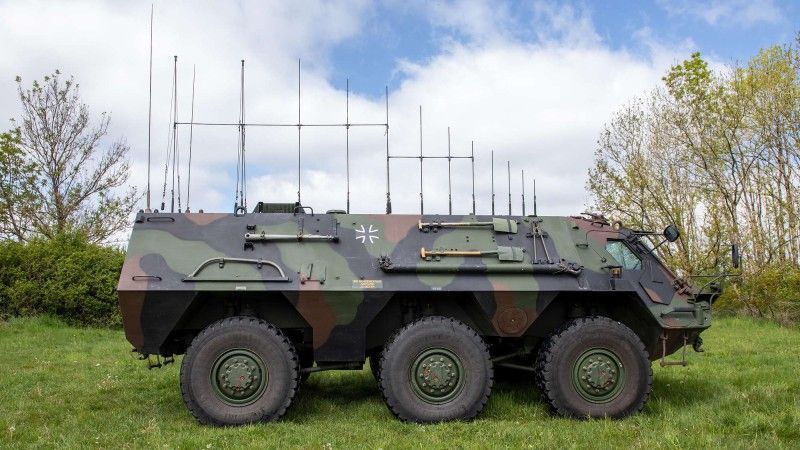
Photo. Bundeswehr/Martina Pump
Germany and the Netherlands are strengthening their cooperation in the field of electronic warfare (EW). Under the joint European Knifefish programme, both countries will acquire modern wheeled electronic warfare vehicles based on an architecture developed by Hensoldt. For the Bundeswehr, this represents a generational leap and the long-awaited replacement of outdated systems dating back to the Cold War.
According to reports from the German defence publication Hartpunkt, among others, the Bundeswehr intends to formalise an order for new electronic warfare systems in the near future under its national GeSys SgK programme (Geschützte Systeme zum Stören von gegnerischer Kommunikation – Protected Systems for Jamming Enemy Communications). The project is being implemented in close cooperation with the Netherlands, which officially assumed the role of lead nation in the Knifefish initiative in mid-2026.
The selection of the vehicle platform represents an interesting development for the German defence industry. Instead of the previously favoured Boxer armoured vehicle, the programme will use the Piranha V 8×8 wheeled armoured personnel carrier manufactured by General Dynamics European Land Systems (GDELS).

These vehicles will serve as the basis for two specialised configurations. The first, accounting for approximately two-thirds of the requirement, will be designed to disrupt enemy communications in the VHF/UHF frequency bands. The remaining third will be equipped with systems optimised for jamming communications in the HF band. This division will enable commanders to conduct flexible, layered electronic warfare operations against an adversary’s command and control networks and data exchange systems.
German-Dutch procurement of electronic warfare vehicles and prospects for further contracts
In Germany, the new vehicles will replace the heavily worn Hornisse (VHF/UHF) and Hummel (HF) electronic warfare systems, both mounted on ageing TPz Fuchs armoured personnel carrier chassis. Berlin is expected to procure approximately 20 systems during the initial phase.
The joint contract covering both countries, expected to be signed before the end of 2026, is anticipated to include an initial batch of 32 vehicles. According to the current schedule, deliveries to Bundeswehr units are planned for 2031–2032.
The initial contracts awarded to Hensoldt alone are estimated to be worth approximately €100 million. However, this figure could eventually increase to as much as €300 million if the Knifefish initiative is expanded to include additional customers.
Denmark and Switzerland are also reportedly interested in acquiring the new Piranha V-based electronic warfare systems, potentially extending the programme beyond its original German-Dutch framework.


