












- WIADOMOŚCI
- OPINIA
- ANALIZA
NATO Summit in Ankara: Relief and a sense of unfulfilled expectations

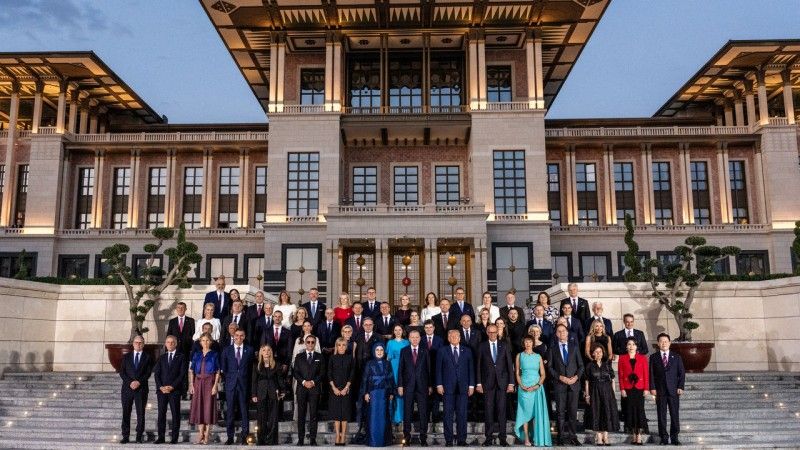
Photo. NATO
During the recently concluded NATO summit in Ankara, as well as throughout the many months of preparations that preceded it, the Alliance undertook the difficult task of not only preserving but also strengthening transatlantic cooperation and giving it a new form.
At the same time, in keeping with the principle of a 360-degree approach to deterrence and defence, efforts were made to develop a holistic view of the extensive range of challenges and threats confronting the Alliance. In the first area, despite numerous negative statements by President Donald Trump concerning NATO and other allies, the meeting may be regarded as a relative success, producing a sense of relief. In the second, however, considerable doubts remain, leaving a sense that the summit did not fully meet expectations.
Relief and unfulfilled expectations
In outlining the agenda for the Ankara summit, Secretary General Mark Rutte described the challenges facing NATO as a clear task: to turn Allied commitments into concrete results. Rutte noted that increased investment, greater industrial production and continued support for Ukraine shall be implemented. He added that all of this contributes to a stronger NATO and greater security for all member states.
The Ankara Summit Declaration also referred directly to the Alliance’s diverse challenges, highlighting the need to build „a stronger Europe within a stronger NATO.” This means that European allies and Canada must assume greater responsibility for the defence of the Alliance. In cooperation with the United States, this is intended to facilitate the integration of nuclear and conventional defence capabilities, supported by intelligence, space and cyber assets, including artificial-intelligence models. With regard to threats, the Declaration also identified Russia as a long-term threat to Euro-Atlantic security and stability, while stating that Iran must never acquire nuclear weapons and must respect freedom of navigation through the Strait of Hormuz. The document also referred, without providing specific details, to, as stated pervasive instability, hybrid threats and recurring shocks, all affecting the transatlantic security environment. But what about the full range of other challenges and threats that NATO faces today and will face in the future?

Tip of the iceberg
The issues outlined above are undoubtedly priorities in the security policies of the Alliance and its member states. They nevertheless represent only the symbolic tip of an iceberg comprising a far broader set of challenges and threats. Without broader and more in-depth analysis, NATO will not only be unable to implement its priority of maintaining a 360-degree approach to deterrence and defence effectively; more fundamentally, it will be unable to function successfully.
Why, then, were issues such as the following not addressed directly, but merely signalled: the dangerous manifestations of China’s policies; hostile activities conducted by Russia’s allies in different parts of the world; climate- and energy-related challenges; migration; terrorism; fundamentalism and other forms of radicalism; and many other issues already affecting not only the transatlantic security environment but the global security architecture as a whole?
Was their marginalisation the result of a lack of consensus or insufficient time? Or was most of the available political energy focused on preserving and strengthening transatlantic unity, amid concerns that these issues might deepen divisions among the allies? Naturally, it is impossible to address such a broad and diverse spectrum of problems during a short summit, nor is that the summit’s primary purpose. Such matters should be covered by the months of negotiations and consultations conducted beforehand by member states and partners.
Nevertheless, the summit’s treatment of the Middle East is strikingly limited, focusing primarily on Iran and the Strait of Hormuz. Although these are current priorities, the question remains: what about the region’s other flashpoints? The critically important regions of the Indo-Pacific, Antarctica and Africa were almost entirely omitted. Another shortcoming was the insufficient emphasis placed on the multidimensional nature of the threat posed by Russia and its allies. In addition to conventional military activity and the threat of using weapons of mass destruction, this threat includes numerous hybrid activities, such as sabotage, espionage, state-sponsored terrorism, disinformation and cyberattacks. These are deliberate and coordinated operations conducted below the threshold of open warfare, frequently exploiting links between intelligence services, criminal groups, diasporas and migrant communities. Russia treats NATO member states as an operational arena encompassing two zones. The first is the direct zone, comprising the eastern flank. The second is an indirect zone, which encompasses the remaining members of the Alliance to varying degrees and in different ways.

NATO 3.0
Without taking the challenges and threats described above into account, NATO will be unable to function effectively in any format, including the proposed NATO 3.0 model. To implement the Ankara Summit Declaration, including Mark Rutte’s call to „translate economic strength into military capabilities,” and to create credible deterrence, the Alliance will require more than the unified and effective engagement of all member states. It will also need a comprehensive, multidimensional approach to the numerous and constantly emerging challenges and threats it faces. In this context, the conduct and outcomes of the Ankara summit may be received with relief, but also with a lingering sense of unfulfilled expectations.
Sebastian Wojciechowski is the Head of the Department of Strategic Studies and International Security at the Faculty of Political Science and Journalism of Adam Mickiewicz University in Poznań. He is Chief Analyst at the Institute for Western Affairs in Poznań, an OSCE expert and a NATO DEEP eAcademy expert on internal and international security, as well as Editor-in-Chief of Strategic Review \[Przegląd Strategiczny\]. His recent publications include „The Evolution and Escalation of the Hybrid Terrorist Threat in the European Union” and „From Disinformation to Espionage: Russia’s Hybrid Actions Against Poland”.


