












- ANALIZA
- WIADOMOŚCI
The West needs a unified strategy towards the Sahel [PART 3]

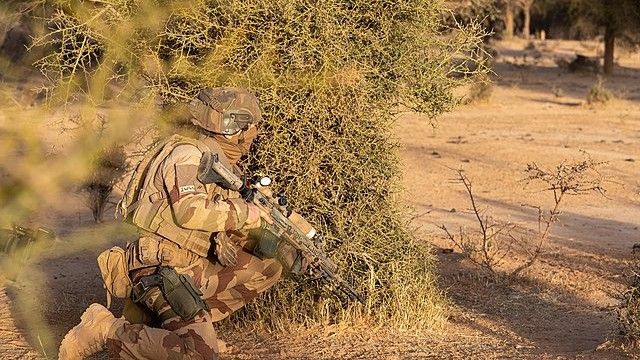
Supporting the fight against jihadists in Mali currently means indirectly strengthening the junta and the Russian presence. Conversely, the total isolation of Bamako makes it easier for JNIM to gain ground and makes the authorities even more dependent on Moscow. A similar dilemma applies to Burkina Faso and Niger. There is no simple choice here between good and evil. There are two threats that must be mitigated simultaneously.
This is the third part of the publication. To proceed to the second part, click here.
The West's dilemma
A repetition of Operation Barkhane in the same form as before is not realistic. The French Republic no longer has the political consent to return, and European nations remember the failure of the mission in the Sahel and the experience of Libya. The end of Barkhane created a vacuum that has not been filled, and Western actions remain uncoordinated and fragmented.
However, this does not mean that NATO should conduct another major intervention. The Alliance must, above all, recognise that the security of the southern and eastern flanks is linked through Russian influence, financial flows, migration, and terrorism. NATO has adopted a plan for stronger engagement in the Southern Neighbourhood and appointed a special representative, but at this moment, the main tools remain dialogue and cooperation at a general level.
This is precisely where a new approach is needed. It cannot be limited to training a few battalions or handing over money to authorities who do not control the provinces. Nor can it consist solely of protecting European borders. The Sahel requires intelligence support, transport protection, and aviation capabilities, but simultaneously the reconstruction of administration, courts, schools, and the local economy. Military actions must be combined with political reforms, development, and countering radicalisation. It must start with a stabilisation mission. Unfortunately, there are no other solutions—except perhaps for deploying troops on the borders of African countries (the more stable ones) and Europe.
See also 

What should be done?
The first direction should be to halt the expansion towards the Gulf of Guinea. Benin, Togo, Ghana, and the Ivory Coast need support before JNIM structures become established, rather than only after another front has emerged. This involves reconnaissance, border security, military mobility, road protection, and countering drones. However, support must also include local communities, as military abuses can destroy the effect of years of programmes in just a few months.
The second element is the reconstruction of regional cooperation despite the rift between ECOWAS and the AES. Terrorists exploit borders, while states waste time on political disputes. Mechanisms for exchanging information on the movement of militants, arms trafficking, and financing are essential. Maintaining channels of contact with juntas does not mean accepting their policies. It means preserving the ability to act where a lack of communication directly strengthens Russia and JNIM.
The third direction should be to strike at Russian financial networks. Sanctions against individual commanders will not suffice if gold continues to reach intermediaries and obtains legal documentation in subsequent countries. There is a need to identify mines, security firms, carriers, and refineries, as well as to ensure greater transparency of imports to the UAE and Europe. It must be emphasised that the Russian presence should be analysed simultaneously as a military, economic, and informational threat, also from a Polish perspective.
The fourth element is a return to the fight—the informational rivalry. Russia has won a significant part of the narrative dispute in Africa because it presented every French failure as proof of the effectiveness of its own model. Today, the real balance sheet must be shown: the fact that after several years of cooperation with Russia, jihadist control has not diminished, the number of victims remains high, and Mali has become a field of regular war. The need for communication with the population of the Sahel was already highlighted during the analysis of Operation Barkhane.
The fifth direction is greater involvement from NATO and the European Union, but without copying previous interventions. The Alliance has enormous military capabilities. The worst solution would be to enter again without a political goal and then withdraw after a few years. However, it is equally bad to believe that a lack of presence means a lack of costs.
The Sahel is part of European security
The destabilisation of the Sahel leads to the development of arms, drug, and human smuggling. It causes internal displacement within Africa and subsequently increases migratory pressure towards the northern part of the continent and Europe. Migrants should not be equated with terrorists. However, it must be accepted that armed organisations use the same routes, criminal networks, and forged documents. The crisis, therefore, concerns both humanitarian security and border protection.
The worsening situation could lead to larger migratory movements and more advanced terrorist operations aimed at Europe. At the same time, regional armies are incapable of controlling a significant part of their own territory. The answer cannot be solely closing borders, as the source of the problem is thousands of kilometres away.
At this moment, the most likely scenario is not the emergence of a single jihadist state covering the entire Sahel. Further fragmentation is more realistic. Capitals will remain in the hands of juntas, Russia will protect regimes and economic interests, while JNIM and Islamic State will expand their control over rural areas and transport routes. Such an arrangement could last for years and gradually spread southwards.
See also

This is precisely why Mali is so important. It is not only a war front for the Russian Federation but also a place where the limitations of the Russian model are visible. Moscow can keep a partner in power, but it cannot rebuild a state. It can extract raw materials but does not stop the expansion of JNIM. Each subsequent year of conflict increases its influence in the capital while simultaneously reducing the authorities’ control over the provinces.
Europe cannot choose between supporting Russian partners and leaving the region to jihadists. It must pursue a policy that limits both threats. This requires contact with the AES, strengthening the Gulf of Guinea states, striking at the financing of Russian operations, and rebuilding reconnaissance capabilities. This will be costly and politically difficult, but further inaction also carries a price.
The biggest mistake would be to assume that Africa, Russia, and Ukraine are three separate topics. Russia uses African raw materials to strengthen its own war efforts. It exploits the security crisis to displace the West and then presents itself as the only partner capable of protecting regimes. Jihadists exploit the same vacuum, extending their influence towards the Gulf of Guinea. If Europe does not create a strategy encompassing these dependencies, it will only react when the threat is once again much closer to its borders.


