- WIADOMOŚCI
- ANALIZA
Russia ordered arson attack on Milrem Robotics. Estonia points directly to Moscow


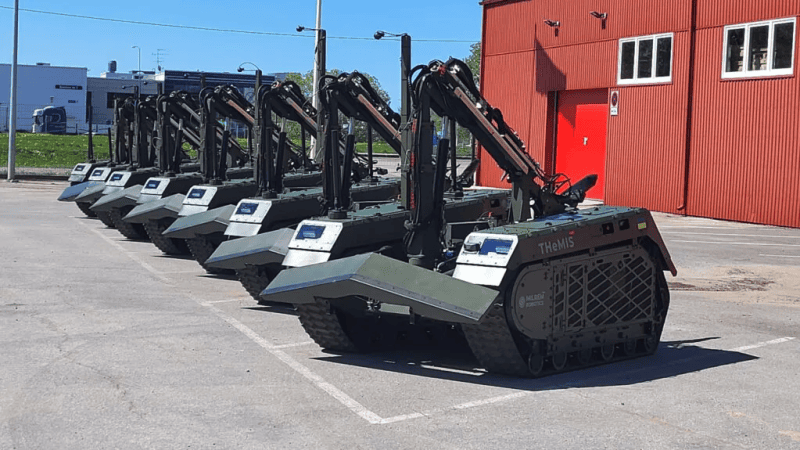
Estonia has formally attributed the August arson attack against Milrem Robotics to Russian security services. KAPO assesses that the fire in Tallinn on the night of 14–15 August was a deliberate and pre-planned act of sabotage commissioned by Russia. This is important because Tallinn has moved from investigating a possible Russian link to direct attribution to the Russian Federation.
Three Latvian citizens suspected of taking part in the attack were detained shortly afterwards and are now in custody in Estonia. According to KAPO, the modus operandi is consistent with other acts of sabotage carried out in Europe on behalf of Russian services. Since the beginning of the full-scale war against Ukraine, Estonia and its partners have identified and detained more than 20 people involved in physical attacks conducted for Russia.
Based on the information collected by the Estonian Internal Security Service @kaitsepolitsei we can conclude with certainty that the arson attack on Milrem Robotics premises that took place on the night of 14–15 august in Tallinn was an act of sabotage ordered by the special…
— Margus Tsahkna (@Tsahkna) September 29, 2026
Not an accident
The choice of target was not accidental. Milrem Robotics produces unmanned ground systems, including THeMIS vehicles used by Ukraine. Defence companies, drone manufacturers and organisations supporting Kyiv are therefore natural targets for Russian services. The objective does not always have to be the destruction of a factory. An attack can test physical security, emergency procedures, response times and the ability of a company to continue operating.
There is another element which should not be ignored. Russia increasingly uses recruited intermediaries rather than its own officers. These people may be paid, manipulated or given a false explanation for the task. This makes the operation cheap, gives Moscow additional distance from the attack and allows the same model to be repeated in different European countries.
For Estonia, this is particularly important. The public debate often focuses on Narva and the possibility of a future Russian military move across the border. Estonia obviously has to defend Narva and strengthen the eastern frontier, but that is only one part of the problem. The Milrem case shows that the threat is already inside the country.
Russia does not need to send troops across the Narva River to attack Estonia. It can recruit people, burn a defence company in Tallinn, target infrastructure, conduct cyber operations or try to weaken support for Ukraine. Estonia therefore has to prepare for two threats at the same time: a conventional challenge from the east and hostile operations conducted inside the state.
This is the most important conclusion from the Milrem case. Estonia is not waiting for a hypothetical attack on Narva. It is already dealing with Russian actions on its own territory. The border must be defended, but so must factories, transport networks, telecommunications and other infrastructure inside the country. That is exactly where Russia is already testing how far it can go below the threshold of open war.
Response of the allies
The incident described represents another example of growing Russian pressure exerted on NATO countries. In the case of Estonia, as well as Lithuania and Latvia, the threat from Moscow takes on an existential significance. Therefore, skillfully deterring Russia and communicating the capacity to effectively repel potential aggression on its part is crucial.
“The United States should take all possible measures to demonstrate its commitment to allied obligations. Strategic ambiguity encourages Russian actions and significantly increases the chances that Putin might take a risk. NATO must deter and, if necessary, defeat a limited Russian invasion at both the political and military levels,” assessed the American Institute for the Study of War in a recent report. In light of such assessments, the Americans’ decision to remain in Estonia and the new rotation that will reinforce Lithuania’s defence should be viewed positively. Indeed, it is Estonia that is hosting an American armoured infantry battalion along with a tank company. Furthermore, one must not forget the 1,200 British troops who will also reinforce this Baltic country next year. There are also Turkish F-16s ensuring secure airspace in this part of NATO.
As Dr Aleksander Olech mentioned, Estonia is hosting an American armoured infantry battalion along with a tank company. Furthermore, one must not forget the 1,200 British troops who will also reinforce this Baltic country next year. There are also Turkish F-16s ensuring secure airspace in this part of NATO.
Another significant deterrent could be a new base that Estonia plans to build right in Narva. As we wrote, up to a thousand soldiers will be able to be stationed at the new facility, which is largely financed by the EU Cohesion Fund.