












- WIADOMOŚCI
- ANALIZA
Estonia keeps US troops. NATO strengthens the Baltic defence

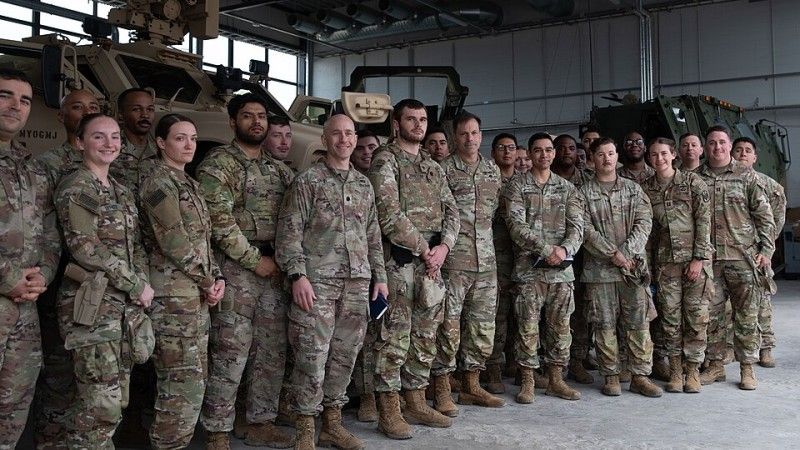
Photo. U.S. Army photo by Pfc. Jaidyn Moore / Wikimedia Commons
The United States is maintaining its military presence in Estonia. This is an important decision at a moment when Russian disinformation increasingly suggests that NATO is weakening its eastern flank and that the Baltic states could be left without sufficient allied support. The military reality is different: US forces remain in Estonia, a new American rotation is heading to Lithuania, and other Allies are simultaneously increasing their presence in the region.
This matters particularly in the context of repeated scenarios concerning Narva and a possible rapid Russian operation against Estonia. As we have argued at Defence24, such scenarios are often reduced to the first hours of a hypothetical attack. But Russia would not only have to cross the border. It would have to sustain forces, move ammunition and fuel, protect logistics and operate while NATO units already deployed in Estonia were responding. That makes the military calculation much more complicated than the simplified narrative of quickly taking Narva and presenting the Alliance with a fait accompli.
Today, Estonia hosts a US armoured infantry battalion together with a tank company, while the UK leads NATO’s Forward Land Forces presence with France contributing on a rotational basis. The United Kingdom has also decided that around 1,200 troops will deploy to Estonia next year, while an entire British brigade will remain at high readiness to reinforce the country. Turkish F-16s are meanwhile operating from Ämari as part of NATO’s Baltic air defence mission.
Lithuania is receiving another important signal at the same time. After months of uncertainty linked to the Pentagon’s wider review of US force posture in Europe, President Gitanas Nausėda confirmed that a new American rotation is already on its way. The exact size has not yet been disclosed, but the United States has maintained roughly battalion-sized armoured rotations there since 2019.
Taken together, these decisions are important because they contradict the narrative that the United States is simply withdrawing from the Baltic region. Washington is reviewing its posture in Europe and may still change the overall structure or number of forces, but Estonia keeps US troops and Lithuania is receiving a new rotation. At the same time, European Allies are adding their own forces and capabilities.

Poland remains the third element of this picture. It hosts the largest US military presence on NATO’s north-eastern flank and serves as a key logistical hub for the region. Discussions about a possible permanent US base would further strengthen that role, although such a project would take years to implement. The immediate deterrence picture therefore depends on forces already present in Poland, Lithuania and Estonia rather than on infrastructure that may only appear in the future.
There are therefore two important signals. First, the Baltic states are not being abandoned. Second, NATO’s eastern flank is becoming more layered, with American, British, French, German and Turkish forces operating alongside national militaries. This does not remove the risk of sabotage, drone incursions or limited provocations. It does, however, make a conventional Russian operation much more difficult, because Moscow would have to assume from the first moment that it would be confronting not only Estonia or Lithuania, but allied forces already deployed on their territory.


