- WIADOMOŚCI
C-OBRA: A new era of digital self-protection on the modern battlefield

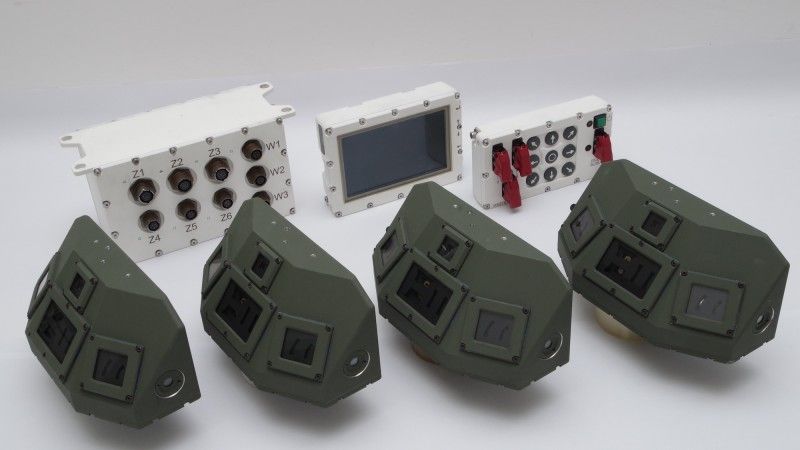
Photo. PCO
The modern theater of operations is evolving rapidly. The proliferation of unmanned aerial vehicles, precision-guided munitions, and advanced fire-control systems is creating new challenges for the crews of combat and support vehicles. Conventional armor is no longer sufficient, as the key is to prevent the enemy from successfully detecting and targeting a vehicle and guiding weapons against it. The Polish defense industry’s answer to this challenge is C-OBRA, a new-generation laser warning system developed by PCO S.A. in cooperation with Zakłady Metalowe Dezamet S.A. Unveiled at the 2026 MSPO defense exhibition in Kielce and entered for the prestigious Defender Award, the solution is a comprehensive, highly automated soft-kill self-protection suite scheduled to enter serial production in 2027.
Revolutionary architecture and detection accuracy
C-OBRA is a major evolution of the well-established Obra family of systems, introducing an entirely new standard of sensitivity, spectral coverage, and functionality. Its principal technological advantage is its fully passive operation. The system monitors its surroundings solely by receiving signals emitted by hostile equipment. It therefore generates no electromagnetic emissions of its own, does not disclose the vehicle’s position, and does not interfere with other onboard electro-optical systems.
The system’s architecture comprises four to eight miniature modular detector heads, a modern electronics unit, and an intuitive control panel with an LCD display. The entire system remains fully operational across the demanding military temperature range of −30°C to +55°C. Its low weight and high environmental resistance allow it to be readily integrated not only with heavy combat vehicles but also with lighter wheeled platforms and unmanned vehicles.
Full-dome protection: Resilience against drone-borne designators and beam-rider missiles
A key feature distinguishing C-OBRA from both earlier-generation solutions and foreign competitors is its exceptionally broad elevation coverage, ranging from -6° to +84°. This field-of-view geometry enables the effective detection of laser designators and rangefinders operating at high angles, including systems carried by reconnaissance and combat drones. Each detector head provides approximately 90° of azimuth coverage, while the system’s high angular resolution in the shortwave band: approximately 8° (1σ)—allows it to locate the source of a laser beam rapidly and accurately.
The system offers a very broad detection spectrum, operating in a broadband range of 0.7–11 µm and a shortwave range of 0.8–1.7 µm. Using advanced digital algorithms, C-OBRA can rapidly identify and classify nearly every type of laser threat, including single- and multiple-pulse rangefinders, continuous-wave target designators, illuminators, and difficult-to-detect laser beam-riding guidance systems used by modern anti-tank guided missiles. In addition to determining an accurate bearing, the system measures and records the precise duration of laser irradiation, enabling an accurate assessment of the adversary’s intent and the type of sensor being used.

Photo. PCO
Intelligent response and synergy with ZWP-81 launchers
A laser warning is valuable primarily when it prompts an immediate response. Integrating C-OBRA with modular 81 mm ZWP-81 smoke grenade launchers (available in configurations of four, six, eight, or 12 tubes) creates a cohesive defensive mechanism. In the modernized ZWP-81M variant, C-OBRA can operate in either fully automatic or manual mode, independently calculating the threat azimuth and selectively launching obscurants to a distance of up to 350 meters exclusively within the threatened sector.
This approach optimizes grenade expenditure, enabling a vehicle to defend itself repeatedly during a single engagement without the risk of rapidly exhausting its supply of obscurants. Combined with a new generation of multispectral ammunition being introduced by Zakłady Metalowe Dezamet S.A., the system provides the vehicle with an immediate screen that effectively degrades not only rangefinders and targeting lasers but also hostile night-vision and thermal-imaging systems.
Situational awareness, BMS integration, and counterattack potential
C-OBRA is much more than a basic warning system—it is a digital data-exchange node. Its modern LCD operator panel displays the tactical situation in real time across a full 360° or in 6,400 mils, continuously tracking the time elapsed since a beam was detected and the current load status of each launcher. Interfaces compatible with BMS- and C2-class battlefield-management systems allow information that a vehicle has been targeted to be distributed within a fraction of a second to the command echelon and other units in the formation.
Equally importantly, C-OBRA can transform passive defense into a rapid fire-response capability. Precise azimuth and elevation data for the emitter can be used to turn a tank turret, an infantry fighting vehicle’s cannon, or a remotely operated weapon station automatically toward the source of the threat. This allows the crew to open fire immediately against a hostile vehicle or neutralize a UAV before the adversary can launch a missile. Crew safety is further enhanced by built-in self-diagnostics and automatic interlocks connected to hatch-position sensors, preventing the accidental discharge of pyrotechnic countermeasures while the hatches are open.
A common protection standard for the Armed Forces and export prospects
C-OBRA’s versatility and compact design mean that it could become a common protection standard across a broad range of Polish Armed Forces vehicles. The system was designed for installation on Krab 2 self-propelled howitzers, Rosomak wheeled armored personnel carriers, WD/WDSz command vehicles, Waran 4×4 and Heron 6×6 carriers, third-generation Jelcz trucks, and platforms belonging to the Gladius unmanned reconnaissance-strike system. Its design also enables it to protect critical logistics, ammunition, and repair vehicles, which in the age of drones are exposed to attack to almost the same degree as frontline units. The system could also be adapted for use on naval platforms in the future.
Introducing a single standardized system would deliver tangible economic benefits by simplifying maintenance, spare-parts supply, and crew training. With production readiness planned for 2027, full compatibility with Western standards, and the flexibility to integrate with foreign platforms, C-OBRA has all the attributes required to become not only a cornerstone of protection for Polish combat vehicles but also an important export product for the Polish defense industry.
Sponsored Article. PCO S.A. S.A. is the partner of this publication.