












- KOMENTARZ
- ANALIZA
- WIADOMOŚCI
Overstretched and dependent: the unsustainability of Israel’s military engagements

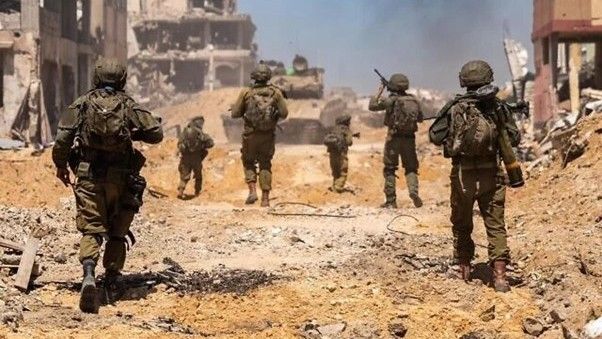
The prolonged series of high-intensity military engagements across the Middle East is placing Israel under growing operational strain and deepening dependence on the US. This model cannot be sustainable in the long term.
While much has already been said about the shortages in American, British, and even French stockpiles exposed by the recent war with Iran, far less attention has been given to even greater strains within Israel. Tel Aviv’s near-constant military engagement in its immediate neighborhood has become so normalized that we may underestimate how deeply exhausting the past few years have been.
With Hamas in Gaza, Hezbollah in Lebanon, the Houthis in Yemen, jihadist groups in Iraq, and, of course, Iran across the Middle East, Israel is today operationally overstretched, confronting multiple high-intensity points of engagement that would be difficult to sustain in the long term and that are pushing the country into deepening dependence on the United States.
An army that "is going to collapse in on itself"
Last month, IDF chief Eyal Zamir reportedly warned that the Israeli army “is going to collapse in on itself,” raising “10 red flags” about its condition during a security cabinet meeting. Chief among them is a manpower shortfall exceeding 15,000 personnel, including 7,000–8,000 combat troops. In addition, reserve units are showing growing signs of war fatigue after six or seven mobilization cycles, with growing numbers refusing redeployment to Gaza.
Zamir suggested comprehensive legislative reform, including a new Draft Law and Reserve Service Law. The proposed measures include extending mandatory service for men back to 36 months and expanding conscription to the Ultra-Orthodox (Haredi) population. Both steps would be politically contentious, yet may prove necessary to avert the scenario he outlined: an IDF that is increasingly unable to sustain even routine operations as the reserve system erodes.
More fundamentally, Israel’s constraints are structural. As a demographically small state already allocating around 7 percent of its population to active and reserve service, it may be approaching the upper limits of what it can sustainably mobilize.
See also 

The industrial and fiscal limits of prolonged engagement
Then come stockpile shortages, from which Israel is no exception either, especially in ballistic missile interceptors, where the country was reported to be running “critically low”. In March, it fired hundreds of Arrow-2 and Arrow-3 missiles – each costing over $1 million and taking significant time to produce – to intercept far cheaper and more scalable Iranian drones and rockets, exposing an unsustainable cost dynamic. The April 8 ceasefire may offer a brief window to replenish depleted stocks, but it does not resolve the underlying problem.
Obviously, Israel is trying to compensate by expanding production capacity, yet that takes money and industrial depth— both of which are under strain. Domestic munitions plants are already operating around the clock in three shifts, while new contracts for tens of thousands of shells place further pressure on the country’s defence-industrial base.
If there is one figure that best captures the draining effect of Israel’s multiple military engagements, it is defence spending as a share of GDP. Since 2022, this has doubled, rising from 4.4 percent to over 8 percent in the record $45 billion defence budget for 2026. This places Israel third in the world, behind Ukraine and ahead of Russia. Such a burden must, and already does, affect the country’s fiscal condition. Israel has been running elevated budget deficits since the pandemic, while its debt has risen rapidly and is projected to exceed 70 percent of GDP this year. At this stage, Israel’s prolonged war economy risks becoming fiscally unsustainable.
See also

An increasingly risky dependence on US military and financial support
Expanding overstretch goes hand in hand with deepening military and financial dependence on Tel Aviv’s vital ally, the United States. High-intensity warfare waged simultaneously across so many fronts requires global high-end capabilities and military mass that Israel simply does not possess and that only Washington can provide. From air power — including missiles, bombs, and fighter aircraft – to space-based intelligence and early-missile warning, the US today acts not only as a force multiplier, but in many respects as a force enabler.
To illustrate this dependence more vividly, Israel recently found itself in urgent need of both US military and commercial ISR capabilities due to a severe shortage of homegrown Ofeq spy satellites, some of which had become outdated or were deorbited. With only four capable satellites in orbit, Israel lacks the scale and revisit rates to continuously monitor all key points of interest. Reportedly, Netanyahu raised the issue in Washington as early as 2024, while Israel signed multimillion-dollar imagery contracts with US operators. Without externally provided data, the much-envied effectiveness of Israeli intelligence could be greatly compromised, and with it, much of its informational superiority in the region.
Israeli military power also rests financially on a constant flow of multibillion-dollar US contributions. By 2024, Israel was by far the largest cumulative recipient of US foreign aid, having received more than $300 billion, mostly in military assistance. Under the 2016 Memorandum of Understanding, the United States committed to provide $3.8 billion annually, but additional support following the 2023 Hamas attack raised that figure to $16.3 billion in 2024 alone — roughly equivalent to Mexico’s entire defence budget for the same year. It is difficult to say where Israel would stand today without this steady backing, and what halting it would mean not only militarily, but also diplomatically.
We may, however, find out sooner than expected. Today, 60 percent of Americans hold a negative view of Israel, marking a sharp reversal from 2022. Not only do around 80 percent of Democrats now hold such views, but Republicans are also becoming increasingly critical, with a majority of those aged 18–49 already taking an unfavourable position. As Leon Hadar concluded in National Interest already a year ago, “the longtime pro-Israel bipartisan consensus in American politics is fading — precisely at the moment Israel needs it most.” If Israel does not change course, this shift in public opinion must eventually translate into actual policy, and even the formidable lobbying efforts may not be enough to stop it.
It is therefore not implausible that Donald Trump could be the last so strongly pro-Israel US president. Even if that proves not to be the case, America’s declining relative power, together with its strategic refocus on homeland affairs and the Indo-Pacific, may in time limit the resources available for Israel. One day, the Israeli political elite may wake up to a new reality in which the United States is either no longer willing or no longer able to answer its calls for support. Then, all the vulnerabilities discussed above would become even more acute, and there is little evidence that Israel is prepared for such a scenario.

The way out: Israel's most consequential choice
As history repeatedly shows, persistent operational overstretch is often the product of ignoring one’s own limits and the warning signs that precede strategic disaster. Israel now appears to be testing the outer limits of what its military, industrial base, and society can sustain, while becoming increasingly reliant on an ally that may retreat from its commitments faster than Jerusalem expects. If Israel decides to persist on this course, or even double down, it is unlikely to end well for either Israel or the region as a whole.
The most logical way out for Israel would be to scale back, narrow its strategic priorities, and act more selectively in the use of military force. At the same time, it should seek to embed itself more constructively in the regional security architecture rather than further isolating itself and destabilising that environment from within. One of the key tests will come on Israel’s northern border after the end of this year, when the UN Interim Force in Lebanon is due to expire. At that point, Israel will face yet another choice between stabilization and escalation, with the latter likely to further strain its already stretched resources.
Militarily, much hinges on the country’s ability to harness the New Defence revolution to deliver scale, speed, and lower costs before US support begins to wane. Such a shift is entirely possible given the strength and dynamism of Israel’s defence-industrial-technological complex and the unmatched resilience of its society. But even the most agile military cannot escape the country’s structural and geostrategic constraints, which will ultimately require strategic restraint and painful compromises — qualities Israel may not yet be ready to accept.


