












- WIADOMOŚCI
Macron in Poland. Strategic missiles and nuclear deterrence

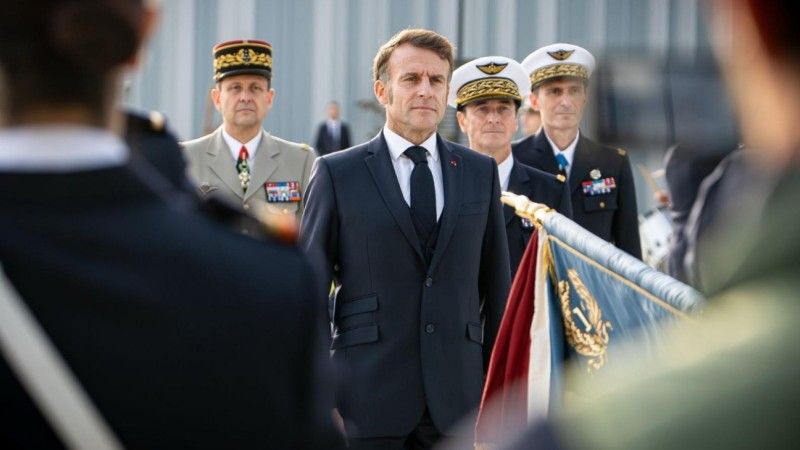
Photo. A.Derewiany/Armée de l'Air et de l'Espace
Next week, French President Emmanuel Macron will visit Poland. According to unofficial information obtained by Defence24.pl, the talks will cover a range of strategic issues, including defence, Polish equipment procurement, and France’s extended nuclear deterrence.
President Macron is scheduled to visit Gdańsk on Monday, 20th April. The visit is to take place on the eve of the anniversary of the signing of the Treaty of Nancy on 9th May, which established 20th April as Polish-French Friendship Day. Macron will meet with Polish Prime Minister Donald Tusk, and the talks will focus on broadly defined international, economic and energy cooperation, as well as security and defence.
The visit of President Emmanuel Macron to Poland is to be accompanied by a broad government delegation and an extensive agenda covering both strategic issues and specific armaments and industrial projects. Consultations between ministers from both countries are to take place, and the delegation is expected to include, among others, the heads of the defence ministry — Catherine Vautrin — and the foreign ministry — Jean-Noël Barrot. This will make it possible to address concrete topics, including defence cooperation.
Nuclear cooperation: energy and deterrence
The most strategic dimension of the talks is expected to concern nuclear energy, but also nuclear deterrence. In the former case, the main topic will be the project for Poland’s second nuclear power plant. When it comes to the latter, the subject will be the extended nuclear deterrence framework announced at the beginning of March by French President Emmanuel Macron. Poland has been mentioned as one of the countries expected to participate in the initiative, alongside the United Kingdom and Germany, as well as Belgium, Greece, Spain, the Netherlands and Denmark.
France’s extended nuclear deterrence is intended to complement NATO arrangements such as nuclear sharing. France operates Rafale fighter aircraft configured to carry ASMP-A missiles. According to unofficial information obtained by Defence24.pl from French sources, various ways of strengthening their presence in Poland are expected to be discussed during the talks. Paradoxically, engagement in the French initiative could also strengthen Poland’s position in talks with the Americans on expanding its role within NATO’s own nuclear sharing system. Cooperation with France will undoubtedly require a high level of commitment. In this context, Paris may expect Poland to place greater emphasis on industrial and economic cooperation with France, including in the defence sector. That will be another topic for discussion.
Conventional defence
The defence talks are also expected to cover conventional weapons procurement. According to unofficial information from French sources cited by Defence24.pl, one of the key issues may be Poland’s acquisition of French missile systems and the joint development of deterrence systems under the ELSA programme. Poland and France have been cooperating within this project, together with several other countries, since 2024. France’s contribution to the deterrence programme may, alongside entirely new projects, include the development of the first EU land-based cruise missile with a range of more than 1,000 km.
It is to be based on the SCALP Naval NCM cruise missile, which is already used on French Navy surface ships and submarines and has been employed in combat. That missile could also be offered to Poland, for which, following the adoption of the new Armed Forces Development Programme, deep strike is one of the priorities. A related issue is the possible approval by the French DGA procurement agency for the integration of cruise missiles with Polish Orka-class submarines, including, potentially, the Swedish A26 vessels. Such a move would represent a qualitative leap for Poland in deep strike capability, enabling it to engage targets at long range from maritime platforms.
The agenda also includes talks on the acquisition of aerial refuelling platforms. This could significantly enhance the operational capabilities of the Polish Air Force, including the F-35, F-16 and FA-50PL, and strengthen interoperability within NATO. By the end of the decade, the number of aircraft in the Polish Air Force capable of aerial refuelling is expected to exceed one hundred. At present, however, the Air Force does not possess this capability and depends entirely on allies (including French aircraft, which have repeatedly refuelled Polish F-16s). It has long been known that aerial refuelling is high on NATO’s list of priorities, especially in a scenario where the United States could not, or would not, provide its fleet of hundreds of aircraft. Poland has already previously signalled an initial interest in acquiring such aircraft from France.
At the end of last year, Deputy Commander of the General Command Maj. Gen. Ireneusz Nowak said in an interview with Defence24.pl that Poland planned to purchase two Airbus A330 MRTT aircraft from the SAFE fund, with long-term requirements amounting to four aircraft. This is one of the most important areas of cooperation with France, and Airbus itself is becoming increasingly present in Poland, also thanks to last year’s contract for several dozen Airbus aircraft for LOT Polish Airlines signed at the Paris Air Show.
An important element is also industrial cooperation with French companies such as KNDS and Eurenco in the production and development of various types of modern ammunition and its components. This fits into the broader trend of rebuilding European production capacity and securing supply chains for operations in high-intensity conflict environments. Other topics will also be discussed, including satellite systems.
In the current political and strategic environment, France is becoming an increasingly important ally for Poland, which is driving efforts to build closer political, economic and defence ties. The agenda for Emmanuel Macron’s visit to Poland reflects the deepening of Polish-French cooperation, and the visit itself may become a step not only towards closer strategic cooperation, but also towards the implementation of concrete security and defence programmes.


