- WIADOMOŚCI
Polish defence minister calls for 24/7 arms production

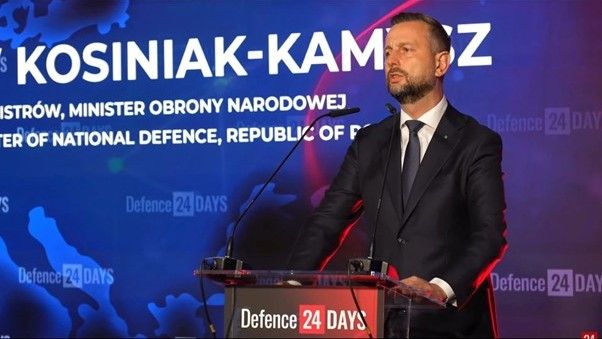
Photo. defence24
The appeal to Poland’s domestic defence industry, delivered at the region’s largest security event, comes amid a growing need to rapidly scale up production of munitions, drones, and missiles.
Opening Defence24 Days, the largest security conference in Central and Eastern Europe, held in Warsaw on 6–7 May, Polish Defence Minister Władysław Kosiniak-Kamysz made a special appeal to Poland’s domestic arms industry.
He argued that wartime-like conditions require full engagement and commitment from Poland’s arms industry, both state-owned and private. He called on manufacturers to shift into continuous production mode, operating across multiple daily shifts, ideally 24 hours a day, seven days a week, in order to deliver the most urgently needed systems at scale and speed.
Polish defence industry to deliver Poland's key capability priorities
While doing so, he also underscored the importance of Poland’s defence industry in adapting the country’s military to rapidly changing battlefield realities. He made clear that Polish procurement will place particular focus on disruptive technologies increasingly decisive in modern warfare, including drones and counter-drone systems, satellite imagery, artificial intelligence, and deep-strike capabilities.
At the same time, the Polish minister cautioned against an excessive focus on any single technological solution. ”Drones change the character of war, but not its nature. There is no army that can be built only on drones,” he noted. Adaptation, he added, does not mean overturning the existing force model, but transforming it, while ensuring that Poland does not lose sight of other critical domains of warfare.
The three pillars of Poland's security strategy
During the same speech, Kosiniak-Kamysz reiterated the three pillars of Poland’s security strategy: society, the army, and alliances. He underlined that Poland will defend itself not only through its armed forces, but also through the strength of its institutions and the commitment of every citizen.
According to the minister, Poland’s key strategic objective remains to build the strongest and largest army in Europe. By 2030, the Polish Armed Forces are expected to number 500,000 soldiers, including through the addition of 200,000 high-readiness reservists. Currently, the total stands at around 217,000, meaning that Poland would have to more than double the size of its armed forces to meet this target.
Referring to the U.S. plans to withdraw 5,000 troops from Germany, Kosiniak-Kamysz declared Poland’s readiness to welcome additional American forces. “There is no secure Europe without an American presence,” he said, expressing hope that Poland can act as a transatlantic bridge between the continent and Washington.
The minister also directed his appeal to European allies. Pointing to the urgency of the security situation facing the continent, he argued that waiting until 2035 to meet the Hague commitment of 5% defence spending may be too late. Instead, Kosiniak-Kamysz called for the target to be reached by 2030. This, however, seems rather implausible, given that many European NATO members are today merely meeting the 2% target.