












- WIADOMOŚCI
- KOMENTARZ
A sweet-and-sour G20 summit in Johannesburg

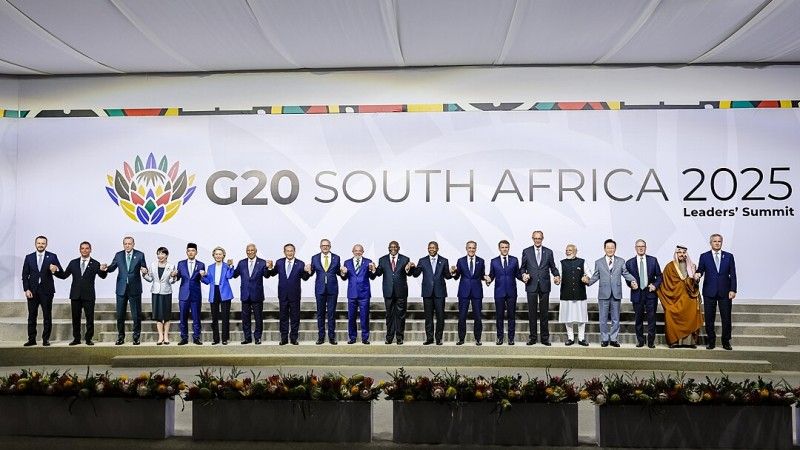
Photo. Ricardo Stuckert (PR)/Wikipedia
The 20th G20 summit, held in Johannesburg on 22-23 November, offered South Africa both reasons for pride and grounds for unease. Media coverage focused less on what happened and more on who chose not to attend. Three absences in particular dominated the headlines: Xi Jinping, Vladimir Putin and Donald Trump – the latter making a conspicuously theatrical point of his no-show. The presidents of Mexico and Argentina were also missing, while Indonesia and Saudi Arabia sent deputies in place of their leaders.
South Africa’s presidency, centered around the theme „Solidarity, Equality, Sustainability,” steered the summit firmly toward the priorities of the Global South, shifting attention away from topics typically emphasized by Western states, such as Russia’s aggression in Ukraine. Despite the domestic narrative presenting both the presidency and the summit as an unqualified success, deep divergences within the group repeatedly stalled discussions – raising uncomfortable questions about the continued relevance of the G20 itself.
South Africa Summit
South African presidency was the fourth consecutive G20 presidency held by a Global South nation, following Indonesia, India and Brazil. As a result, the agenda in recent years has increasingly reflected the priorities of developing regions: investment in under-funded areas, food security, borrower-centered lending frameworks, and climate change understood as a threat disproportionately affecting countries in hotter zones. South Africa’s priorities under its chosen theme aligned with this trajectory.
Johannesburg hosted the first G20 summit ever held on African soil, with the African Union participating as a full-fledged member. Unsurprisingly, African priorities featured prominently: disaster resilience, financing the energy transition, and critical minerals. Notable attention was given to the G20 Compact with Africa – launched in 2017 under World Bank auspices – whose aim is to mobilize private capital for African investment. The summit inaugurated Phase 2.0 of the project, intended to be more dynamic than the first iteration, which had been criticized for its sluggish execution.
African issues have not resonated this loudly on the global stage for some time, which alone marks a significant achievement for South Africa’s presidency. The African Union, having joined the G20 in 2023, solidified its status as a full member. Momentum was also given to the African Development Bank and its cooperation with the World Bank. Strong arguments were aired for greater support from wealthy nations to poorer ones, especially in the face of climate impacts borne disproportionately by the latter. From South Africa’s perspective – and that of the continent more broadly – the summit successfully elevated crucial topics to a high-level forum. It also represented a continuation of Global South leadership within the G20 and a rebalancing of global priorities long skewed toward the West.
Yet the same presidency also led to an undeniable decline in the summit’s political stature – a fact South African diplomacy struggled, unsuccessfully, to mask. Xi Jinping simply ignored the event. Putin likewise stayed away; although his presence might have boosted media interest. Travelling to South Africa could have exposed him to arrest – the same reason he skipped the 2023 BRICS summit in Johannesburg.
Important absences
The most damaging absence, however, was that of U.S. President Donald Trump. Since the start of his term he has sharply escalated tensions between Washington and Pretoria, further inflamed by South Africa’s explicitly pro-Palestinian position. Trump declared he would not set foot in South Africa while „human rights abuses” against the white population continued – generating the summit’s most widely circulated headline. Xi’s absence, while less sensational (he also skipped the BRICS summit in Rio in July), deeply disappointed the organizers given China’s extensive engagement on the continent.
Beyond the optics, disagreements plagued committee and working-group sessions. The eventual adoption of a 122-point Leaders« Declaration should be recognized as a diplomatic victory for South Africa. One particular clause proved contentious: „We concur that, guided by the Purposes and Principles of the UN Charter in its entirety, we will work for a just, comprehensive, and lasting peace in Sudan, the Democratic Republic of Congo, the Occupied Palestinian Territory, Ukraine, as well as ending other conflicts and wars around the globe.”\ Neither the absent United States nor Argentina endorsed this document.
Nevertheless, the simple fact that South Africa shepherded the summit to a conclusion counts as both an organizational and diplomatic success.
South Africa’s presidency strengthened the voice of the Global South – and especially Africa – within the G20. But it simultaneously exposed and exacerbated a decline in the group’s prestige. The future trajectory of the G20 remains uncertain.


