












- WIADOMOŚCI
- ANALIZA
- KOMENTARZ
Are we witnessing the beginning of the end of war in Europe?

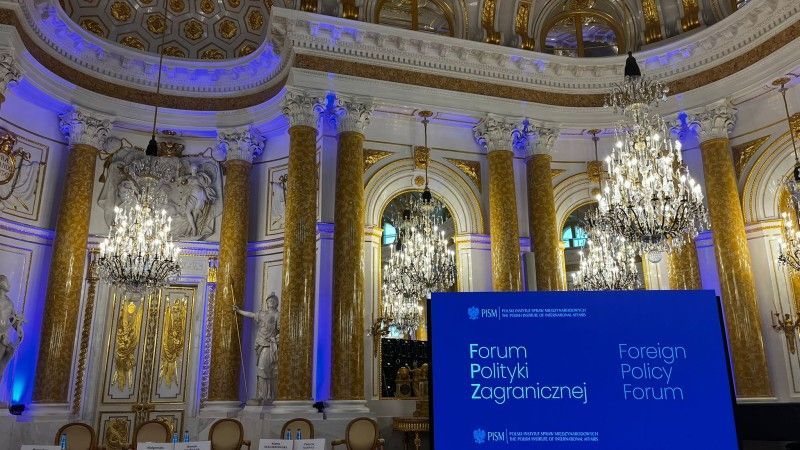
Photo. Katarzyna Łukasiewicz
Are we witnessing the beginning of the end of war in Europe? That is a question posed by the organizers of the Foreign Policy Forum, the Polish Institute for International Affairs (PISM). And even if we are, do we know exactly what „the end” might mean?
The panelists agreed: we live in the times of the politics of power and the international law’s perspective is not relevant anymore. According to the PISM’s analyst Patrycja Sasnal, „in the 90s we were sold a vision of the new world of peace – today everything is turned upside down”.
Lost hopes and the fall of the law
To clarify, the 90s were a particular time for Poland and for all the nations of the so-called Eastern block. The fall of the communism was seen even as the actual end of the slavery rooting from the decisions following the end of the World War II. It was a great revolution that happened across half of Europe, but with revolution there came many questions regarding the system those freshly free nations wanted to build. But we had a lot of other countries to look up to. The ones in Europe and the ones across the Atlantic.
Today looking up to does not seem like the best idea since the myths we grew up on have disappeared in front of our eyes. What we need in this part of the world is our own vision. We are experienced enough – maybe we just felt comfortable enough under the care of the older brothers. But this is not the case anymore.
2025 certainly has not been a year of peace. The wars have been ravelling across the world, as since the beginning of time: Israel’s horrific crimes against Palestinians, the war with Iran, wars in Sudan, Democratic Republic of Kongo, Yemen, Pakistan and India, ongoing China and Taiwan tensions. But the greates threat in Europe is once again Russia. And it is not only the kinetic war going on in Ukraine, it is also the whole arsenal of hybrid menace in all of Europe, including Poland. And it is, once again, one of the symptoms of the politics of power.
But let’s go back in time because that is what we need to see the whole (or almost whole) picture of the current state of the world. The US« wars in Iraq and Afghanistan, the „wars on terror,” led, in a long process, to the fall of the international law and degeneracy of the Western democracies. „The US today is a mass-invigilation country that breaks its own laws or makes up the laws post factum”, Sasnal said. „The world has seen the main democracy of the world breaking the law. Russia saw it, China saw it, everyone saw it,” PISM analyst added.
As Sasnal continued, in the US, companies such as Palantir Technologies were established, which unify data between US agencies, and thanks to them „decisions to kill people were made based on metadata, i.e. not even the content of conversations, but their number.”.
Additionally, in her opinion, the place of the main ally of the US is today the Middle East, not Europe. And it was the Middle East that has seen over 300 000 American soldiers marching through its land in the last 25 years.
No seats for the wicked
What truly troubles the European decisionmakers today, as well as the European citizens, is the total degradation of the EU-US relations. President Donald Trump doesn’t really like the EU and doesn’t respect its laws. Meanwhile, as Małgorzata Bonikowska, a Polish political analyst put it, the multilateralism of the EU has been developing for years under the guise of the US. „It was the big role of the US. The US have been something above. If Europe was able to reach compromises, then fine. But if not, the US would determine the directions,” Bonikowska recalled.
As the expert sees it, if not for Joe Biden’s decision regarding giving help to Ukraine in its war against Russia, „everything would have looked differently today”. The US« role is twofold and it changes depending on the situation: the US can be a mediator or a coercionist. But today’s world shows that the old rules do not apply anymore.
”Trump does not understand nor resepcts the EU. He prefers bilateral relations, but no country in the EU matters on a global scale,” Bonikowska commented. Simultaneously, the analyst sees Poland as a country that could matter and could also set the directions on the European field because, as JD Vance would put it, „it holds some cards in the European game”. The EU is not a project that listens to everyone equally, Bonikowska said, but it is possible for Poland to „use its strengths” and even „make Europe speak a little bit Polish”. „The orientalization of the EU progresses since the attention is concentrated on its eastern flank. Let’s use it for the sake of this project,” analyst argued.
As Bonikowska said, Europe isn’t given a seat at the table just because it thinks it’s entitled to one. Meanwhile Poland has a great chance to better fit into the new world because it has never been a global power. „The countries that were once a global power have much greater problems, and it’s very difficult for them to come to terms with the fact that they are no longer such a power,” Bonikowska believes.
Hard to argue with that one. Some countries in Europe are „better than the others” and no European solidarity projects has been able to change it. The „old Europe”, as it likes to call itself, although with no actual historical background, still feels supreme. And maybe from the heights of this superiority, it is hard to see the cracks on the picture. Maybe the old ones indeed need some new glasses.
The old and the cold war
Trying to answer the question of the conference: Are we witnessing the beginning of the end of the war in Europe?, experts recalled the cognitive warfare, meaning any activities designed to affect attitudes of the groups o people. It includes information warare, manipulation methods, all the tools needed to artificially change the way of thinking of the masses.
And it is, indeed, the war we take part in daily, often without realizing. It destroys communities, trust and European solidarity, so needed today. While modern Russia cannot boast of any special achievements in various fields – economy, technology, etc., it is „at the absolute world forefront in hybrid operations”, commented Polish diplomat Marek Magierowski. In his opinion, Poland and other countries could learn a lot from Russia in this regard. ”Vladimir Putin wants to win the old cold war, not the new one”, Magierowski added, „and regardless of when and how the war with Ukraine will end, its end will not mean the end of the information warfare”.
„I don’t expect Russia to take kinetic action against any NATO member in the coming years. However, it has other tools it will use to make our daily lives miserable,” Magierowski admitted.


